IBD Literature Report
Coverage: September 26, 2026 - October 03, 2026
126
Papers This Week
18
Categories
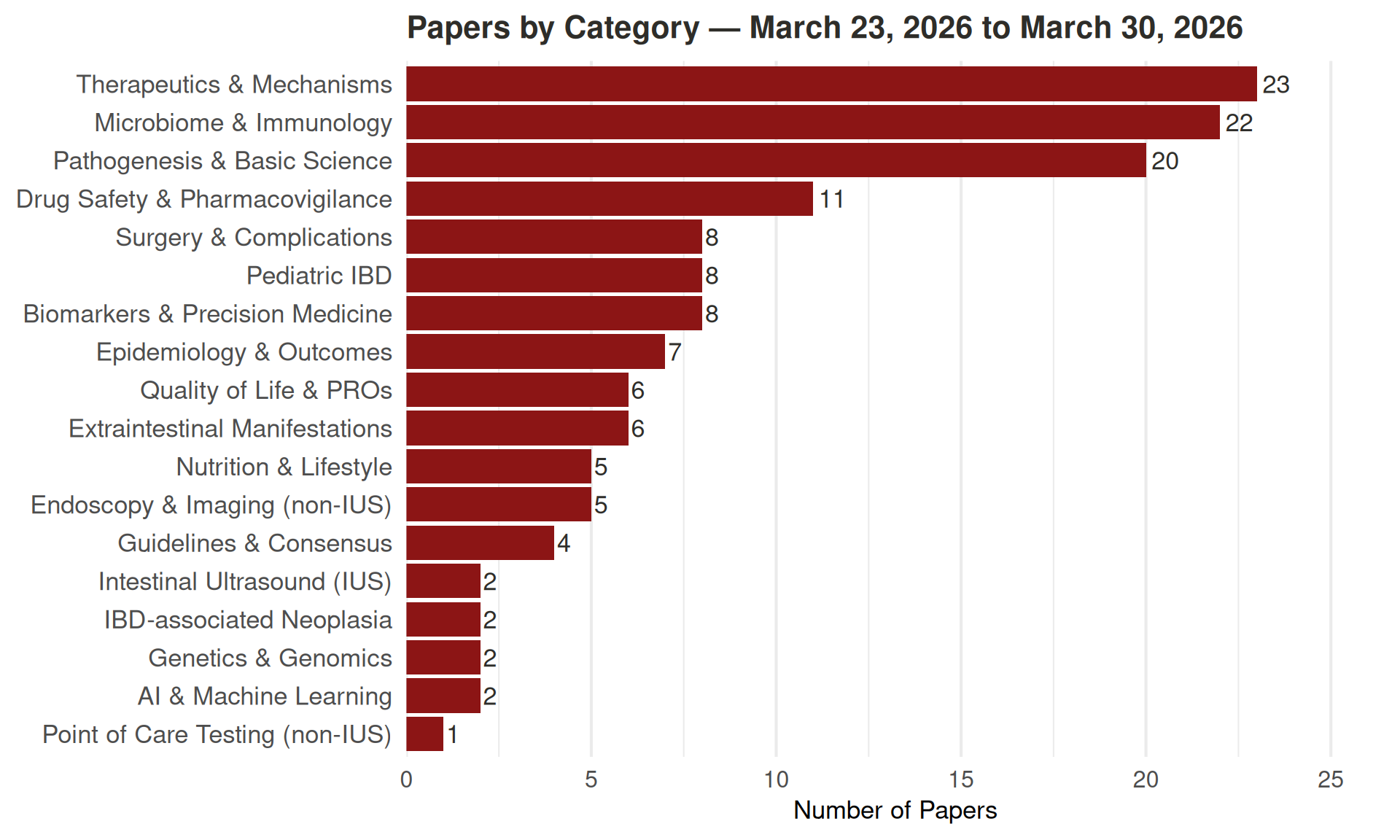
Papers by Category
Click a category to expand. Click a paper title to read its abstract.
Microbiome & Immunology (20 papers)
Probiotic Intervention With Bacillus coagulans and Lactobacillus acidophilus in Small Animals Experimental Ulcerative Colitis: Insights From a Small Animal Model. Veterinary medicine and science | 2026-11
Inflammatory bowel disease is a significant health concern not only in humans but also in companion animals and livestock, where it manifests as chronic diarrhoea, abdominal pain, and mucosal injury. Probiotics have gained increasing attention as potential therapeutic agents due to their immunomodulatory effects and ability to restore intestinal homeostasis. This study investigated the therapeutic efficacy of Bacillus coagulans and Lactobacillus acidophilus in an acetic acid-induced ulcerative colitis model in Wistar rats. Forty male rats were randomly assigned to control, colitis, mesalazine, B. coagulans, and L. acidophilus treatment groups. Disease severity was evaluated by macroscopic and histopathological scoring, colon length and weight, pro-inflammatory cytokine levels (IL-1β, IL-17), and inflammasome-associated gene expression (NLRP3, Caspase-1, IL-18, TNF-α). The results showed that colitis induction significantly increased pro-inflammatory cytokine expression and histological damage compared with controls. Both probiotics markedly reduced inflammatory markers, improved colon morphology, and attenuated inflammasome activation. Their protective effects were comparable to mesalazine, the standard treatment. These findings suggest that B. coagulans and L. acidophilus can serve as effective adjunct therapies for ulcerative colitis in veterinary practice, with potential translational applications for companion animals and livestock.
Shayesteh F, Shahini Shams Abadi M, Rouhi L, Doosti A, Bagheri N
Bile acid signaling in health and disease.Review Molecular biomedicine | 2026-10-02
Bile acids (BAs), cholesterol-derived amphipathic metabolites which are traditionally regarded as digestive surfactants, are now recognized as pleiotropic signaling molecules that act through ligand-, receptor-, and tissue-specific mechanisms to maintain systemic homeostasis. They exert biological functions via nuclear receptors (FXR, PXR, VDR, CAR) and membrane receptors (TGR5, S1PR2, MRGPRX4). These receptors activate transcriptional and membrane-initiated programs, including FXR-SHP/FGF19 feedback, TGR5-cAMP-PKA signaling, S1PR2-ERK/AKT/RhoA pathways, MRGPRX4-dependent Ca2⁺ signaling, PXR/CAR/VDR-driven detoxification responses, and non-receptor-mediated membrane and mitochondrial stress pathways. This review discusses how the diversity of BA structures, hepatic synthesis, conjugation, transportation, enterohepatic circulation, and microbiota-mediated transformation generates receptor- and tissue-specific signals. Furthermore, we summarize the physiological functions of BA signaling in lipid, glucose, and energy metabolism, intestinal epithelial integrity, mucosal immunity, neuroendocrine regulation, musculoskeletal adaptation, and renal water-salt balance. Additionally, we discuss the effects of disrupted BA signaling on cholestatic and metabolic liver diseases, alcohol-associated liver disease, hepatocellular carcinoma, inflammatory bowel disease, BA diarrhea, colorectal cancer, obesity, type 2 diabetes, atherosclerosis, and biliary tract diseases. Finally, the therapeutic strategies that modulate BA signaling, including the use of FXR and TGR5 agonists, FGF19 analogues, transporter inhibitors, enzyme-targeting methods, microbiota-based treatments, and hydrophilic BA therapies, are evaluated. By categorizing BA biology according to the production of ligands, receptor activation, tissue responses, and disease mechanisms, this review highlights BA signaling as an integrated regulatory network and a tractable therapeutic axis in health and disease.
Fan Z, He M, Liang T, Zhang B, Zhao N, Li P
Chinese yam polysaccharide attenuates DSS-induced ulcerative colitis by modulating gut microbiota and eicosanoid metabolism.★ International journal of biological macromolecules | 2026-10-02
This study investigated the protective mechanisms of Chinese yam polysaccharide (CYP) against dextran sulfate sodium (DSS)-induced ulcerative colitis (UC) in mice, focusing on intestinal barrier repair, gut microbiota-mediated effects, and host lipid metabolic regulation. CYP treatment alleviated disease severity and restored colon length and histological structure, but did not significantly attenuate DSS-induced body weight loss. It upregulated ZO-1, occludin, and MUC-2, enhanced antioxidant enzyme activities, and reduced myeloperoxidase activity. Western blot analysis further demonstrated that CYP inhibited MAPK and NF-κB signaling pathways in colonic tissue, thereby reducing mucosal inflammation and alleviating hepatic oxidative stress. Furthermore, CYP supplementation modulated the gut microbiota by altering the relative abundances of key genera, including Bacteroides and Prevotella, and enhanced short-chain fatty acid production. Fecal microbiota transplantation (FMT) from CYP-treated donors partially reproduced the protective effects on histology in recipient mice, suggesting that gut microbiota may contribute to CYP-mediated protection. However, FMT did not significantly improve body weight, disease activity index, or colon length, indicating that the transferable protective effects were limited primarily to local histological improvement rather than full clinical recovery. Additionally, FMT did not significantly restore hepatic levels of the anti-inflammatory eicosanoids 18-HEPE and 13(14)-DiHDPA, whereas direct CYP administration markedly increased these metabolites. These results indicate that CYP-induced recovery of hepatic eicosanoid metabolism was not transferable through FMT. Overall, these findings suggest that CYP alleviates experimental colitis through a dual mechanism involving microbiota-associated immunoregulation and microbiota-independent host lipid metabolic modulation, providing mechanistic insight into the multi-level protective actions of CYP in UC.
Qian Y, Li J, Xiao J, Cheng L, Zhang J, Wu Y, Yu Y, Xie J, Yang J, Morisseau C
Fusobacterium nucleatum enhances enterotoxigenic Bacteroides fragilis-mediated neuron loss and intestinal motility dysfunction. Nature microbiology | 2026-10-01
Gut dysmotility is a common long-term effect of enterotoxigenic Bacteroides fragilis (ETBF) colonization but the underlying mechanisms are not clear. Here, using mouse colonization models, we found that ETBF-secreted B. fragilis toxin (BFT) causes loss of colonic myenteric neurons, which are crucial regulators of intestinal motility. BFT induced apoptosis in these neurons through the NOD1-RIPK2-CASP9-CASP3 pathway, leading to gut dysmotility that persisted even after the clearance of ETBF. Analyses of human inflammatory bowel disease and colorectal cancer patient cohorts showed a positive correlation between ETBF and Fusobacterium nucleatum abundance. In mice, F. nucleatum-derived 2-hydroxybutyric acid enhanced BFT production in ETBF by alleviating RprY-mediated suppression and aggravated neurotoxicity and dysmotility. This enteric neuron loss and dysmotility enhanced susceptibility to dextran sulfate sodium-induced colitis in mice. Therapeutically, a Bifidobacterium-based probiotic attenuated neuron toxicity and improved intestinal motility. Our findings reveal bacterial interactions regulating intestinal function and a potential clinical therapeutic approach to preventing outcomes of ETBF colonization.
Zhang Y, Zhao Y, Zhang L, Xuan B, Wang Z, Yu B, Li W, Huang X, Zhou Y, Ning L
Assessment of epithelial barrier integrity in cellular monolayer models using low cost, clinically approved fluorescent contrast agents. PloS one | 2026-10-01
Epithelial barriers serve as the interface between body tissue and the external environment, maintaining tissue homeostasis by regulating the transport of various cells, molecules and microbes between these compartments. In particular, the epithelial barrier of the gut is a key component in numerous physiological processes that collectively define human health, such as nutrient absorption, microbiota regulation and neuroimmune communication. As such, gut epithelial barrier dysfunction, also known as ‘leaky gut’ syndrome has been associated with a variety of different conditions such as inflammatory bowel disease, type II diabetes, HIV and undernutrition. A diverse range of in vitro models have therefore been developed to better understand epithelial barrier function in different disease contexts. To study gut permeability in vitro, typical measurements include transepithelial electrical resistance (TEER) and the use of fluorescent contrast agents such as FITC-dextran to assess barrier integrity and permeability, with microfluidic ‘gut-on-a-chip’ models exclusively using FITC-dextran. However, utilising FITC-dextran in this context has multiple drawbacks for translational gastroenterology research. Namely, FITC-dextran is expensive, not clinically approved, and there is no agreed molecular weight ‘cut-off’ to determine barrier damage. The molecular weight of FITC-dextran also does not mimic substances used for barrier assessment in clinical settings (e.g., lactulose) nor the molecules thought to drive enteropathy in vivo (e.g., LPS and other pathogen associated molecular patterns (PAMPs)). Therefore, the clinically approved fluorescent contrast agents fluorescein and methylene blue (which have molecular weights comparable to substances used in the clinic) were explored in cellular monolayer models of the gut epithelium as low-cost alternatives for fluorescent assessment of epithelial barrier integrity. Both fluorescein and methylene blue exhibited analogous behavior to FITC-dextran, indicating suitability for use in fluorescent epithelial barrier assays. Hence, wider adoption of fluorescein and methylene may provide cost savings for in vitro epithelial barrier assessment assays as well as opportunities for more advanced, coherent and translational assessment of epithelial barrier function in health and disease.
Monfort Sanchez E, Watson AF, Haider T, Chrysostomou D, Storder M, Mandal N, Kelly P, Marchesi JR, Avery J, Bourke CD
The IKKε-GABPA axis regulates STING transcription to orchestrate antiviral immunity and inflammation. The Journal of experimental medicine | 2026-10-01
The cGAS-STING pathway plays a critical role in antiviral defense and inflammatory homeostasis. While posttranslational regulation of STING is well characterized, the transcriptional networks directly governing Sting1 expression remain unclear. Here, we identify the transcription factor GA-binding protein alpha (GABPA) as a critical regulator of STING-dependent type I IFN (IFN-I) responses in macrophages. Mechanistically, GABPA directly binds to the Sting1 promoter, thereby transcriptionally sustaining basal STING expression. Upon viral infection, activated IκB kinase epsilon (IKKε) phosphorylates GABPA at S447, which further enhances its transcriptional activity and amplifies the STING-IFN-I signaling cascade. Notably, Gabpa deficiency protects mice from DSS-induced colitis, and this protective effect is abolished upon Sting1 deletion. Strikingly, patients with inflammatory bowel disease (IBD) or systemic lupus erythematosus (SLE) exhibit elevated GABPA expression that positively correlates with STING hyperactivation and enhanced inflammatory signatures. Moreover, a GABPA-blocking peptide effectively suppresses aberrant IFN-β production in peripheral blood mononuclear cells (PBMCs) from SLE patients, highlighting its therapeutic potential for interferonopathies.
Zhang J, Zhao T, Lei H, Gan R, Liu X, Meng Y, Ren D, Su J, Tang Y, Sun J
Akkermansia muciniphila WW001 protects against DSS-induced colitis by restoring intestinal barrier integrity and modulating inflammatory responses. Folia microbiologica | 2026-09-30
Inflammatory bowel disease (IBD) is a chronic, relapsing disorder intimately linked to impaired intestinal barrier function. Akkermansia muciniphila, a beneficial gut bacterium, has been shown to enhance intestinal barrier function. This study aimed to characterize a newly identified strain, A. muciniphila WW001, and evaluate its protective effects on intestinal barrier integrity in IBD models. Lipopolysaccharide (LPS)-induced Caco-2/HT29-MTX cell model and dextran sulfate sodium (DSS)-induced mouse model were employed to assess its protective effects on intestinal barrier function. Whole-genome sequencing, comparative genomic analysis, and molecular docking were performed to explore the unique genetic characteristics of WW001. In line with these genomic features, WW001 significantly strengthened intestinal barrier function and displayed distinct functional characteristics compared with A. muciniphila ATCC 835, as evidenced by elevated transepithelial electrical resistance (TEER), reduced paracellular permeability, upregulation of tight junction proteins, suppression of pro-inflammatory cytokines, and elevation of anti-inflammatory cytokine levels. Furthermore, WW001 alleviated colitis symptoms and promoted goblet cell proliferation, which were associated with its distinct genomic features and increased short-chain fatty acid (SCFA) concentrations. The enriched glycoside hydrolase repertoire may indicate an enhanced capacity for mucin-derived glycan utilization; however, the causal relationships among these genomic features, mucin utilization, SCFA changes, and barrier protection remain to be established. These findings demonstrate that A. muciniphila WW001 enhances intestinal barrier function and exerts anti-inflammatory effects, while the associated metabolic changes may contribute to its beneficial effects, supporting its potential application as a probiotic candidate for IBD intervention.
Zhou X, Li M, Zhang Y, Chen J, Li C, Wang D, Li M, Zhang XE, Gu J
Rewinding the gut clock: from chronodisruption to targeted therapies.Review★ Gut | 2026-09-30
Circadian rhythms orchestrate daily oscillations in physiology and behaviour, enabling optimal alignment between internal biological processes and environmental cycles. A hierarchical system centred in the suprachiasmatic nucleus and supported by peripheral clocks across tissues ensures temporal alignment of metabolic, immune and GI functions. Within the GI tract, local clocks drive rhythmic programmes that regulate digestion, absorption, motility, hormone secretion, immune responses and interactions with the gut microbiota. Feeding-fasting cycles and microbial metabolites act as powerful zeitgebers for intestinal clocks, shaping rhythmic gene expression and intestinal metabolic oscillations. Chronodisruption-arising from misaligned light exposure, sleep disturbances or mistimed eating schedules-uncouples central and peripheral clocks. These disturbances, increasingly prevalent in shift workers, disrupt microbial rhythmicity and intestinal homeostasis. Chronodisruption contributes to metabolic disorders, including obesity, dyslipidaemia and type 2 diabetes, and increases the susceptibility to GI disorders such as IBD, IBS, GORD and colorectal cancer. Emerging therapeutic strategies aim to restore circadian alignment. Time-restricted feeding reinforces endogenous rhythmicity, improves metabolic health and restores GI rhythmic processes through entrainment of clock genes, nutrient-sensing pathways and microbial oscillations. Chronobiotics, including melatonin and phytochemicals, further offer non-invasive approaches to resynchronise disrupted clocks. Finally, chronotherapy and chronotype-tailored interventions further underscore the potential of personalised medicine based on circadian biology. Advances in research on rhythmic metabolites and interorgan metabolic coupling offer promising opportunities for understanding systemic circadian coordination. Overall, reinforcing circadian alignment holds potential for preventing and treating metabolic and GI diseases associated with modern lifestyle-induced chronodisruption.
Leng H, Depoortere I
Microbial-Derived Exerkines as a Model of Drug Discovery.Review American journal of physiology. Cell physiology | 2026-09-29
There has been a growing interest in the utilization of the gut microbiome as a therapeutic tool. The relationship between the gut microbiome and exercise provides a unique opportunity to maximize the therapeutic capacity of the gut microbiome. Here, we summarize the potential of leveraging the gut microbiome to confer the health benefits of exercise through a novel class of microbial metabolites termed microbial-derived exerkines (MDEs). We identify multiple candidate and established MDEs described in the literature (e.g., pipecolic acid, succinate, short-chain fatty acids, indole-3-propionic acid, 3-hydroxyphenylacetic acid) and explore their implications in conditions such as inflammatory bowel disease, aging, skeletal muscle atrophy, cancer, diabetes, cardiovascular disease, and Alzheimer’s disease. Given the beneficial effects of exercise on numerous diseases, we anticipate MDEs will be a productive avenue for drug discovery and therapeutic progress.
Burke BI, Valentino TR, Ismaeel A, Wen Y, McCarthy JJ
Detrimental and Beneficial Diets Regulate Acute Pancreatitis Through Convergent Gut Microbiota Pathways.Review Journal of inflammation research | 2026-09-21
Diet is a key factor in regulating gut microbiota homeostasis, thereby influencing the incidence, severity, and prognosis of acute pancreatitis (AP). This review categorizes common dietary patterns into harmful types (Western diet, high-fat diet, ketogenic diet, high-salt diet) and beneficial types (Mediterranean diet, high-fiber diet, plant-based diet, restricted diet). Unlike previous reviews that list dietary patterns one by one, this paper analyzes them within the framework of the four core pathological/protective pathways of AP. Harmful diets primarily exacerbate AP by inducing dysbiosis, reducing SCFAs (especially butyrate), impairing the gut barrier, promoting bacterial translocation and excessive inflammatory responses; beneficial diets alleviate AP progression by enriching probiotics, increasing SCFA synthesis, enhancing barrier integrity, and suppressing systemic inflammation. This paper particularly emphasizes that most current evidence comes from non-AP models such as obesity and inflammatory bowel disease, and AP-specific causal evidence remains very limited. By integrating clinical, animal, and cellular experimental evidence, this paper aims to elucidate the potential relationship between diet, gut microbiota, and AP, and to provide a theoretical basis for dietary intervention strategies targeting the gut microbiota.
Wu J, Bai R, Zhong Z, Zhang C, Liu T, Lu T, Song Y, Miao Z, Zhang D, Wang Z
Exercise and Intestinal Barrier Integrity: Molecular Mechanisms and Therapeutic Potential in Gut Health and Disease.Review Biology | 2026-09-21
The intestinal barrier (IB) is a critical interface that maintains internal homeostasis. Its functional compromise-termed intestinal hyperpermeability-permits luminal antigens such as lipopolysaccharide to enter the circulation, triggering metabolic endotoxemia and low-grade systemic inflammation that underpin both intestinal and extra-intestinal diseases. This narrative review was based on a comprehensive literature search of PubMed, Web of Science, and Scopus databases up to July 2026, using keywords related to exercise, intestinal barrier, tight junction proteins, inflammation, oxidative stress, gut microbiota, and short-chain fatty acids. The synthesis indicates that regular moderate-intensity continuous training (30-60 min/session, 3-5 sessions/week) enhances barrier integrity through upregulation of tight junction proteins, suppression of TLR4/NF-κB-driven inflammation, activation of Nrf2-mediated antioxidant defenses, and beneficial remodeling of gut microbiota composition and short-chain fatty acid production. Exercise also induces peripheral-gut crosstalk mediated by myokines and vagal cholinergic signaling. The relationship between exercise volume and barrier function follows a J-shaped dose-response curve, with moderate exercise conferring protection while excessive high-intensity or prolonged exercise transiently increases permeability via splanchnic hypoperfusion and hypoxia-induced epithelial stress. Exercise shows preliminary therapeutic potential as an adjunctive intervention in inflammatory bowel disease, irritable bowel syndrome, and metabolic-associated fatty liver disease, with systemic benefits extending through the gut-liver and gut-brain axes. However, clinical translation remains limited by small sample sizes, short follow-up periods, and heterogeneous protocols. Future research should prioritize large-scale randomized controlled trials, precision exercise prescriptions, and synergistic exercise-probiotic co-interventions to establish definitive clinical guidelines.
Yang W, Liu Y, Wang H, Yang G
Targeting Interleukin-7 Signalling in Ulcerative Colitis: Rationale and Emerging Clinical Evidence.Review Life (Basel, Switzerland) | 2026-09-20
Ulcerative colitis (UC) remains difficult to control in a substantial proportion of patients despite an expanding range of advanced therapies. Interleukin-7 (IL-7) is a homeostatic cytokine that supports lymphocyte survival, persistence and intestinal trafficking through signalling via IL-7 receptor-α (IL-7Rα; CD127), providing a rationale for selective pathway inhibition in chronic intestinal inflammation. This narrative review examines the biology of IL-7/IL-7R signalling in inflammatory bowel disease (IBD) and summarises the preclinical, translational and clinical development of lusvertikimab, a humanised monoclonal antibody targeting IL-7Rα. MEDLINE was searched from inception to 31 July 2026, supplemented by reference-list screening, trial registries, conference proceedings and regulatory sources. Experimental studies show that IL-7 supports the persistence of colitogenic effector-memory T cells and contributes to innate immune activation. Human translational data demonstrate enrichment of IL-7R pathway activity in treatment-refractory IBD, association with anti-TNF non-response, and IL-7-mediated upregulation of the gut-homing integrin α4β7. Preclinical IL-7R blockade attenuated experimental colitis, reduced intestinal T-cell trafficking and altered inflammatory responses in UC tissue. In a first-in-human study, lusvertikimab produced sustained receptor occupancy and suppression of IL-7-associated gene expression without broad lymphocyte depletion. In the phase II CoTikiS trial, lusvertikimab improved Modified Mayo Score versus placebo, with significant pooled endoscopic improvement but no significant pooled differences in clinical or endoscopic remission. Early safety findings were reassuring. Selective IL-7Rα blockade therefore represents a biologically distinct therapeutic strategy in UC, although larger controlled studies, biomarker validation and clarification of dose selection and long-term safety are required to define its clinical role and whether combination strategies warrant future evaluation in selected patients.
Manti M, Raspa V, Patel K, Honap S
Microbiota-Associated Amino Acid Metabolites in Inflammatory Bowel Disease: Emerging Key Players in the Host-Microbe Interface.Review Microorganisms | 2026-09-20
Inflammatory bowel disease (IBD), encompassing Crohn’s disease (CD) and ulcerative colitis (UC), is a chronic relapsing intestinal inflammatory disorder driven by complex interactions among host genetics, immune dysregulation, and gut microbiota dysbiosis. The functional contribution of microbial metabolites beyond short-chain fatty acids and bile acids remains incompletely understood. A critical and unresolved question is whether microbiota-associated amino acid metabolites are merely passive indicators of dysbiosis or active drivers of intestinal inflammation and tissue repair. In this review, we summarize recent advances in the roles of microbiota-associated amino acid metabolites and their derivatives in IBD, highlighting that amino acid metabolites constitute a functionally distinct class of bioactive signaling molecules that operate through four representative metabolic networks: tryptophan metabolism, aspartate-related metabolism, branched-chain amino acid (BCAA) metabolism, and arginine-polyamine metabolism. We synthesize recent clinical metabolomic data and identify reductions in tryptophan-derived indoles, glutamate, histidine, and selected BCAAs across IBD clinical cohorts and sample matrices, whereas metabolites such as serine, proline, and polyamine degradation products are frequently elevated or associated with disease activity or therapeutic response. Mechanistically, microbiota-associated amino acid metabolites are implicated in intestinal homeostasis and IBD pathogenesis through multifaceted pathways, including modulation of intestinal epithelial barrier integrity (e.g., cell-cell junction, mucus secretion, and stem cell-driven mucosal repair), innate and adaptive immune responses, host-pathogen interactions, and extraintestinal inflammatory signaling (e.g., systemic inflammation, and brain-gut axis communication). Finally, we highlight current challenges and limitations in achieving a causal understanding of microbiota-associated amino acid metabolic alterations in IBD, particularly regarding their origin, spatial distribution, and functional relevance, as well as their potential utility for disease stratification and treatment-response assessment, and discuss how these insights may inform the future development of next-generation biomarkers and precision therapeutic strategies tailored to individual metabolic phenotypes in IBD.
Meng X, Tian C, Zhu Y, Zheng D
Functional Gut Microbiota Alterations in Patients with Inflammatory Bowel Disease Receiving Long-Term Biologic Therapy: A Pilot Comparative Study. Journal of clinical medicine | 2026-09-18
Background: Biological therapies have substantially improved clinical outcomes in inflammatory bowel disease (IBD); however, the relationship between long-term biologic therapy, disease remission, and gut microbiome characteristics remains incompletely understood. This pilot study aimed to characterize the taxonomic composition and taxonomically inferred functional microbiome features of patients with IBD receiving long-term biologic therapy and achieving clinical and biological remission at the time of microbiome assessment. Methods: Patients with IBD receiving long-term biologic therapy and achieving clinical and biological remission at the time of microbiome assessment were prospectively enrolled. Gut microbiome composition was assessed using 16S rRNA gene sequencing. Functional microbiome profiling included microbial diversity (Shannon index), fecal pH, Firmicutes/Bacteroidetes ratio, and bacterial groups associated with short-chain fatty acid production, mucin degradation, and lipopolysaccharide (LPS) production. Comparative analyses between disease phenotypes and biologic therapies were performed using non-parametric statistical methods. Results: Fifteen patients with IBD were included, comprising eight patients with ulcerative colitis and seven with Crohn’s disease. Several microbiome features were outside the laboratory-specific reference intervals despite clinical and biological remission at the time of microbiome assessment. Shannon diversity values were below the laboratory-specific reference threshold in 60.0% of patients, while taxa associated with mucin degradation, lactate production, and LPS production were outside the respective reference intervals in 66.7%, 53.3%, and 46.7% of patients. The Firmicutes/Bacteroidetes ratio was outside the reference interval in 46.7% of patients. The gut microbiota was predominantly composed of Firmicutes and Bacteroidetes, with considerable interindividual variability in taxonomic composition and taxonomically inferred functional features. No statistically significant differences were identified between Crohn’s disease and ulcerative colitis or between biologic therapies after false discovery rate correction. Conclusions: Patients with IBD receiving long-term biologic therapy and achieving clinical and biological remission at the time of microbiome assessment exhibited substantial interindividual variability in taxonomic composition and taxonomically inferred functional microbiome features. Several parameters were outside laboratory-specific reference intervals; however, the cross-sectional design and absence of pre-treatment and matched healthy control samples preclude conclusions regarding microbiome restoration or treatment-related effects. These findings support further longitudinal investigation of microbiome characteristics during biologic therapy.
Frandeș SI, Frandeș O, Macarie M, Bățagă SM
MiR-29a deficiency disrupts gut microbiota-bile acid homeostasis and impairs the anti-inflammatory effects of lithocholic acid in colitis. Frontiers in cellular and infection microbiology | 2026-09-17
Gut microbiota, bile acid metabolism, and their derived metabolites are critical regulators of intestinal inflammation in inflammatory bowel disease (IBD). While microRNA-29a (miR-29a) is a recognized epigenetic regulator of intestinal inflammation, its role in shaping microbiota-driven bile acid metabolism, particularly secondary bile acid production, remains unclear. This study aimed to investigate how miR-29a regulates microbiota-bile acid axis, with an emphasis on lithocholic acid (LCA) and its anti-inflammatory effects in colitis. Colitis was induced in wild-type and Mir29a/Mir29b-1 locus-deficient mice using dextran sulfate sodium (DSS), and disease severity, colonic injury, and inflammatory responses were assessed. Fecal microbiota composition and bile acid profiles were characterized using 16S rRNA gene sequencing and targeted metabolomics. Alterations in bile acids were further examined in relation to disease severity. In vitro, Caco-2 cells were used to evaluate the anti-inflammatory effects of LCA under modulation of miR-29a expression. MiR-29a/b1 deficiency significantly exacerbated DSS-induced disease severity, colonic injury, inflammatory responses, and epithelial ultrastructural damage. KO-DSS mice exhibited gut microbiota dysbiosis, with reduced microbial diversity and altered community structure. Targeted metabolomics revealed impaired primary-to-secondary BA biotransformation, characterized by chenodeoxycholic acid (CDCA) accumulation and a reduced LCA/CDCA ratio. In vitro, LCA supplementation attenuated DSS-induced pro-inflammatory gene expression, whereas this protective effect was partially diminished by miR-29a inhibition. These results support a role for miR-29a in maintaining gut microbial bile acid homeostasis during colitis and contributing to the epithelial anti-inflammatory response to LCA. Together, these findings link host microRNA regulation to microbiota-derived BA function and may inform future precision strategies for IBD.
Xiao X, Gong Q, Zheng X, Zhou J, Shao C, Zuo Q, Cai C
S100B in brain-gut-liver crosstalk: from glial activation to multiorgan inflammation.Review Frontiers in immunology | 2026-09-17
S100 calcium-binding protein B (S100B) is conventionally viewed as a marker of astrocytic injury, blood-brain barrier (BBB) disruption, and neurological disorders. Emerging evidence places S100B within the broader brain-gut-liver axis of inflammatory signaling. This review proposes that S100B is a glial-derived integrating effector that couples enteric glial activation, barrier dysfunction, hepatic fibrosis, and hepatic encephalopathy (HE) into a multi-organ inflammatory network. Its spatial expression map, release kinetics, alarmin (damage-associated molecular pattern, DAMP) activity, and immune-cell infiltration differ among the gut, liver, and brain, shaping axis signaling. S100B is predominantly expressed in astrocytes of the central nervous system, Schwann cells, and enteric glial cells and is also detected in liver tumor immune cells, biliary epithelial cells, and activated hepatic stellate cell (HSC)-associated lesions. It exerts context-dependent functions: at low, nanomolar concentrations it supports neurotrophic activity and barrier integrity, whereas sustained elevation acts as a DAMP that amplifies inflammatory responses through receptor for advanced glycation end products (RAGE), Toll-like receptor 2 (TLR2)/Toll-like receptor 4 (TLR4), nuclear factor kappa B (NF-κB), NOD-, LRR-, and pyrin domain-containing protein 3 (NLRP3) and a disintegrin and metalloproteinase 10 (ADAM10)/β-catenin pathways. Clinically, S100B kinetics, a rapid release with a short half-life after acute injury versus chronic multi-organ spillover in cirrhosis, determines whether elevation reflects a local glial event or systemic disease burden. S100B has been implicated in enteric infectious enteritis, inflammatory bowel disease (IBD), diarrhea-predominant irritable bowel syndrome (IBS-D), cholestatic fibrosis, metabolic dysfunction-associated steatotic liver disease (MASLD), alcohol-associated liver disease (ALD), viral hepatitis, hepatocellular carcinoma (HCC), and HE with comorbid neuroinflammation. Available evidence suggests that S100B is a candidate link between glial responses, barrier dysfunction, hepatic inflammation, and neuroinflammation within the brain-gut-liver axis, although its causal role, tissue origin, and clinical utility require further validation.
Liu Q, Ming Y, Ji C, Fu L, Li R, Yang Z, Wen S
Probiotic drug interactions in ulcerative colitis: a microbiota and metabolite perspective.Review Frontiers in microbiology | 2026-09-16
Ulcerative colitis (UC) is a chronic relapsing inflammatory bowel disease that imposes a substantial lifelong burden on patients, particularly as it commonly develops during adolescence or early adulthood. Despite major advances in pharmacological management, including the introduction of biologic agents and small-molecule therapies, considerable interindividual variability in therapeutic response remains a major clinical challenge. Emerging evidence in pharmacomicrobiomics indicates that the gut microbiota contributes to this variability through bidirectional interactions with drugs. These interactions involve direct microbial biotransformation of drugs, modulation of host metabolic pathways and transport systems, and pharmacodynamic effects mediated by microbiota that collectively influence drug efficacy, safety, and therapeutic outcomes. Strategies aimed at restoring microbial homeostasis, including dietary interventions, probiotics, prebiotics, synbiotics, postbiotics, and fecal microbiota transplantation, have therefore attracted increasing attention as adjunctive approaches in UC. Among these, probiotics are the most extensively investigated, and selected formulations have demonstrated clinical benefit in inducing and maintaining remission of UC. However, while their direct therapeutic effects have been widely reviewed, considerably less attention has been devoted to understanding how probiotics interact with conventional UC therapies and whether they modify treatment efficacy through pharmacokinetic, pharmacodynamic, or microbiota-mediated mechanisms. This review provides an up-to-date overview of probiotic-drug interactions in UC, with particular emphasis on microbiota- and metabolite-mediated mechanisms that may influence therapeutic efficacy and contribute to interindividual variability in treatment response. Finally, we discuss current concepts for the rational use of probiotics as adjuncts to UC pharmacotherapy and highlight key knowledge gaps and future research directions in this rapidly evolving field. A better understanding of these interactions may ultimately support microbiota-informed therapeutic strategies aimed at optimizing treatment outcomes in UC.
Štofilová J, Benetinová V, Bertková I, Hanzelová Z, Kamlárová A, Kvaková M
Qijiao Shengbai capsule ameliorates ulcerative colitis in mice by modulating gut microbiota and protecting the intestinal barrier, associated with suppression of the TLR4/MyD88/NF-κB pathway. Frontiers in microbiology | 2026-09-16
Qijiao Shengbai capsule (QJSB) is a classic traditional Chinese compound formulation composed of seven herbal ingredients, primarily used clinically to treat leukopenia. Individual herbs and their active components within QJSB demonstrate favorable efficacy against ulcerative colitis (UC). Nevertheless, no evidence exists of QJSB being a full-form prescription for treating UC. This study identified the chemical composition of QJSB using UHPLC-ESI-Q-Exactive Plus Orbitrap-MS. At the same time, a mouse model of ulcerative colitis (UC) was established using DSS to examine the effects of QJSB on disease symptoms, inflammatory factors, intestinal barrier function, and colonic histopathological changes. Furthermore, metabolomics, 16S rRNA sequencing, and network pharmacology were combined to analyze the potential mechanisms underlying the effects of QJSB intervention in UC-affected mice, and key pathways predicted by network pharmacology were validated using Western blot analysis. The results showed that QJSB treatment significantly alleviated DSS-induced colitis symptoms in UC mice, as evidenced by weight recovery, a decrease in the disease activity index (DAI), improvement in colonic shortening, and reduced tissue damage. Gut microbiota analysis indicated that QJSB modulates the composition of the gut microbiota by upregulating the abundance of Akkermansia and Lactobacillus and downregulating the abundance of Bacteroides. Metabolomics results suggest that QJSB may help correct metabolic disturbances involving amino acids, linoleic acid, arachidonic acid, and alpha-linolenic acid. Furthermore, QJSB was associated with reduced levels of pro-inflammatory factors (TNF-α, IL-6, IL-1β), lipopolysaccharide (LPS), and myeloperoxidase (MPO), as well as improved intestinal barrier function. Western blot results suggest that QJSB intervention may be associated with the suppression of TLR4/MyD88/NF-κB signaling pathway activation. The present findings suggest that QJSB may exert therapeutic effects against UC, potentially through mechanisms involving the inhibition of inflammatory responses, protection of intestinal barrier function, regulation of metabolic homeostasis, and restoration of gut microbial ecology. These results imply that QJSB could serve as a potential therapeutic candidate for UC and provide a new basis for its clinical application.
Lu Y, Zhang M, Jiang S, Zhang S, Chen Z, Wang J, Liu L, Wang P, Gao X
Sleep fragmentation frequency is associated with distinct immune, microbial, and barrier-related profiles in DSS-induced colitis in mice. Frontiers in immunology | 2026-09-15
Sleep fragmentation is common in inflammatory bowel disease, but whether different fragmentation frequencies are associated with distinct biological responses during colitis remains unclear. This study examined endpoint-specific responses to low- and high-frequency sleep fragmentation in DSS-induced colitis in mice. Male C57BL/6 mice were assigned to Control, DSS, DSS with low-frequency sleep fragmentation (DSS+LSF), DSS with high-frequency sleep fragmentation (DSS+HSF), or high-frequency sleep fragmentation alone (HSF). Colitis was induced with 2% DSS for 7 days. Sleep fragmentation was applied for 12 h/day during the light phase at 60 sweeps/h for LSF or 240 sweeps/h for HSF. Clinical indices, histology, epithelial barrier-associated proteins, inflammatory and stress-related markers, colonic CD4+ T-cell subsets, fecal microbiota composition, and fecal SCFAs were assessed. Clinical and macroscopic indices varied across experimental groups, but corrected comparisons among DSS-treated groups were not significant. Plasma corticosterone was increased in both DSS+LSF and DSS+HSF, whereas MPO was higher in DSS+LSF than in DSS+HSF. Colonic Th2 proportions were higher in DSS+HSF than in DSS and DSS+LSF. Other histological, barrier-associated, inflammatory, and metabolic findings were primarily descriptive. Low- and high-frequency sleep fragmentation were associated with distinct, endpoint-specific response profiles during DSS-induced colitis rather than a simple linear increase in disease severity. These findings support frequency-associated, domain-specific responses and warrant further longitudinal and mechanistic investigation.
Tu MS, Fan TA, Huang YH, Wu RC, Kuo CJ, Chen NH, Chuang LP, Lin SW, Chen YL, Yang HY
EPS deficiency aggravates intestinal mucosal inflammation and dysbiosis through disrupting macrophage polarization balance in ulcerative colitis. Frontiers in immunology | 2026-09-15
Ulcerative colitis (UC) is a chronic, immune-mediated inflammatory bowel disorder, and macrophages are essential for maintaining intestinal mucosal balance during UC. Long intergenic non-coding RNA-erythroid prosurvival (lincRNA-EPS) is a novel lincRNA identified as a key inflammatory regulator. Nonetheless, the specific role of EPS in the pathogenesis of UC remains unclear. To investigate the contribution of EPS to intestinal inflammation, a model of colitis induced by dextran sulfate sodium (DSS) was created using both EPS gene knockout (EPS-/-) mice and wild-type (WT) mice. The impact of EPS on macrophage activities was assessed through various methods including qRT-PCR, flow cytometry, and immunofluorescence. Biopsies of the colon were collected from individuals diagnosed with UC for the purpose of EPS detection. EPS-/- mice exhibited more severe intestinal mucosal inflammation after DSS treatment, which was characterized by an increase in inflammatory cell infiltration, suppressed recovery of tight junction proteins and microbiota balance. EPS inhibits M1 macrophage polarization while promoting M2 macrophage polarization both in vitro and in vivo. The expression of EPS was found to be decreased in the inflamed mucosa and peripheral blood mononuclear cell (PBMC) of individuals suffering from UC, showing a negative correlation with the level of disease activity. This study revealed a novel function of EPS in macrophages in regulating the M1/M2 balance, inflammation, and gut microbiota during the pathological process of UC, and targeting EPS may represent a promising therapeutic approach for UC.
Zhu F, Jin G, Shi L, Qin Y, Xue H, Dai F, Chen X, Zhou G
Therapeutics & Mechanisms (18 papers)
Review Article: Beyond the Therapeutic Ceiling in Inflammatory Bowel Disease-Mechanism-Based Positioning and Emerging Therapeutic Strategies.Review★ Alimentary pharmacology & therapeutics | 2026-10-02
Therapeutic options for inflammatory bowel disease (IBD) have expanded rapidly with the introduction of selective interleukin (IL)-23 inhibitors, Janus kinase inhibitors, sphingosine-1-phosphate receptor modulators, and several emerging therapeutic classes. Consequently, the major clinical challenge has shifted from developing effective therapies to determining how best to position them within increasingly complex treatment algorithms. To review the contemporary and emerging therapeutic landscape in IBD, focusing on mechanism-based treatment positioning, disease modification, refractory disease, and novel therapeutic strategies that may overcome the current therapeutic ceiling. We performed a comprehensive review of PubMed, Ovid MEDLINE, Embase, and major international conference proceedings to identify pivotal clinical trials, long-term extension studies, comparative effectiveness studies, real-world evidence, and emerging therapeutic developments in IBD. Comparative studies have strengthened the positioning of selective iL-23 inhibitors as foundational therapies in IBD, while oral small molecules continue to expand with novel mechanisms and improved convenience. Emerging strategies targeting TL1A, fibrosis and advanced combination therapy offer the potential to further improve outcomes, particularly in refractory disease. However, important challenges remain regarding optimal treatment sequencing, patient selection, long-term safety and disease modification. Contemporary IBD management is increasingly defined by mechanism-based therapeutic positioning rather than simply expanding treatment options. Ongoing advances in comparative effectiveness research, novel therapeutic targets, and treatment strategies have the potential to further individualise care and improve long-term patient outcomes.
Subhaharan D, Subramanian S
Comparative effectiveness and safety of upadacitinib versus vedolizumab in anti-TNF-exposed patients with ulcerative colitis.★ Inflammatory bowel diseases | 2026-09-30
Head-to-head comparative evidence between upadacitinib and vedolizumab for anti-tumor necrosis factor (TNF)-exposed ulcerative colitis (UC) patients is lacking. This study compared their real-world effectiveness and safety. This multicenter retrospective cohort included anti-TNF-exposed UC patients with a partial adapted Mayo score ≥ 2 who received upadacitinib or vedolizumab between March 2021 and February 2026 and had a minimum of 16 weeks of follow-up. Clinical outcomes were assessed at weeks 16 and 26, with endoscopic evaluation at week 26. The primary outcome was steroid-free symptomatic remission (SFSR) at week 16, defined as rectal bleeding subscore = 0 and stool frequency subscore ≤ 1, with no corticosteroid use for at least 2 weeks prior to assessment. Propensity score-based inverse probability of treatment weighting (IPTW) was used to adjust for imbalance of baseline characteristics. A total of 242 patients were analyzed (120 vedolizumab, 122 upadacitinib). After IPTW, upadacitinib was superior in achieving week-16 SFSR (71.7% vs 54.6%; adjusted odds ratio [aOR] 2.11, 95% CI, 1.67-2.65, P < .001). At week 26, upadacitinib remained superior in SFSR (82.6% vs 61.8%; aOR 2.93, 95% CI, 1.85-4.66, P < .001) and also demonstrated higher rates of endoscopic improvement (75.3% vs 47.1%; aOR 3.42, 95% CI, 2.57-4.56, P < .001), and endoscopic remission (41.5% vs 22.2%; aOR 2.49, 95% CI, 1.71-3.63, P < .001). There was no significant difference regarding the risk of drug discontinuation between the two groups (aHR 0.46, 95% CI, 0.20-1.04, P = .058). However, the overall incidence of adverse events was higher with upadacitinib (0.475 vs 0.213 per person-year, P < .001), while the rates of serious adverse events were not significantly different between groups. Upadacitinib demonstrates superior effectiveness over vedolizumab in anti-TNF-exposed UC but carries a higher burden of adverse events, highlighting the need for personalized benefit-risk assessment to guide treatment selection. In anti-TNF-exposed ulcerative colitis patients, upadacitinib was more effective than vedolizumab at achieving steroid-free remission and endoscopic healing but was associated with a higher overall rate of adverse events.
Wan J, Zhang H, Yuan X, Ren Z, Sha S, Wu C, Li Y, Liu X, Wang X, Zhou J
Real-World Experience of Risankizumab in Refractory Pediatric Inflammatory Bowel Disease.Case report ACG case reports journal | 2026-09-29
The incidence of pediatric inflammatory bowel disease (IBD) is rising globally. Anti-tumor necrosis factor agents remain the mainstay of treatment, but a significant number of patients experience treatment failure. This case-series presents real-world experience using risankizumab, an IL-23 inhibitor, in 9 children with severe-refractory IBD. Multiple biologics had failed in all patients before initiation. Response was assessed using symptoms, biomarkers, endoscopy, and imaging. Five patients achieved clinical remission, and 4 failed to achieve complete remission. Noninvasive monitoring tools, such as intestinal ultrasound, were used. No adverse events were reported. Risankizumab may be a promising option in refractory pediatric IBD.
Alsarhan A, Krishnamurthy B, Elyyan E, Alhajjar M, Tzivinikos C
Upadacitinib Is Associated with the Lowest Risk of Treatment Failure Among Advanced Therapies for Ulcerative Colitis: A Real-World Administrative Claims Study.★ Clinical gastroenterology and hepatology : the official clinical practice journal of the American Gastroenterological Association | 2026-09-29
We compared the real-world effectiveness of advanced therapies (AT) in patients with ulcerative colitis (UC). Using the OptumLabs® Data Warehouse, a nationally representative US administrative claims database, we identified patients with UC initiating infliximab, adalimumab, vedolizumab, ustekinumab, tofacitinib, or upadacitinib between 2016 and 2023. The primary outcome was time to treatment failure (composite of IBD-related hospitalization, IBD-related surgery, or new corticosteroid prescription occurring >90 days after index date); treatment discontinuation and switching were treated as censoring events. The secondary outcome was proportion of quarters in corticosteroid-free disease stability. Confounding was addressed using multinomial propensity score-based inverse probability weighting with generalized boosted models and competing risk adjustment for mortality. We identified 7,283 patients contributing 9,078 treatment episodes with initiation of infliximab (n=1,624), adalimumab (n=2,315), vedolizumab (n=3,164), ustekinumab (n=1,274), tofacitinib (n=547), or upadacitinib (n=154). After IPW adjustment, upadacitinib was associated with significantly lower risk of treatment failure compared with infliximab (HR 0.61 [95% CI, 0.42-0.88]), adalimumab (HR 0.59 [0.41-0.86]), vedolizumab (HR 0.69 [0.48-1.00]), ustekinumab (HR 0.65 [0.45-0.95]), and tofacitinib (HR 0.59 [0.40-0.88]). Vedolizumab was associated with lower risk of treatment failure compared with infliximab (HR 0.88 [0.79-0.98]) and adalimumab (HR 0.86 [0.78-0.95]). Upadacitinib had the highest adjusted proportion of quarters in corticosteroid-free disease stability (0.70 [0.63-0.77]). Findings were consistent in patients with and without prior AT exposure. In this large real-world UC cohort, upadacitinib was associated with the lowest risk of treatment failure and greatest corticosteroid-free disease stability compared with all other ATs evaluated.
Hupé M, Ahuja D, Yeh KH, Patel SB, Xu R, Vuyyuru SK, Silverman A, Ananthakrishnan AN, Olén O, Goodwin SW
Infliximab-Associated Paradoxical Psoriasiform Reaction in Pediatric Ulcerative Colitis: Resolution with Ustekinumab. American journal of therapeutics | 2026-09-29
Abstract not available.
Akçay BI, Ergen YM, Teke S, Çetin E, Balık ZB, Ataş A, Balamtekin N
Subcutaneous infliximab for maintenance therapy in children and adolescents with inflammatory bowel disease: a systematic review and meta-analysis.Meta-analysis European journal of pediatrics | 2026-09-29
Subcutaneous infliximab is licensed for maintenance only in adults with inflammatory bowel disease, and pediatric evidence sits in small cohorts never pooled. We estimated the effectiveness, pharmacokinetics, immunogenicity, and safety of subcutaneous infliximab as maintenance therapy in children and adolescents with inflammatory bowel disease. We searched MEDLINE, Embase, Web of Science, CENTRAL, and trial registries from inception to 12 July 2026. Eligible studies were observational cohorts and case series of at least five children under 18 years old treated with subcutaneous infliximab after a switch from intravenous infliximab or de novo. Single-arm proportions were pooled with a random-effects model. Five cohorts (162 children; 113 [70%] Crohn disease, 45 [28%] ulcerative colitis, 4 [2%] unclassified) were included. Over a median follow-up of about 6 months (range 12 weeks to 12 months), treatment persistence was 89.8% (95% CI 72.6-99.0) and clinical remission at the closest timepoint to 6 months was 90.2% (61.3-100). Serum infliximab concentration roughly doubled after the switch (pooled mean 11.4 to 21.9 µg/mL), and new antidrug antibodies were rare (0.7%). Clinical relapse occurred in 4.8%, serious adverse events in 1.5%, and injection site reactions in 11.0%. Certainty of evidence was low to very low. In children with inflammatory bowel disease, subcutaneous infliximab maintained clinical remission and sustained drug exposure after a switch from intravenous therapy, with low discontinuation and an acceptable safety profile. Because almost all children switched while in remission, these data do not establish that de novo initiation can induce remission and need prospective confirmation. PROSPERO CRD420261469356 (registered 4 August 2026). • Subcutaneous infliximab maintains steady drug exposure and is licensed for maintenance treatment only in adults with inflammatory bowel disease; pediatric use is off-label and rests on small single-center cohorts. • In this first meta-analysis confined to children (five cohorts, 162 patients), treatment persistence and clinical remission rate were both near 90%, serum concentrations roughly doubled after the switch, and serious adverse events were rare.
Miotto DADSM, Ramos IO, Grassi CM
Upadacitinib for Acute Severe Ulcerative Colitis: Real-World Tertiary Care Outcomes. Digestion | 2026-09-29
Background Acute severe ulcerative colitis (ASUC) affects up to 25% of patients with ulcerative colitis. Despite intravenous (IV) corticosteroids as first-line therapy, 30-40% require rescue treatment and up to 40% undergo colectomy within one year. Upadacitinib (UPA) has shown ability to induce rapid response in moderate-severe UC, but real-world data in ASUC remain limited. We aimed to describe outcomes of UPA initiation for ASUC across Mayo Clinic sites. Methods We conducted a descriptive study of 23 adults hospitalized with ASUC between 2022-2025 at Mayo Clinic. Patients with their first ASUC admission who were started on UPA were included. All patients received IV methylprednisolone (40-60 mg/day) within 24-48 hours of admission, followed by UPA initiation (inpatient or shortly after discharge). Clinical, laboratory, and treatment data were extracted from electronic medical records. Outcomes included colectomy during admission and colectomy within one year. Descriptive statistics were done using Microsoft Excel. Results Twenty-three patients received UPA (median age 35 years; 88% pancolitis; 4% PSC). Out of the 23, 18 were started on UPA during the ASUC admission. Before admission, 10 patients (43%) were receiving corticosteroids, three (13%) were on mesalamine, one (4%) on azathioprine, and 12 (52%) were on biologic therapy; four patients (17%) were already on lower dose UPA maintenance. The median number of prior advanced therapies was two (range 1-4). Admission labs showed a mean CRP of 56.3 mg/L (SD 44.9) and fecal calprotectin of 2521.9 µg/g (SD 783.9). Patients received IV corticosteroids for a mean of 3.7 days (SD 1.1), and UPA was initiated at a median of hospital day 3 (IQR 4). 2/18 patients (11.1%), who were started on UPA inpatient, required colectomy during admission. Of the 23 patients who received UPA during hospitalization or shortly after discharge, one year colectomy rate was 4/23 (17%). Conclusions In this cohort, initiation of UPA during hospitalization or shortly after discharge for ASUC was feasible and was associated with lower colectomy rates compared with published outcomes for patients treated with infliximab or cyclosporine, both during hospitalization (11.1% vs. 21% vs. 25%) and at one year (17% vs. 35% vs. 45%). These findings suggest that UPA may serve as an effective rescue option for hospitalized ASUC patients, particularly when rapid control of inflammation is needed. Larger prospective studies are warranted to confirm these observations and to define optimal timing, patient selection, and long-term safety in the ASUC setting.
Jamal F, Gonzalez AJ, Elmasry S, Elshaer A, Malik T
Dual-Targeted Therapy With Upadacitinib and Ustekinumab in Pediatric Refractory Perianal Crohn’s Disease.Case report ACG case reports journal | 2026-09-28
Perianal Crohn’s disease (pCD) is a challenging manifestation of CD. We present the case of a 17-year-old adolescent girl with severe, refractory pCD, complicated by a rectovaginal fistula, who failed multiple lines of therapy and required a temporary ileostomy. While on upadacitinib (UPA) monotherapy, she experienced a flare with magnetic resonance imaging (MRI)-confirmed perianal abscesses. The addition of ustekinumab (UST) to UPA resulted in marked improvement in clinical symptoms and radiographic resolution of perianal disease on follow-up MRI. No adverse events occurred. This case highlights dual UPA/UST therapy as a promising strategy for severe, refractory pCD in an adolescent.
Sathe N, Kline M, Kellar A, Choi D, Gokhale R
Prior vedolizumab exposure and fibroblast-derived MMP13 are associated with ustekinumab nonresponse in ulcerative colitis. Journal of gastroenterology | 2026-09-28
As therapeutic options for ulcerative colitis increase, optimizing the sequencing of advanced therapies has become an important challenge. We examined whether baseline clinical characteristics influence the effectiveness of ustekinumab and investigated molecular signatures associated with ustekinumab resistance. This multicenter, retrospective study enrolled 102 patients with ulcerative colitis who initiated ustekinumab at 11 institutions. Clinical response and remission were assessed at 2, 6, and 12 months. Ustekinumab persistence was evaluated by Kaplan-Meier analysis. Predictive factors of nonresponse at 6 months were analyzed by logistic regression. To explore the molecular determinants of ustekinumab nonresponse, colonic tissue analyses were performed to identify candidate genes and their cellular sources. Cytokine stimulation experiments using intestinal fibroblasts were conducted to investigate upstream regulatory pathways. The 6-month clinical response and remission rates were 69.6% and 42.2%, respectively, with a 1-year ustekinumab persistence rate of 72.5%. Prior vedolizumab exposure was independently associated with ustekinumab nonresponse (odds ratio = 3.956; 95% confidence interval = 1.085-14.429). Transcriptomic profiling demonstrated enrichment of extracellular matrix-related pathways in nonresponders, and quantitative polymerase chain reaction confirmed significantly elevated matrix metalloproteinase 13 expression. In vitro stimulation assays demonstrated that interleukin-1β robustly induced matrix metalloproteinase 13 expression in intestinal fibroblasts. Prior vedolizumab exposure was associated with lower ustekinumab effectiveness, suggesting that treatment history may be important when determining therapeutic sequencing in ulcerative colitis. Fibroblast-derived matrix metalloproteinase 13 represents a promising molecular marker associated with nonresponse to ustekinumab and may reflect an interleukin-1β-driven inflammatory fibroblast program linked to diminished treatment responsiveness.
Tsuruta Y, Furuta Y, Nakashima M, Pan C, Takano S, Sakurai K, Kitada H, Omoto K, Matsuyama T, Sakai Y
Crohn’s disease unmasks pulmonary sarcoidosis on biologic screening: dual granulomatous pathology responsive to infliximab.Case report BMJ case reports | 2026-09-28
A man in his 30s with longstanding ileal Crohn’s disease was found to have pulmonary sarcoidosis during routine pre-biologic evaluation. Although he had no respiratory symptoms, lung function testing showed mildly reduced diffusion capacity. Radiological imaging demonstrated diffuse pulmonary nodules and mediastinal lymphadenopathy, and transbronchial biopsies confirmed non-necrotising granulomas consistent with sarcoidosis. In the setting of postoperative endoscopic Crohn’s recurrence and pulmonary sarcoidosis with mildly reduced diffusion capacity, infliximab was selected to provide dual disease control. Crohn’s disease improved endoscopically and histologically, while follow-up CT showed radiological improvement of the pulmonary sarcoidosis. This case highlights the diagnostic complexity of overlapping granulomatous diseases and the potential therapeutic advantage of tumour necrosis factor-alpha inhibition when treatment of both conditions is being considered.
Fraz E, Karpati PMT, Rubtsov D, Masel P, Kandpal H, Davidson M, Khaing MM
Persistence, Safety and Pharmacokinetics of Vedolizumab After Switching to the Subcutaneous Route in a Prospective French National Cohort Study.★ Alimentary pharmacology & therapeutics | 2026-09-27
We conducted a prospective study to evaluate the persistence, efficacy, pharmacokinetics, and safety of subcutaneous VDZ (SC-VDZ) after switching from the intravenous (IV) route. All patients with ulcerative colitis (UC) or Crohn’s disease (CD) in clinical remission who switched from IV-VDZ to SC-VDZ between 2022 and 2024 were included in this multicentric prospective French national cohort study. Primary endpoint was SC-VDZ persistence at Week 52. Patients who had a disease-related surgery, repeated or prolonged (> 14 days) steroid courses, and those who were lost to follow-up were considered non-persistent. Among the 337 patients analysed, 246 (73%) had UC and 91 (27%) CD; 214 (64%) were on a standard IV-VDZ regimen. At Week 52, SC-VDZ persistence was 84% [95% confidence interval: 80-88], with no significant difference between diseases (p = 0.36). During the study period, 32 patients (10%) had a dose increase of SC-VDZ (either to 216 mg weekly or to 108 mg 2-weekly), including 17 (53%) who had been on a standard IV-VDZ regimen, and five (16%) eventually stopped VDZ due to persistent loss-of-response despite dose increase. Twelve out of 16 patients were successfully switched back to IV-VDZ. Vedolizumab drug levels were similar between persistent and non-persistent patients throughout the study period. A total of 183 patients (54%) reported at least one AE, most frequently injection-site reactions (20%) and infections (17%), leading to SC-VDZ discontinuation in 25 patients (7%). In this multicentric cohort, the persistence at 1 year from switch to SC-VDZ in IBD patients was 84%.
Hupé M, Mathieu N, Amiot A, Seksik P, Charkaoui M, Gilletta-de-Saint-Joseph C, Bourreille A, Serrero M, Bouhnik Y, Nachury M
Empirical anti-TNF dose intensification in inflammatory bowel disease: real-world outcomes from a resource-limited setting.Letter Journal of gastrointestinal and liver diseases : JGLD | 2026-09-26
Abstract not available.
Arenas A, Ruedi D, Walsen G, Ibañez P
Medical Therapies Beyond Infliximab for Perianal Fistulizing Crohn’s Disease: Current Evidence and Future Perspectives.Review Journal of clinical medicine | 2026-09-21
Perianal fistulizing Crohn’s disease (pfCD) represents one of the most challenging manifestations. Optimal management requires a multidisciplinary approach combining surgical drainage, appropriate imaging, and advanced medical therapies. While infliximab remains the first-line medical therapy, primary non-response or secondary loss of response occurs in many patients, which highlights the need for effective alternative treatments. This narrative review summarizes the current evidence regarding medical therapies beyond infliximab, including biologics, small molecules, and emerging therapeutic strategies. A literature search of PubMed, Embase, and Scopus was conducted up to February 2026 to identify studies evaluating medical treatments of pfCD. Current evidence suggests that ustekinumab and upadacitinib remain effective following anti-TNF failure, while vedolizumab demonstrates limited efficacy. Evidence supporting IL-23 inhibitors, including risankizumab and guselkumab, is limited but rapidly evolving, with ongoing prospective trials expected to clarify their role. Novel approaches such as advanced dual-targeted therapy, subcutaneous infliximab optimization, hyperbaric oxygen therapy, and exclusive enteral nutrition have also shown encouraging preliminary results in selected patients. However, most available data derive from post hoc analyses, retrospective cohorts, or small prospective studies, with considerable heterogeneity in outcome definitions and limited incorporation of standardized radiological endpoints. Future adequately powered randomized controlled trials using harmonized clinical and magnetic resonance imaging -based outcomes are essential to establish optimal treatment sequencing and improve long-term fistula healing. Until then, individualized multidisciplinary management remains fundamental to optimizing outcomes in patients with pfCD.
Fuentes-Valenzuela E, Tarrasó FJ, Botella B, Nos P, Vera I, Iborra M
Safety of Biologic Therapy for Inflammatory Bowel Disease in Liver Transplant Recipients. Biomedicines | 2026-09-19
Background/Objectives: Liver diseases and chronic inflammatory bowel diseases (IBD) are closely associated, particularly primary sclerosing cholangitis (PSC) and ulcerative colitis (UC). In severe cases of PSC, liver transplantation (LT) may be required, just as severe IBD may necessitate biologic therapy. Evidence on combining biologics with post-transplant immunosuppression is limited, particularly regarding hepatotoxicity, infections, and drug-drug interactions. We therefore assessed the safety of biologic therapy for IBD in LT recipients. Methods: In this retrospective, single-center analysis, all patients treated at the inflammatory bowel disease and post-liver transplantation outpatient clinics of the University Hospital Regensburg were screened. Patients with both LT and IBD were included in the analysis. Medical records, laboratory parameters, and imaging studies were reviewed. Conclusions: A total of 17 liver transplant recipients with IBD were identified. Eleven patients had PSC as the underlying liver disease, while the remaining patients had autoimmune hepatitis (AIH), PSC-AIH overlap syndrome, or cryptogenic liver cirrhosis. Three patients had Crohn’s disease, and 14 had ulcerative colitis. Five patients required biologic therapy because of active IBD. Two patients received two sequential biologic agents, whereas one patient received four different biologics during follow-up. No significant safety signals were observed regarding hepatotoxicity, susceptibility to infections, or interactions with concomitant immunosuppressive therapy, including tacrolimus, mycophenolate mofetil, ciclosporin, and prednisolone. No evidence of clinically relevant safety concerns associated with biologic therapy was identified in liver transplant recipients with IBD. Therefore, biologic therapy combined with conventional post-transplant immunosuppression appears feasible and well tolerated in LT recipients with active IBD; larger prospective studies are needed. However, larger prospective studies are needed to confirm these findings.
Elger T, Loibl J, Müller M, Rusch S, Baier-Kleinhenz L, Kandulski A, Buechler C, Tews HC
Neutrophil extracellular traps as a potential therapeutic target in inflammatory bowel disease: a systematic review and meta-analysis.Meta-analysis Frontiers in immunology | 2026-09-17
Elevated Neutrophil extracellular traps (NETs) associated biomarkers have been documented in inflammatory bowel disease (IBD) patients and preclinical models, but the therapeutic potential of targeting NETs remains unclear. This systematic review summarizes NETs-associated biomarkers in IBD patients and evaluates NETs-targeted interventions in preclinical models. Following PRISMA guidelines, we searched databases up to November 2025. Clinical and preclinical studies assessing NETs expression and targeted modulation in IBD were included. Standardized mean difference (SMD) and 95% confidence interval (CI) were calculated using random-effects models. Forty-eight studies (12 clinical, 31 pre-clinical, 5 mixed) were identified. In clinical studies, NETs-associated biomarkers were elevated in the colonic mucosa and blood compared with healthy controls, and higher NETs burden was associated with more severe disease severity and poorer prognosis in IBD patients. In preclinical studies, direct NETs inhibition and degradation reduced disease activity index (SMD = -1.00 and -1.71, P< 0.05) and histological scores (SMD = -1.70 and -2.95, P< 0.01), and reversed colon shortening (P< 0.05). NETs modulation restored epithelial barrier by increasing occludin expression (SMD = 1.35 and 2.59, P< 0.01) and reducing intestinal permeability (P<0.05). Interventions suppressed pro-inflammatory cytokines (IL-1β, IL-6, TNF-α, and IFN-γ; P< 0.05) and increased anti-inflammatory cytokines (TGF-β, IL-10; P< 0.05). Subgroup analyses suggested administration route, modeling methods, and sample types may contribute to heterogeneity, although testing for subgroup differences was limited by the small number of studies. Sensitivity analyses indicated that pooled estimates for most outcomes were relatively stable, although several outcomes were not robust in sensitivity analyses after excluding individual studies. These findings should therefore be interpreted with caution. NETs accumulation is a hallmark pathological feature of IBD. In preclinical IBD models, targeted NETs modulation ameliorates colitis by restoring the intestinal barrier integrity and suppressing inflammatory cascades. Further high-quality preclinical and translational studies are needed to define standardized detection methods, optimal dosing, and delivery strategies for clinical translation. https://www.crd.york.ac.uk/PROSPERO, identifier CRD420261365119.
Wu YJ, Huang Y, Fang H, Gu BY, Ge HC, Xu RY, Qian JM, Qin DP
Palmitoylation reprograms the intestinal mucosal barrier microenvironment: potential mechanisms and promising therapeutic targets.Review Frontiers in pharmacology | 2026-09-17
Homeostasis of the intestinal mucosal barrier microenvironment is contingent upon the coordinated interplay among mechanical, chemical, and immunological barriers. Recent studies have demonstrated that protein S-palmitoylation, a dynamic and reversible lipid modification, holistically reprograms the intestinal mucosal barrier microenvironment. This is achieved by modulating the membrane localization of tight junction proteins (Claudins and ZO proteins) and E-cadherin/catenin complexes, the secretion and anchoring of MUC2, as well as the membrane recruitment and signaling activation of receptors such as TLR4, NOD2, and NLRP3. Dysregulation of this modification not only drives barrier collapse and chronic inflammation in inflammatory bowel diseases (IBD), such as ulcerative colitis, but also exacerbates pathological progression by modulating the phenotypic remodeling of innate immune cells, including macrophages and neutrophils. Targeting the palmitoylation cycle-including ZDHHC acyltransferases, depalmitoylases (APTs and PPTs), or upstream metabolic enzymes like FASN-using either the broad-spectrum inhibitor 2-BP or selective inhibitors (ML348 and Palmostatin B), has shown promise in preclinical models restore barrier function and attenuate intestinal inflammation. However, it is important to emphasize that the therapeutic potential of these agents in IBD is currently supported primarily by in vitro and animal studies, and their clinical efficacy and safety remain to be established. This review systematically proposes a conceptual framework for the “reprogramming of the intestinal mucosal barrier microenvironment by S-palmitoylation.” By integrating current evidence spanning from molecular modifications to barrier functions and from mechanistic insights to therapeutic strategies, we aim to provide novel molecular targets and a theoretical foundation for the development of mucosal healing therapies that are independent of traditional immunosuppression.
Chen Y, Xiao J, Liu H, Wang Z
Population Pharmacokinetics of Subcutaneous Infliximab: A Real-World Study of Naïve and Switch Patients. Pharmaceutics | 2026-09-15
Background: Subcutaneous infliximab (SC-IFX) represents a significant advance for patients with inflammatory bowel disease (IBD) due to the possibility of home self-administration. However, at this time, there are no clear recommendations for implementing model-informed precision dosing (MIPD) in accordance with real-world clinical knowledge. Objective: The aim of the present study is to develop a population pharmacokinetic (PopPK) model for SC-IFX. Methods: A multicenter retrospective observational study was performed in adult patients (both naïve patients and those switched from intravenous administration) diagnosed with IBD. PopPK analysis was performed using NONMEM with a nonlinear mixed-effects model approach. A stepwise covariate modeling approach was implemented to identify anthropometric and clinical factors influencing SC-IFX disposition. The bootstrap method was used for internal model validation. Results: A total of 250 serum concentration samples of IFX, corresponding to 45 patients, were analyzed. A one-compartment model with first-order absorption adequately described the data. The final model included total body weight and suspected immunogenicity as covariates of clearance (CL). Suspected immunogenicity was associated with a 70.0% increase in clearance, while each kg deviation from the median weight (73 kg) modified clearance by 0.888%/kg. Conclusions: A PopPK model for SC-IFX was successfully developed and validated using European real-world data. This exploratory model establishes a foundation for future MIPD applications, offering a structured approach to initiate or transition patients to SC-IFX therapy.
Vicente B, Zazo H, Sánchez-Hernández JG, Revilla N, Teixeira-da-Silva P
Herpesviridae Reactivation and Therapeutic Outcomes in Patients with Ulcerative Colitis Treated with Tofacitinib. Journal of clinical medicine | 2026-09-14
Background: Ulcerative colitis (UC) is a chronic inflammatory bowel disease. Historically, anti-tumor necrosis factor (TNFα) agents have been the mainstay of biological therapy. Recently, Janus kinase inhibitors (JAK-I) have emerged as oral alternatives. However, despite their acknowledged efficacy, concerns remain regarding viral reactivation, particularly Herpesviridae viruses. Aims: This study assesses the incidence of Herpesviridae (HSV and VZV) reactivation and the effect on the clinical course of UC patients treated with tofacitinib (JAK-I). Methods: This prospective cohort study monitored 27 UC patients starting treatment with tofacitinib for clinical and inflammatory disease activity using the simple clinical colitis activity index (SCCAI) and fecal calprotectin. Saliva samples from 24 patients were also analyzed by PCR for Herpesviridae reactivation. Follow-up duration for each patient was up to 42 months. The majority of samples (118/172) were collected over the first 12 months of therapy. Results: Clinical remission (SCCAI ≤ 3) was achieved in 48.1% of the patients. Reactivation of HSV and VZV was detected in 33.3% (8/24) and 4.2% (1/24) of tofacitinib-treated patients, respectively, with no symptomatic outbreaks, and in 4.2% (1/24) of patients primarily infected with HSV. Clinical disease activity was not associated with positive or negative HSV in saliva (66.7% vs. 33.3%, respectively, p = 0.21, R = 2.00, 95% CI 0.85-4.69); however, the study was not powered for this comparison. Similarly, the study was unable to detect or exclude an association between calprotectin levels in patients with or without Herpesviridae reactivations (p = 0.87). Conclusions:Herpesviridae virus (HSV/VZV) reactivation under tofacitinib treatment within the study cohort was asymptomatic, and the study was unable to detect or exclude an association with disease activity. No symptomatic herpes zoster reactivation occurred; however, the small cohort cannot exclude a clinically meaningful risk.
Harnik S, Lang N, Yehezkel S, Fudim E, Yavzori M, Piccard O, Finkel O, Meningher T, Abayev OL, Tepperberg Oikawa M
Quality of Life & PROs (16 papers)
Patient outcomes and healthcare utilisation following implementation of an advanced therapy care pathway for inflammatory bowel disease: a multicentre, prospective quasi-experimental preimplementation/postimplementation study in the Netherlands.Multicenter study BMJ open gastroenterology | 2026-10-01
Care pathways have the potential to decrease treatment variation and improve patient outcomes. This study aims to evaluate the effect of an advanced therapy care pathway (ACP) on patient outcomes, healthcare utilisation and treatment variation among patients with inflammatory bowel disease (IBD) in the Netherlands. A multicentre, prospective quasi-experimental preimplementation/postimplementation study was conducted, with a preimplementation (December 2020-December 2021) and postimplementation period (March 2022-March 2023). Outcomes were collected from electronic medical records and validated questionnaires according to the International Consortium for Health Outcomes Measurement standard set. The effect of the ACP was analysed using difference-in-differences (DiD) analysis. 1173 patients were included; the majority was female (55%) with a median age of 45 years (IQR 33-58 years). Most patients had Crohn’s disease (64%). Patients reported a high level of disease control and this did not change postimplementation (DiD-estimate: 0.12, 95% CI -0.74 to 1.01). Number of emergency room visits and hospital admissions decreased significantly 6 months postimplementation; however, the effect attributable to the ACP was only maintained for admissions (DiD-estimate visits: -0.05, 95% CI -0.10 to 0.01; DiD-estimate admissions: -0.06, 95% CI -0.11 to -0.03). Implementation of an ACP, in which a minimum of care is defined, can achieve outcomes comparable to standard practice, highlighting the value of prioritising structured care pathways, especially given the current burden of IBD on healthcare systems. An ACP can guide healthcare providers and policymakers in standardising treatment and improving quality of care in chronic disease management. NL8276/NL-OMON21751 (https://onderzoekmetmensen.nl/en/trial/21751).
Visser EH, Oude Voshaar MA, Van Linschoten RCA, Hoekstra J, Robbers K, de Jonge V, Koehler E, Verweij KE, van der Wiel S, van der Horst D
Potential of Ginkgo biloba Extract to Intervene in Chronic Inflammation-Related Diseases.Review Phytotherapy research : PTR | 2026-10-01
Chronic inflammation is a pathological mechanism of central importance that underpins a wide range of diseases, including neurodegenerative, cardiovascular, respiratory, gastrointestinal, and dermatological disorders. Ginkgo biloba extract (GBE), a standardized formulation derived from Ginkgo biloba leaves, has attracted growing attention due to its anti-inflammatory, antioxidant, and neuroprotective properties. This review comprehensively summarizes the current preclinical and clinical evidence regarding the therapeutic potential of GBE and its active constituents in inflammation-related diseases. GBE has been shown to attenuate pro-inflammatory cytokine production, suppress nuclear factor kappa B (NF-κB) activation, restore redox homeostasis, and modulate disease-relevant pathways in models of Alzheimer’s disease, Parkinson’s disease, multiple sclerosis, atherosclerosis, asthma, chronic obstructive pulmonary disease, inflammatory bowel disease, inflammatory skin conditions and rheumatoid arthritis. While these findings highlight the promising multi-targeted anti-inflammatory actions of GBE, limitations remain regarding the identification of specific active compounds, standardization of formulations, and the availability of robust clinical evidence. Further research is warranted to clarify the mechanisms of action and optimize delivery of GBE, and to validate the efficacy and safety of GBE in large-scale clinical trials.
Lin Y, Cho I, Zhu X, Wang K, Zhu L, Wong W, Murray M, Zhou F
Health Related Quality of Life in Patients with Inflammatory Bowel Disease in Department of Gastroenterology of Dhaka Medical College Hospital: An Observational Study.Observational study Mymensingh medical journal : MMJ | 2026-10
Inflammatory bowel diseases (IBD) consisting of Crohn’s disease (CD) and Ulcerative colitis (UC) are chronic inflammatory disorders of the GI tract with various symptoms such as diarrhea, fatigue, weight loss and abdominal pain. Factors like extra intestinal manifestations, the effects of medical and surgical treatments, frequent hospitalizations that place substantial burden on the daily lives and cause significant impairment in their quality of life. Health related quality of life (HRQoL) assessment is totally separate entity for assessing the effectiveness of clinical activity and management. This study was performed to assess the impact of IBD on patients’ Health Related Quality of Life using SF-36 questionnaire. This was a Cross sectional observational study conducted in the Department of Gastroenterology, Dhaka Medical College and Hospital, Dhaka, Bangladesh from October 2018 to September 2019. In total fifty (50) patients more than 18-year-old diagnosed as IBD were enrolled for the study. In this study, total 50 IBD patients were enrolled with male predominance 38(76.0%). The mean age of patients was 30.19 years in Ulcerative colitis and 30.39 years was in Crohn’s Disease. Among total (n=50) patients, Ulcerative colitis were 32(64.0%) and Crohn’s disease were 18(36.0%). In respect of disease activity 37(74.0%) were with active disease and 13(26.0%) were in remission. Clinical factors such as disease activity, disease severity, surgery, stricturing Crohn’s disease were associated with significantly low HRQoL scores. No differences were found between HRQoL scores with Ulcerative colitis and Crohn’s disease, location of diseases, medical therapies and duration of the disease. The evaluation of HRQoL by SF-36 for patients with IBD in clinical practice enhances the understanding of the disease impact on patients’ lives and activities but also help us to manage the patients appropriately.
Rahman SM, Islam MA, Siddique AA, Rahman SM, Alam MM, Jeeba J, Ullah P, Rahman MM
Inflammatory Bowel Disease, Self-Esteem and Sexual Well-Being. Nursing research and practice | 2026-09-30
This research explored associations between self-esteem, satisfaction with physical appearance, sexual satisfaction and physical and mental health among women living with inflammatory bowel disease in Australia. Inflammatory bowel disease which includes Crohn’s disease and ulcerative colitis is a chronic autoimmune disease. Its relapsing, remitting nature has deleterious impacts on self-esteem and sexual well-being. The study employed a cross-sectional design with secondary exploratory analyses and used an online survey to collect data from Australian women between March and November 2024. Responses from 64 women revealed a nuanced but complex interrelationship between self-esteem and biopsychosocial factors which impact on sexual well-being. Self-esteem scores for all women sat at the low end of normal, and none of the women reported any level higher than average. Women with lower self-esteem reported more dissatisfaction with their physical appearance, poorer mental health and lower sexual satisfaction. Having a high self-esteem is a protective factor in adaptation to life events. The chronic nature of inflammatory bowel disease highlights that adaptation and self-realignment are ongoing processes of which clinicians must be cognisant because chronic illness can have negative effects on self-esteem. Sexual well-being is influenced by multiple intersecting biopsychosocial factors. Routinely incorporating discussions which relate to mental health, self-esteem and body image into assessments for people living with inflammatory bowel disease is critical in holistic care. The findings provide justification for integrated teams of psychologists, sexual health nurses and potentially body-image specialists which could be coordinated by registered nurses. Women-specific care pathways which acknowledge reproductive life stages, relationship health, sexual well-being, hormonal variation, menstrual impacts and sociocultural gender pressures are required. Introducing regular screening, which includes adding registries on digital platforms, may assist with ensuring equitable holistic healthcare.
O’Reilly K, Holroyd E, You W, Peters K
Anti-inflammatory activity of Chlorella polysaccharide AHP. Molecular and cellular biochemistry | 2026-09-30
Current medications for inflammatory bowel disease (IBD) are associated with various side effects. Researches had shown that bioactive substances (such as polysaccharides) exhibited anti-inflammatory activity, immunomodulatory activity and the property of the regulation of gut microbiota, which could contribute to the repair of colonic tissue and the improvement of intestinal health. The bioactive substances provided a new direction for developing safe, effective and novel therapeutic strategies. Therefore, the objective of this study was to evaluate the efficacy and safety of Chlorella polysaccharide AHP for the treatment of Caco-2 cell injury and ulcerative colitis in mice. This study investigated the anti-inflammatory activity of polysaccharide extracted from Chlorella (AHP) and its mechanisms through in vitro and in vivo experiments. In vitro, AHP significantly reduced reactive oxygen species (ROS) level, suppressed apoptosis and downregulated the levels of proinflammatory factors in dextran sulfate sodium (DSS)-induced Caco-2 cells, demonstrating antioxidant and anti-inflammatory effects. In vivo, AHP alleviated pathological damage of colon, decreased oxidative stress and levels of pro-inflammatory cytokines, enhanced expression of tight junction proteins and repaired intestinal mucosal barrier in mice with DSS-induced colitis. Furthermore, AHP modulated gut microbiota composition and levels of related metabolites, contributing to its anti-inflammatory activity through microecological regulation. These findings indicated that AHP mitigated DSS-induced cell injury and colonic damage via multiple pathways, confirming its potent anti-inflammatory properties through in vitro and in vivo experiments. This study provided important theoretical basis for exploring new treatments of IBD with bioactive substance AHP and developing functional foods based on AHP.
Zhou B, Liang S, Ou J, Shang C
MrgprD-mediated macrophage polarization drives chemically induced colitis in mice. The Journal of pathology | 2026-09-30
Inflammatory bowel disease (IBD) is characterized by aberrant immune responses in the gut. Mas-related G protein-coupled receptor D (MrgprD), which is primarily expressed in sensory neurons of the dorsal root ganglia (DRG), is known to promote neuroinflammation. However, its potential role in driving intestinal inflammation remains undefined. Here, we show that systemic Mrgprd KO alleviated dextran sodium sulfate (DSS)-induced acute colitis. We found that MrgprD was expressed in colonic macrophages and DSS treatment increased its expression. Mrgprd global deletion reduced macrophage infiltration in the colon and suppressed their pro-inflammatory M1 polarization following DSS challenge. Using conditional KO mouse lines, we further demonstrate that myeloid-specific Mrgprd deletion conferred stronger protection than its neuronal deletion. This is evidenced by preserved colon length, reduced histopathology scores, improved barrier integrity, and decreased M1 macrophage proportions. Notably, neuron-specific, but not myeloid-specific, Mrgprd KO accelerated intestinal motility under physiological conditions. MrgprD deficiency reduced M1-associated gene expression and suppressed NF-κB signaling activation in both colonic lamina propria cells and bone marrow-derived macrophages (BMDMs), whereas activation of MrgprD by its agonist enhanced these responses in BMDMs. Bioinformatic analysis further supports the involvement of the MRGPRD-NF-κB signaling axis in human IBD. Collectively, our findings identify MrgprD as a novel driver of acute colitis, acting primarily through NF-κB-mediated pro-inflammatory macrophage polarization in the colon. © 2026 The Pathological Society of Great Britain and Ireland.
Lv Y, Xia L, Qiao Z, Li T, Xu M, Kong M, Tang Z, Wan F, Lan L
The overlooked connection: Managing menstrual irregularities in chronic conditions - A scoping review.Review Women’s health (London, England) | 2026-09-29
BackgroundMenstrual irregularities are frequently reported among women living with chronic conditions, yet menstrual health remains inconsistently assessed and poorly integrated into chronic condition management. The extent to which menstrual irregularities are reported, interpreted, and managed across chronic condition contexts has not been comprehensively synthesized.ObjectiveTo map the existing evidence on the prevalence, types, and management of menstrual irregularities among women of reproductive age with chronic conditions.Eligibility criteriaEligible studies included biological females aged 18-45 years with chronic conditions, including cardiovascular disease, chronic kidney disease, diabetes, inflammatory bowel disease, and liver disease, reporting menstrual irregularities.Sources of evidenceA scoping review was conducted in accordance with the Joanna Briggs Institute methodology and reported following PRISMA-ScR guidelines. Systematic searches of MEDLINE, CINAHL, Embase, Scopus, and Web of Science, along with grey literature sources, were conducted for English-language studies published from 2010 to 2025. Data was extracted and synthesized.Charting methodsFour independent reviewers used a standardized form to extract study design, population characteristics, chronic condition, menstrual irregularities, and key findings; discrepancies were resolved through consensus.ResultsTwenty-six studies from 15 countries met the inclusion criteria. Across categories of chronic condition, the most reported menstrual irregularities included amenorrhea, oligomenorrhea, polymenorrhea, and menorrhagia, and were consistently associated with adverse cardiometabolic, inflammatory, and quality-of-life outcomes. Reported interventions were heterogeneous and largely symptom-focused, with limited attention to underlying systemic or hormonal mechanisms.ConclusionsMenstrual irregularities are common among women with chronic conditions and may serve as early clinical markers of systemic dysfunction and disease progression. Integrating standardized menstrual assessment into chronic condition management represents an important opportunity to improve early detection, risk stratification, and patient-centered care. Future research should prioritize longitudinal and interventional studies to inform evidence-based, multidisciplinary models that embed menstrual health as a core component of chronic condition care.
Dueck JL, Hwu H, Popat S, Thompson AK, Tegg NL, Norris CM
Influencing factors of health-related productivity loss among patients with inflammatory bowel disease in paid employment based on the theory of social ecosystem: a mixed-methods study. Minerva gastroenterology | 2026-09-29
Inflammatory bowel disease (IBD) often impairs work productivity, yet its multilevel determinants remain underexplored. This study aimed to assess the factors associated with paid employment-related health-related productivity loss among patients with IBD based on social ecosystem theory. A mixed-methods design with a nested qualitative phase was employed. The quantitative phase involved a survey of 291 patients with IBD in paid employment who were recruited from the inpatient department of a single tertiary hospital in Suzhou, China, assessing variables such as self-efficacy, fatigue, psychological status, and social support. Logistic regression analyses were used to identify factors associated with overall productivity loss and to further assess the stability of the findings. In the qualitative phase, guided by the theory of social ecosystem, semi-structured interviews were conducted with a purposively selected nested subsample to further explore the influences at the micro-, meso-, and macro-system levels. The overall productivity loss rate among patients with IBD in paid employment was 67.7%, with 197 of 291 participants classified as having overall productivity loss. Factors associated with higher odds of productivity loss included female sex, older age, higher disease activity, intestinal stricture, fatigue, anxiety, depression, and business or service occupations. Protective factors were ulcerative colitis (UC), higher self-efficacy, and greater social support. Additional analysis showed that the main results remained stable after model refinement. The qualitative analysis yielded three main themes, and the percent agreement between the two coders was 92.9%. Among a single-center hospital-based inpatient sample of patients with IBD in paid employment, productivity loss was common and was influenced by factors across the micro level, meso level, and macro level. These findings may support multilevel strategies to enhance self-management and psychological well-being, strengthen family and workplace support, and improve structural societal support. However, the findings should not be overgeneralized to all patients with IBD in China or to unpaid productivity domains such as domestic work and caregiving.
Shang L, Yin R, Mao L, Zhen Q, Xie C, Gu J, Shi X
Effectiveness, safety, and clinical outcomes of treatment with the oral α4-integrin antagonist carotegrast methyl in patients with active ulcerative colitis: a multicenter observational study (CANAL study).★ Inflammatory bowel diseases | 2026-09-28
Carotegrast methyl is an oral α4-integrin antagonist used to induce remission in patients with ulcerative colitis with an inadequate response to 5-aminosalicylate (5-ASA). This multicenter, retrospective observational study evaluated the clinical usefulness of carotegrast methyl in real-world practice. Patients with an inadequate response to 5-ASA who received carotegrast methyl were included. Clinical data were collected during and after treatment for up to 52 weeks. The primary endpoint was the response rate at week 8. The remission rate at week 8, response/remission rate at end of treatment, cumulative response/remission rate, and adverse drug reactions were also assessed. Effectiveness was evaluated using the patient reported outcomes-2 measure (sum of Mayo subscores for stool frequency and rectal bleeding). Data were collected from 196 patients, of whom 180 were evaluable for effectiveness. The PRO-2-defined response and remission rates at week 8 were 57.8% and 43.3%, respectively, and the rates at the end of treatment (median treatment duration: 83.5 days) were 58.9% and 50.0%, respectively. The cumulative PRO-2-defined response/remission rates increased until week 16, followed by a slight further increase. Adverse drug reactions occurred in 31 of 196 patients (15.8%, 43 events), with no serious events. In terms of patient-reported symptom improvement, carotegrast methyl is an effective and well-tolerated treatment for patients with ulcerative colitis who have an inadequate response to 5-ASA. A substantial proportion of patients responded to 8 weeks of treatment. Continued treatment for up to 16 weeks may improve symptoms, even in patients with insufficient response at week 8.
Hirai F, Matsuoka K, Watanabe K, Hokari R, Kobayashi T, Saruta M, Nakase H, Yamamoto T, Matsubayashi M, Okamoto R
Evaluation of a Mental Health Care App-Based Fatigue Management Program for Patients With Inflammatory Bowel Disease in Remission: Protocol for a Randomized Controlled Trial.RCT JMIR research protocols | 2026-09-28
Fatigue remains a major unresolved issue affecting the quality of life of patients with inflammatory bowel disease (IBD), even during clinical remission. Scalable psychological approaches are needed to support effective fatigue management. The aim of this study is to evaluate the effectiveness of a multicomponent mobile cognitive behavioral intervention package for fatigue management among patients with IBD in remission and to explore factors associated with engagement with the intervention and its effectiveness. This was an open-label, waitlist-controlled randomized controlled trial. Eligible participants were adults (≥18 years) diagnosed with Crohn disease or ulcerative colitis who met remission criteria and had at least mild fatigue. Participants were randomized 1:1 using stratified block randomization based on disease type, sex, and baseline fatigue severity. The intervention was a multicomponent mobile intervention package centered on a 7-week cognitive behavioral therapy-based educational course, supplemented by adjunctive support messages. The primary outcome was fatigue, measured using the Functional Assessment of Chronic Illness Therapy-Fatigue (FACIT-F), and the secondary outcome was self-efficacy, measured using the 13-item Inflammatory Bowel Disease Self-Efficacy Scale Short Form (IBD-SES13). A sample size of 175 participants per group was required. Recruitment of participants began on July 28, 2025, and ended on February 24, 2026. A total of 502 patients with IBD in clinical remission agreed to participate and were assessed for eligibility. Among them, 351 met the eligibility criteria and were randomized, while 151 (30.0%) had FACIT-F scores of 40 or higher and were excluded. Currently, follow-up is ongoing. The clinical outcome data will be analyzed after follow-up is completed, and the results are expected to be submitted for publication in 2027. This study may contribute valuable knowledge regarding participant engagement and the potential impact of a multicomponent mobile cognitive behavioral intervention package on fatigue in patients with IBD. The findings will support future refinement of the intervention and inform large-scale evaluations and implementation efforts.
Tanaka M, Wakai S, Sakagami K, Kawakami A, N Takashina H, Kang J, Nagahori M, Ito H
Assembled Hyaluronic Acid Therapeutics for Targeting M1 Macrophages and Regulating Immune Homeostasis for Ulcerative Colitis Treatment.★ Advanced science (Weinheim, Baden-Wurttemberg, Germany) | 2026-09-27
Hyperactivated M1 macrophages with excessive reactive oxygen species (ROS) exacerbate intestinal inflammation, driving the progression of inflammatory bowel diseases (IBDs), for instance, ulcerative colitis. Current standard treatments for IBDs show limited efficacy and off-target side effects. Herein, we develop an oral, drug-free hyaluronic acid (HA)-based therapeutics that could self-assemble in aqueous solution, accumulate in inflamed colons and attenuate M1-like activation, thereby rebalancing the colonic immune landscape. Such drug-free therapeutics are generated by the conjugation of unsaturated fatty acids to HA via dynamic covalent boronate-catechol ester bonds. Mechanistically, the nano-assemblies (termed uhNAs) effectively scavenge ROS, dampen NF-κB signaling, and diminish pro-inflammatory cytokines in M1-like phenotypes. In DSS-induced acute colitis, oral uhNAs treatment elicits significant decreases in M1-like macrophages, CD8+ T cells, and neutrophils with concomitant increases in Tregs. In chronic and relapsing DSS colitis, uhNAs also confer robust protection, supporting sustained colonic immune remodeling during recurrent intestinal inflammation. Single-cell RNA-sequencing corroborates these shifts and maps the myeloid, B and T-cell programs, highlighting the downregulated inflammatory responses following uhNAs treatment. Notably, uhNAs-OA outperform physical HA (or HA-PBA)/oleic-acid mixtures, and two clinically established IBD drugs (5-aminosalicylic acid and dexamethasone), protecting mice models against both acute and chronic colitis.
Wan J, Ma A, Zhang Y, Zhang M, Lin Y, Zhang X, Li H, Han W
Patient Perspectives on Climate Change and Sustainable Healthcare Practices: A Cross-Sectional Survey Study in Patients with Inflammatory Bowel Disease. Journal of gastrointestinal and liver diseases : JGLD | 2026-09-26
In the management of inflammatory bowel disease (IBD), resource-intensive procedures, such as endoscopy and treatment with biologics, substantially increase the environmental footprint. Understanding patients’ perceptions on sustainable healthcare is crucial to develop climate-friendly policies. We explored perspectives on climate change and healthcare in patients with IBD using a cross-sectional survey. A web-based questionnaire was distributed to the Crohn and Colitis Netherlands panel and shared on their social platforms. The questionnaire included 27 items covering climate-related knowledge, concerns, sustainable behavior, the healthcare system’s role in climate change, opinions on sustainable treatment alternatives, demographics, and IBD history. Descriptive statistics were used to summarize patient characteristics and responses. Cluster analysis was performed to identify subgroups with similar perspectives. The analysis included 498 responses. A majority (72.5%) expressed concerns about climate change and 78.1% engaged in sustainable behaviors. Whilst 58.4% of patients preferred not to receive background information on sustainability when choosing between treatments, 71.3% would opt for the most sustainable treatment, 85.7% support reusable medical materials, and 77.1% would be willing to adjust their current IBD treatment to a more sustainable option. Support for sustainable healthcare practices was more divided when measures involved personal inconvenience. We identified three clusters with varying perspectives on sustainable healthcare practices. In the cluster with the most positive perspective on climate-friendly healthcare, patients were more often higher-educated, had more baseline knowledge on climate change, and already made sustainable choices in their daily life. IBD patients are concerned about climate change and generally support sustainable healthcare practices, provided these do not compromise their health or cause personal inconvenience.
Oomkens D, Hazeleger L, Van der Horst D, Duijvestein M
The role of Fusobacterium nucleatum outer membrane vesicles in disease and related mechanisms: a scoping review of pathogenesis and potential therapeutic applications.Review Journal of oral microbiology | 2026-09-23
Fusobacterium nucleatum (F. nucleatum) has been implicated in the exacerbation of cancer development and metastasis. Outer membrane vesicles (OMVs) derived from Gram-negative bacteria have gained considerable attention as a message bridge between bacteria and host cells. This review aims to comprehensively explore the role of F. nucleatum OMVs in the pathogenesis of diseases, their interaction with host cells, and their potential as novel therapeutic targets or vector tools. A comprehensive literature search was conducted in PubMed, Scopus, and Web of Science for studies published up to March 2026. Subsequently, the review was performed in accordance with the PRISMA-ScR guidelines. Twenty-one studies were finally included in accordance with the predefined inclusion criteria. These studies suggest that OMVs derived from F. nucleatum contain multiple virulence factor proteins, including FadA, Fap2, and FomA, and are associated with inflammatory bowel disease, colorectal cancer, oral squamous cell carcinomas, and rheumatoid arthritis. F. nucleatum OMVs can be internalized by intestinal epithelial cells, leading to the downregulation of tight junction proteins. These vesicles also induce the release of proinflammatory cytokines through the activation of autophagy, the NF-кB signaling pathway, or the AIM2 inflammasome. Additionally, they promote macrophage polarization towards a proinflammatory phenotype, ultimately triggering a cascade of inflammatory responses. Furthermore, F. nucleatum OMVs enhance bacterial adhesion and autoaggregation, facilitate immune suppression, and promote tumor growth and metastasis. Notably, F. nucleatum OMVs also possess potential as engineered drug delivery vehicles for cancer immunotherapy. This review summarizes the current evidence regarding the molecular mechanisms through which F. nucleatum OMVs interact with both immune and non-immune cells, as well as the identification and composition of these OMVs, providing insights into their potential for preventive and therapeutic applications.
Luo C, Li Z, Yi F, Wen P, Zou T, Jiang S, Jin Z
Engineered E. coli Nissle 1917 alleviates colitis-associated depression via gut-brain axis restoration. Science bulletin | 2026-09-17
Inflammatory bowel disease (IBD) patients disproportionately suffer from depression and anxiety, which exacerbate clinical outcomes yet remain inadequately addressed by current anti-tumor necrosis factor (TNF) biologics. To bridge this therapeutic gap, we engineered Escherichia coli Nissle 1917 (eEcN) as a clinically translatable living microbial therapeutics platform for dual-targeted intervention. eEcN is designed to autonomously secrete immunomodulatory outer membrane vesicles (OMVs) bearing TNFα-neutralizing nanobodies (TNFαnb). These bioengineered nanovesicles specifically target inflamed colon tissue, enabling localized TNFα blockade, mucosal healing, and immune regulation. Concurrently, the eEcN remodels the gut microbiota, increasing symbiotic Lactobacillus abundance to elevate intestinal γ-aminobutyric acid (GABA) levels, addressing a core neurotransmitter deficit in IBD-associated depression. In murine colitis models, this integrated strategy surpassed conventional anti-TNF therapy, simultaneously ameliorating intestinal pathology and depression-like behaviors. Mechanistically, eEcN attenuated neuroinflammation and restored hippocampal GABAergic neurotransmission via the gut-brain axis. This engineered living biomaterial platform, synergizing targeted OMVs-mediated nanobody delivery with microbiota-driven neurometabolite production, represents a promising approach for the complex pathophysiology of IBD and its neuropsychiatric comorbidities.
Xu J, Shi T, Qian D, Cheng K, Xu P, Chen X, Wang C, Ru N, Li T, Ma N
Eating Disorders in the Context of Gastrointestinal Diseases-A Narrative Review.Review Nutrients | 2026-09-17
Background/Objectives: The clinical overlap between gastrointestinal (GI) conditions and psychiatric disorders represents a challenge in clinical practice. Eating disorders (EDs), including anorexia nervosa, bulimia nervosa, binge eating disorder (BED), and avoidant/restrictive food intake disorder (ARFID), may co-occur with gastrointestinal (GI) diseases and complicate their management. Orthorexia nervosa is a proposed and emerging construct characterized by pathological preoccupation with healthy eating and rigid dietary practices. This narrative review aims to summarize current evidence regarding eating disorder symptomatology, ARFID screening and diagnosis, orthorexic symptomatology, pathophysiological mechanisms, and diagnostic challenges across gastrointestinal diseases, with particular attention to inflammatory bowel disease (IBD), disorders of gut-brain interaction (DGBIs), celiac disease, eosinophilic esophagitis, upper gastrointestinal motility disorders, and the potential role of the gut microbiota. Methods: The review was structured in accordance with the SANRA guidelines. A structured literature search was conducted primarily in PubMed, with Scopus and Google Scholar used as supplementary sources for identifying additional relevant publications through citation tracking and examination of reference networks, for articles published from 2011 through early 2026. Results: The available literature indicates an association between GI disorders and disordered eating, with potentially bidirectional relationships involving symptom burden, dietary restriction, psychological factors, and gut-brain signaling. Chronic GI symptoms often necessitate dietary modifications, which can inadvertently trigger or mask pathological restrictive eating behaviors. Diagnosing ARFID and orthorexia in these cohorts is particularly challenging due to overlapping somatic symptoms. Primary EDs are also associated with gastrointestinal symptoms and alterations in the gut microbiome; however, human evidence remains predominantly observational, and the temporal and causal relationships between dysbiosis, nutritional restriction, inflammation, and gastrointestinal dysfunction remain uncertain. Conclusions: The convergence of EDs and GI conditions requires heightened clinical vigilance. Distinguishing between necessary, symptom-driven dietary restrictions and pathological eating behaviors is crucial. Implementing an integrated, multidisciplinary care model-involving gastroenterologists, psychiatrists, and dietitians-is essential to improve diagnostic accuracy and patient outcomes.
Kopystecka A, Kasztelan-Szczerbinska B, Cichoz-Lach H
Immunomodulatory properties of umbilical cord mesenchymal stromal cells in immune disorders: immunoregulatory functions, therapeutic progress, and engineering strategies for enhanced efficacy.Review Frontiers in immunology | 2026-09-15
Immune disorders remain a major global health challenge, as conventional immunosuppressive therapies are often hampered by severe side effects and unsatisfactory long-term efficacy. Umbilical cord-derived mesenchymal stromal cells (UC-MSCs) have emerged as a promising therapeutic modality for various immune disorders and balance immune homeostasis by regulating various immune cells and secreting anti-inflammatory mediators. We systematically review and synthesize preclinical and clinical evidence supporting UC-MSC treatment for major immune diseases, with graft-versus-host disease, systemic lupus erythematosus, inflammatory bowel disease, and rheumatoid arthritis being prime examples. Despite the promising therapeutic outcomes, therapeutic efficacy and large-scale clinical manufacturing of UC-MSC therapies are constrained by multiple challenges. This review also systematically examines the major translational bottlenecks for UC-MSCs in treating immune disorders, including cellular heterogeneity, non-uniform preparation standards, impaired homing and biodistribution, and insufficient long-term safety data. Finally, two main avenues for enhancing UC-MSC therapeutic potential are summarized, including optimized culture strategies, such as hypoxic preconditioning, cytokine priming, and three-dimensional spheroid culture, and genetic engineering. It is hoped that we will be able to gain a deeper understanding of the development of stable and scalable UC-MSC interventions for immune diseases.
Xie C, Lu Y, Ma J, Deng M, Liu C
Nutrition & Lifestyle (9 papers)
Irritable bowel syndrome.Review Nature reviews. Disease primers | 2026-10-01
Irritable bowel syndrome (IBS) is one of the most prevalent disorders of gut-brain interaction, characterized by recurrent abdominal pain or abdominal discomfort associated with altered bowel habits in the absence of identifiable structural disease. IBS affects ~4-11% of the global population and is associated with substantial healthcare utilization, impaired quality of life and considerable socioeconomic burden. IBS is increasingly recognized as a heterogeneous condition caused by dysregulated bidirectional communication within the gut-brain axis. Altered gastrointestinal motility, visceral hypersensitivity, epithelial barrier dysfunction, neuroimmune activation, gut microbiome and metabolome changes, central pain amplification, stress and autonomic dysregulation, and sex-related biological influences underlie pathophysiological mechanisms. IBS can develop after a gastrointestinal infection and can frequently co-occur with other disorders of gut-brain interaction, chronic pain conditions, psychological disorders and organic gastrointestinal disorders such as inflammatory bowel disease and coeliac disease. Diagnosis relies on a positive symptom-based approach using the Rome V criteria, supported by clinical assessment and limited testing to exclude differential diagnoses. Management focuses on improving symptoms and quality of life through an individualized, stepwise approach that involves patient education, dietary interventions, pharmacological therapies and gut-brain behaviour therapies. Emerging biomarkers, multi-omics approaches, digital health tools and precision medicine strategies may enable mechanism-based diagnosis and targeted treatment in the future.
Chang L, Corsetti M, Chey WD, Ford AC, Schmulson MJ, Shin A, Barbara G, Ballou S, Mayer EA, Siah KT
Fisetin Attenuates Human Macrophage Polarization and Pro-Inflammatory Responses via NLRP3 and NF-κB/MAPK Suppression. Cell biology international | 2026-10
Natural compounds with anti-inflammatory properties are increasingly explored as therapeutic agents due to their lower risk of side effects compared with conventional drugs. Fisetin, a dietary bioflavonol abundant in fruits and vegetables, exhibits anti-inflammatory activity in several cell types, including murine macrophages. However, its effects on human macrophages remain unclear. In this study, human pro-inflammatory M1 macrophages were generated from THP-1 monocytes using PMA, LPS, and IFN-γ. The effects of fisetin on cytokine and chemokine secretion, reactive oxygen species (ROS) production, apoptosis, and phagocytic activity were evaluated. In addition, the NF-κB, MAPK, and NLRP3 inflammasome pathways were analyzed. This study shows that fisetin pre-treatment significantly suppressed LPS/IFN-γ-induced secretion of pro-inflammatory cytokines (IL-6, TNF-α, IL-1β, IL-8) and chemokines (MCP-1, CCL5, CXCL9, CXCL10). It also reduced ROS generation, NLRP3 inflammasome activation, and phagocytic activity. Mechanistically, fisetin inhibited NF-κB activation as well as JNK/MAPK and p38/MAPK signaling, indicating that its anti-inflammatory actions are mediated through multiple pathways. Importantly, fisetin did not affect the viability or proliferation of THP-1-derived macrophages, suggesting that reduced cytokine release was primarily due to attenuation of macrophage polarization rather than cytotoxicity. Fisetin attenuates inflammatory responses in human M1 macrophages through suppression of NF-κB, MAPK, and NLRP3 inflammasome signaling. By limiting cytokine release, ROS production, and phagocytic activity without impairing cell survival, fisetin emerges as a promising natural candidate for managing chronic inflammatory disorders, including atherosclerosis, neurodegenerative diseases, and inflammatory bowel disease.
Onpan N, Lorthongpanich C, Kheolamai P, Chingsuwanrote P, Rodboon N, Luanpitpong S, Saisawang C, Issaragrisil S
Low Phase angle is a marker of deteriorated nutritional status and indicates a more active and endoscopically severe inflammatory bowel disease. Clinical nutrition ESPEN | 2026-09-29
Malnutrition is a common complication in inflammatory bowel disease (IBD) but is frequently underdetected. Phase angle (PhA), a bioelectrical impedance parameter (BIA), is considered an indicator of membrane cell integrity and overall health. The primary aim of this study was to investigate the association between PhA and nutritional status in adult patients with IBD. Secondary aims were: (i) to compare PhA values of IBD patients with age-, sex- and BMI-standardized reference values; (ii) to explore the associations of PhA with body composition, handgrip strength and laboratory markers; (iii) to evaluate the diagnostic accuracy of PhA for the detection of malnutrition; and (iv) to investigate the associations of PhA with disease activity and endoscopic severity. Adult outpatients diagnosed with Crohn’s Disease (CD) or ulcerative colitis (UC) were included in this double-center cross-sectional study. Data regarding nutritional status, body composition, muscle function, disease activity, endoscopic severity and blood tests were obtained through BIA, validated scores and ileocolonoscopy. Statistical software was employed for data analysis. A total of 144 IBD (96 CD and 48 UC) patients participated in the study with a median PhA of 5.7°, significantly lower to age/gender/BMI-standardized reference values (6.03°,p=0.018). PhA was statistically significantly (p<0.01) strongly correlated with nutritional status, handgrip strength (r=0,700), hematocrit (rs=0.621), lean mass (r=0.591), body cell mass (r=0.518), height (r=0.517) and albumin (rs=0.516,) and was statistically significantly (p<0.05) lower in patients with malnutrition (4.71°vs5.7°), active (5.14°vs6.10°,p=0.009) and endoscopically mild-to-severe disease (5.29°vs5.84°). Patients with low PhA tend to have higher inflammatory markers and a cut-off of 6.25° identified malnutrition with 87.5% sensitivity (28/32; 95%CI=71.9 to 95.0%) and 43.8% specificity (49/112;95%CI=34.9to53.0%) and 92.5% NPV (49/53;95%CI=82.1to97.0%). PhA is simple and easily obtainable BIA parameter that reflects nutritional status and systemic disease burden. Although its clinical application can facilitate the early detection of malnutrition, further prospective studies are required to establish its prognostic role.
Vadarlis A, Germanidis G, Maris T, Pramateftakis MG, Chourdakis M
The effect of nutritional support on clinical disease progress and malnutrition in inflammatory bowel patients. The British journal of nutrition | 2026-09-29
Individuals with inflammatory bowel disease (IBD) are at continuous risk of malnutrition, which significantly impacts their prognosis. This study aimed to evaluate the effects of a high-protein diet (HPD) and a high-protein enteral-supplemented diet on disease severity and nutritional status in IBD patients. Forty-eight IBD patients with malnutrition (18-64 years) were assigned to a HPD (n 24) or a high-protein enteral-supplemented diet (n 24) for 12 weeks. Nutritional Risk Screening (NRS-2002), disease activity (CDAI/Mayo) and anthropometric parameters were evaluated at baseline, week 6 and week 12. In the overall study population, significant differences were found between baseline NRS-2002 and disease severity scores (p < 0·001). Across all study participants, the prevalence of severe malnutrition decreased from 79·2 % to 45·8 %, and all scale scores declined by the end of the study. In the HPD group, NRS decreased from 2·75 (sd 0·79) to 2·17 (sd 0·48) and in the enteral-supplemented group from 3·38 (sd 0·58) to 2·92 (sd 0·72) (p < 0·001). Both groups gained weight, with greater increase in the enteral-supplemented group (6·24 (sd 1·70) kg v. 3·55 (sd 1·72) kg, p < 0·001). Planned dietary interventions were found to have a positive impact on both disease progression and malnutrition. When high-protein content is supported by enteral products, dietary therapy may be more effective.
Derya İpek K, Öngün Yılmaz H
Dietary management in inflammatory bowel disease: A narrative review of the current evidence. Saudi journal of gastroenterology : official journal of the Saudi Gastroenterology Association | 2026-09-24
Diet is increasingly recognized as both an environmental determinant and a therapeutic target in inflammatory bowel disease (IBD), yet dietary guidance for clinicians has historically been inconsistent and, in many cases, excessively restrictive. This narrative review synthesizes current evidence-based dietary recommendations for the management of IBD across disease phases, anchored on the European Crohn’s and Colitis Organization (ECCO) 2025 Dietary Management Consensus and supplemented by landmark randomized controlled trials, systematic reviews, meta-analyses, and consensus guidelines published through September 2025. The ECCO 2025 Dietary Management Consensus (published September 2025) and select regional Saudi guidelines published after the initial literature search were incorporated as pre-specified anchor references given their direct relevance to this review’s framework. No single IBD diet is universally applicable. During active Crohn’s disease (CD), exclusive enteral nutrition (EEN) has the strongest evidence for inducing remission, while the Crohn’s Disease Exclusion Diet with Partial Enteral Nutrition (CDED + PEN) offers an evidence-based, food-based alternative, particularly for biologic-naive patients. Specific dietary modifications are warranted in patients with fibrostenotic strictures. During remission, dietary fiber is associated with a lower relapse risk, the Mediterranean dietary pattern supports remission maintenance in ulcerative colitis (UC), and partial enteral nutrition may sustain remission in CD. Dietary fiber and dairy products do not require routine restriction; ultra-processed foods and excessive red meat intake should be reduced. Micronutrient deficiencies - affecting more than 50% of IBD patients - require systematic monitoring and targeted supplementation rather than empirical universal supplementation. Multiple prevalent dietary misconceptions lack scientific support and cause measurable nutritional harm if left uncorrected. Evidence-based dietary management of IBD requires individualized, phase-specific recommendations, access to IBD-experienced dietitians, and systematic micronutrient monitoring. Gastroenterologists are well-positioned to translate this evidence into meaningful clinical practice for their patients. As a narrative review, this work is subject to inherent methodological limitations, including potential selection bias in the literature and the absence of formal quality assessment of individual studies.
Mosli MH
Treatment burden, adaptation, and support needs during exclusive enteral nutrition in children with Crohn’s disease: a qualitative meta-synthesis.Review Frontiers in nutrition | 2026-09-16
To synthesise child and adolescent accounts and caregiver and healthcare-professional perspectives on treatment burden, adaptation, and support needs during exclusive enteral nutrition (EEN) and early food reintroduction in paediatric Crohn’s disease. A multi-perspective qualitative meta-synthesis using the Joanna Briggs Institute (JBI) meta-aggregative approach. PubMed, Embase, Web of Science Core Collection, the Cochrane Library, Scopus, China National Knowledge Infrastructure, Wanfang, VIP, and the Chinese Biomedical Literature Database were searched from inception to 30 January 2026. Reference lists were examined for eligible reports and theses. A structured update of PubMed and targeted publisher, index, citation, and Chinese-language title sources was conducted on 20 July 2026. In response to peer review, CINAHL with Full Text (EBSCOhost) was searched from inception to 10 August 2026. Qualitative studies and mixed-methods reports with an identifiable qualitative component were eligible. Direct child or adolescent accounts were distinguished from caregiver proxy accounts and healthcare-professional perspectives, with findings labelled by treatment phase. Two reviewers independently screened reports, extracted findings and illustrations, and appraised qualitative components using the JBI checklist. Findings were assigned JBI credibility levels, synthesised inductively, assessed using ConQual, and examined in two sensitivity analyses: one restricted to four child-focused EEN reports and one excluding the two survey-based reports. Six studies were included after reassessment led to the exclusion of one broader paediatric inflammatory bowel disease dietary study and one parent survey without an identifiable qualitative analysis. All six contained direct child or adolescent data; two also included caregiver data and one included healthcare-professional data. Twenty-two findings were grouped into eight categories and three synthesised findings: multiple burdens of EEN, reported adaptation and changing perceptions during EEN, and support needs across EEN and early food reintroduction. Both sensitivity analyses retained all three synthesised findings and all eight categories. ConQual confidence was moderate for each. The evidence suggests that children and adolescents may experience EEN as demanding and socially visible. Caregiver and professional perspectives add context but should not replace children’s accounts. Practice implications concerning early assessment, family support, school coordination, and food-reintroduction guidance are proposed considerations rather than established interventions.
Wang F, Li X, Guan Y, Tian J, Huang B, Xie J
Metabolic reprogramming in ulcerative colitis: integrating dietary drivers, pathogenesis, and therapeutic advances.Review Frontiers in immunology | 2026-09-15
Ulcerative colitis (UC) is a complex disorder characterized by gene-environment interactions that compromise the integrity of the mucosa and submucosa. The current evidence indicates a significant correlation between the increasing incidence of UC and the consumption of a Western diet. Dietary patterns alter the nutritional composition, thus inducing metabolic shifts in the intestinal microenvironment that disrupt gut homeostasis and contribute to the development of UC. Mechanistically, metabolic abnormalities in epithelial cells, macrophages, neutrophils, and other cell types compromise the integrity of the intestinal epithelial barrier and modulate immune-inflammatory responses, promoting the onset and progression of UC. Furthermore, the dysregulation of microbial metabolites disrupts gut microbiota homeostasis, contributing to disease progression. Here, we summarize the association between the dietary pattern and UC risk; we further elaborate on the metabolic alterations in colonic epithelial cells, immune cells, and the gut microbiota during UC; and we discuss how these changes influence disease progression. Finally, we discuss potential therapeutic strategies targeting metabolic reprogramming for UC management. By integrating insights from macroepidemiology and micromolecular mechanisms, we delineate the association between metabolic reprogramming and UC and provide a valuable reference for future research into key mechanisms and novel treatment approaches.
Liu Y, Wan Y, Lu X, Xu A, Ding X, Li Y
Probable everolimus-associated severe colitis with hematochezia in a patient with metastatic hormone receptor-positive, HER2-negative breast cancer: a case report.Case report Frontiers in pharmacology | 2026-09-15
Everolimus, an inhibitor of the mechanistic target of rapamycin (mTOR), is used with endocrine therapy for endocrine-resistant hormone receptor-positive, human epidermal growth factor receptor 2 (HER2)-negative advanced breast cancer. Although diarrhea is a recognized adverse effect, severe inflammatory colitis accompanied by gastrointestinal bleeding is rare and remains insufficiently characterized. A 60-year-old woman with metastatic estrogen receptor-positive, progesterone receptor-positive, HER2-negative breast cancer involving the bone and liver presented with a 2-day history of severe abdominal pain, bloody diarrhea, and hematochezia approximately 6 months after starting exemestane, everolimus, and zoledronic acid. Contrast-enhanced computed tomography demonstrated marked circumferential wall thickening and submucosal edema involving predominantly the cecum, ascending colon, and proximal transverse colon, with pericolic fat stranding and mild free fluid. Colonoscopy showed diffuse mucosal erythema and edema, and colonic biopsy demonstrated moderate chronic active non-specific colitis with focal surface epithelial erosion and preserved mucosal architecture. No viral cytopathic changes or evidence of inflammatory bowel disease, dysplasia, or malignancy were identified. Cytomegalovirus testing of colonic tissue and peripheral blood was negative, and available stool investigations identified no infectious etiology. Everolimus was permanently discontinued. Management included bowel rest, intravenous fluids, initial antibiotics, intravenous methylprednisolone, transfusion of two units of packed red blood cells for symptomatic anemia, and nutritional support. Follow-up computed tomography demonstrated complete resolution of the colonic inflammatory abnormalities. The diagnosis rested on the temporal relationship with everolimus exposure, multimodal objective evidence of colitis, structured assessment of competing diagnoses, and sustained recovery following permanent drug withdrawal and medical management. The event was retrospectively classified as Common Terminology Criteria for Adverse Events Grade 3 colitis, and a Naranjo score of five supported a probable adverse drug reaction. Histopathology confirmed active colitis but was non-specific and did not independently establish everolimus causality. Probable everolimus-associated severe colitis should be considered when patients receiving mTOR inhibitors develop acute abdominal pain, diarrhea, or gastrointestinal bleeding. Because histopathological findings may be non-specific, diagnosis requires integration of drug exposure, objective evidence of intestinal inflammation, careful exclusion of competing etiologies, and clinical evolution following withdrawal of the suspected agent.
Fatayer A, Qupp SK, Morcos J, Zyadah Z, Alresheq A, Bushnaq J, Qubaja M, Laban OA
Therapeutic response to exclusive enteral nutrition correlates with suppressed IL-17 signaling activity and diminished IL-1β secretion in pediatric Crohn’s disease. Frontiers in nutrition | 2026-09-14
To identify molecular correlates associated with therapeutic outcomes of exclusive enteral nutrition (EEN) in pediatric Crohn’s disease (PCD). This prospective observational cohort study recruited 27 treatment-naive pediatric patients with endoscopically active PCD. Intestinal mucosal tissues were collected via endoscopy at baseline and after EEN treatment. RNA sequencing, principal component analysis (PCA), protein-protein interaction (PPI) analysis, and quantitative real-time polymerase chain reaction (qRT-PCR) were performed to identify and validate differentially expressed genes (DEGs). Patients were classified into mucosal healing [MH, Simple Endoscopic Score for Crohn’s Disease (SES-CD) < 3, n = 13] and non-mucosal healing (NMH, SES-CD ≥ 3 with ulcers, n = 14) groups according to post-treatment SES-CD. PCA revealed partial transcriptomic segregation between the MH and NMH groups after EEN. Bioinformatic enrichment analysis identified the IL-17 signaling pathway as the most significantly enriched pathway, encompassing nine core DEGs. Integrated qRT-PCR validation and PPI network analysis pinpointed IL-1β as the key target gene. Correlation analysis demonstrated that intestinal mucosal IL-1β expression was moderately and positively correlated with SES-CD scores (P = 0.001, r = 0.42, 95% CI: 0.17-0.63), Lewis scores (P < 0.001, r = 0.65, 95% CI: 0.41-0.79), and weighted Pediatric Crohn’s Disease Activity Index (wPCDAI) values (P < 0.001, r = 0.51, 95% CI: 0.26-0.69). Moreover, compared with the NMH group, the MH group exhibited lower mucosal expression levels of IL-17A [MH: 0.50 (1.42) vs. NMH: 2.58 (2.05), P = 0.03], IL-17RA (MH: 0.95 ± 0.37 vs. NMH: 1.34 ± 0.53, P = 0.04), and IL-17RB [MH: 1.18 (0.54) vs. NMH: 1.64 (1.32), P < 0.01] after EEN treatment. EEN attenuates intestinal inflammation in PCD, and this therapeutic response may associate with suppressed IL-17 signaling activity and reduced IL-1β secretion.
Tang W, Wang Y, Tang Z, Zheng C, Shi J, Meng Y, Huang Y
AI & Machine Learning (7 papers)
AI-generated guidance for non-specialist physicians managing inflammatory bowel disease: expert evaluation and case-based testing of GPT-4 and DeepSeek. Digestion | 2026-09-29
Shortages of inflammatory bowel disease (IBD) specialists, particularly in China and other resource‑constrained settings, mean that many patients are managed by non‑specialist physicians. Artificial intelligence (AI) models may provide clinical guidance, but their practical value for non‑specialists remains uncertain. We evaluated the quality of AI‑generated IBD guidance and its utility for non‑specialist physicians using standardized, case‑based clinical vignettes. Twenty real-world IBD clinical questions submitted by non-specialist physicians and one standardized case vignette were entered into GPT-4 and DeepSeek using identical prompts. Seven IBD specialists independently rated response accuracy and completeness on 5-point Likert scales, and 12 non-specialist physicians rated clinical usefulness. The 12 non‑specialist physicians completed a two‑round cross‑over, pre-post case‑based test using 20 IBD clinical vignettes to evaluate whether reviewing AI outputs improves responses to common management vignettes. Both models produced generally accurate and complete answers (median expert scores ≥4.0/5). Experts rated DeepSeek higher for the accuracy and completeness of diagnosis,treatment and, and follow-up. After reviewing AI answers, non‑specialist physicians’ case‑based test scores improved significantly: median per‑round score (0-10) increased from 5.5 to 8.0 for GPT‑4 (Δ=3.0, p<0.001) and from 6.0 to 8.0 for DeepSeek (Δ=2.5, p<0.001). The between‑model difference in score change was not significant (p=0.781). Across both models, common limitations included limited patient‑level individualization, inconsistent red‑flag/referral triggers, and lack of verifiable, time‑stamped references; no harmful recommendations were identified, but safety omissions were present in both models. GPT-4 and DeepSeek generated relatively accurate and comprehensive guidance and improved non-specialist physicians’ performance in IBD case vignettes testing, supporting their potential as adjunct educational and reference tools for clinical reasoning. If implemented clinically, AI-based support should incorporate explicit safety prompts (red flags and referral triggers), and be validated prospectively within real-world workflows.
Liu Y, Hu C, Song X, Xiang L, Tan W, Guo H, Wang H
AI Clinical Trials Registered on ClinicalTrials.gov Showed Persistent Misalignment with Global Disease Burden, 2010-2026. Journal of clinical epidemiology | 2026-09-28
To determine whether artificial intelligence (AI) clinical trial activity aligns with global disease burden, and whether the 2023 launch of a global AI health equity initiative was associated with a reorientation of research priorities. We conducted a cross-sectional metaresearch study mapping 2,771 AI clinical trials registered on ClinicalTrials.gov between 2010 and 2026 to Global Burden of Disease (GBD) Level 3 disease causes, quantifying mismatch between trial allocation and burden across three metrics: disability-adjusted life years (DALYs), deaths, and prevalence. Log-log regression of trial count on global DALYs returned a slope of 0.31, indicating that a 10-fold increase in disease burden was associated with only a 2.0-fold increase in AI trial activity against an expected slope of 1.0 under proportional allocation. Slopes for deaths (0.56) and prevalence (0.14) showed similar subproportional patterns. Fifty-six of 160 GBD Level 3 causes (35.0%) had no AI trials identified by our title-based search criteria across the entire study period, collectively representing 14.4% of global DALYs; diarrheal diseases alone carried 56.5 million DALYs with zero trials. Among causes with at least one trial, inflammatory bowel disease (mismatch ratio 12.94), non-melanoma skin cancer (12.41), and alopecia areata (19.06, n = 2 trials) were among the most over-represented relative to their burden. Neonatal disorders (0.05), malaria (0.02), and tuberculosis (0.10) were the most under-represented. Mismatch patterns were broadly consistent across burden metrics (DALY vs. deaths Spearman r = 0.77; DALY vs. prevalence r = 0.60). To assess whether the July 2023 launch of the Global Initiative on AI for Health (GI-AI4H) by WHO, ITU, and WIPO was associated with a reorientation of research priorities, we compared mismatch ratios before and after July 5, 2023. Among 75 eligible causes, 32 (42.7%) experienced worsened mismatch and 43 (57.3%) improved; however, the largest shifts reflected reductions in extreme over-representation among already heavily researched conditions rather than gains for high-burden neglected ones. AI clinical trial activity remains substantially misaligned with global disease burden. No observable reorientation toward high-burden neglected conditions was detected in registration data following the establishment of a formal international equity mandate. Artificial intelligence is increasingly used in medical research, but it is unclear whether AI clinical trials focus on the diseases that cause the most harm worldwide. We looked at every AI-related clinical trial registered on the website ClinicalTrials.gov between 2010 and 2026 and compared how many trials existed for each disease against how much illness, death, and disability that disease causes globally. We found that AI trials often focus on diseases that are already well studied, such as certain skin conditions and some cancers, while diseases that cause enormous suffering worldwide, such as diarrheal diseases, malaria, and newborn health problems, had few or no identified AI trials at all. In fact, 56 diseases that together account for more than one in every seven years of healthy life lost worldwide had no identified AI trials studying them. Diseases that cause more global harm did tend to attract more AI trials overall, but not nearly in proportion: a tenfold increase in a disease’s burden was linked to only about a twofold increase in AI trial activity. In 2023, the World Health Organization and other international bodies launched an initiative meant to direct AI health research toward the diseases most in need. We compared AI trial activity before and after this initiative launched and found no clear shift toward the neglected diseases it aimed to help. These findings suggest that decisions about which diseases to study with AI are being shaped more by where research is already easy or already funded than by where AI could help the most people. Funders and researchers may need to take deliberate steps to direct AI research toward high-burden, understudied diseases if this pattern is to change.
Kirby K, Forbes C, Livsey T, Camasso N, Langerman R, Calvert N, Vassar M
Integrated bioinformatics analysis of m6A/m7G/m5C/m1A RNA methylation-related genes in ulcerative colitis. Biochemical and biophysical research communications | 2026-09-26
Ulcerative colitis (UC), a primary subtype of inflammatory bowel disease, remains incompletely understood in terms of its molecular etiology. This study aimed to characterize the gene signatures associated with m6A, m7G, m5C, and m1A RNA modifications and explore their potential role in UC pathogenesis. We integrated three GEO datasets and, via LASSO regression, random forest, and SVM-RFE algorithms, identified three core differentially expressed RNA methylation-related genes (DERMGs): upregulated IFIT5 and MSI2 and downregulated NCBP1. These biomarkers showed diagnostic capability in the training cohort, with area under the curve (AUC) values above 0.75. The nomogram incorporating all three markers achieved an AUC of 0.947, with robust performance maintained in both the testing set and an additional external validation cohort. Functional enrichment analysis revealed that IFIT5 and MSI2 expression was positively correlated, whereas NCBP1 expression was inversely correlated with key inflammatory pathways, such as TNFA signaling via NF-κB, the inflammatory response, IL6/JAK/STAT3 signaling, and apoptosis. Immune infiltration assessment revealed that the expression of the core DERMGs was primarily associated with T cell subsets, as further supported by partial correlation analysis controlling for inflammatory burden. In addition, changes in the expression of these genes corresponded with clinical remission after treatment with infliximab or vedolizumab. In vitro experiments confirmed that LPS stimulation upregulated IFIT5 and MSI2 and downregulated NCBP1 in NCM460 and Caco-2 colonic epithelial cells. Collectively, these findings highlight the involvement of RNA methylations in UC pathogenesis and suggest IFIT5, MSI2, and NCBP1 as potential diagnostic and therapeutic targets.
Wu W, Tan W, Li M, Wen X, Yan Z, Huang L, Zheng Y, Wu Q, Wu B
Single-cell immune repertoire atlas maps coordinated circulating adaptive immune states in inflammatory bowel disease. bioRxiv : the preprint server for biology | 2026-09-23
Single-cell studies have defined immune states in inflammatory bowel disease (IBD), but how adaptive receptor histories organize circulating immunity remains unclear. We generated a single-cell transcriptomic atlas of peripheral blood from 249 participants with Crohn’s disease, ulcerative colitis, or non-IBD control status, including 182 with productive TCR and BCR recovery. Expanded TCR clonotypes marked inflammatory-memory and cytotoxic states, while distinct but similar paired TCRs shared inflammatory programs across participants. BCR lineage maturation linked IgA-associated mucosal and plasma B cell programs to somatic mutation and class switching, distinguishing maturation-associated biology from clonal expansion. Helper, regulatory, and cytotoxic T-cell programs covaried with B-cell states, and inferred interactions nominated reciprocal antigen-presentation and helper pathways. Repertoire-based machine learning distinguished diagnosis, inflammation, and contemporaneous six-month treatment-response status. Together, this atlas connects receptor architecture to coordinated systemic immune remodeling, establishes a foundation for repertoire-informed patient stratification, and prioritizes candidate mechanisms of IBD pathogenesis. Paired single-cell receptors map circulating adaptive immune states across IBDTCR expansion and paired-chain convergence identify inflammatory programsBCR lineage maturation links plasma programs to mutation and class switchingRepertoire features benchmark diagnosis and clinical-state classification. Gubatan et al. present a peripheral blood single-cell transcriptome and paired immune-receptor atlas across IBD and controls. Clone-aware analyses connect TCR expansion and sequence similarity to inflammatory programs, distinguish B-cell phenotype from lineage maturation, and link participant-level T-B covariation to an inferred ligand- receptor interactome. Machine learning models with repertoire features classify diagnosis, inflammatory status, and contemporaneous six-month treatment-response status.
Gubatan J, Ye J, Lund-Andersen C, Canas J, Zhou Y, Boye T, Hoang J, Sojwal RS, Fardeen T, Tran T
WHAT IS NORMAL? MULTIMODAL CHARACTERIZATION OF NON-DISEASED PEDIATRIC DUODENAL BIOPSIES USING MACHINE LEARNING IMAGE ANALYSIS AND TRANSCRIPTOMICS. bioRxiv : the preprint server for biology | 2026-09-22
Pediatric endoscopy is performed only when clinically indicated, limiting access to healthy duodenal tissue. Biopsies with duodenal no pathologic abnormality (NPA) are often used as controls despite the presence of symptoms or inflammatory disease found elsewhere in the gastrointestinal (GI) tract. We characterized pediatric duodenal NPA tissue across clinical, histologic, cellular, and transcriptomic domains. Archival duodenal NPA biopsies were obtained with clinical metadata and hematoxylin-and-eosin whole-slide images (WSIs). Duodenal mRNA-seq data were analyzed from a subset of patients with duodenal NPA. Clinical metadata and WSIs underwent machine-learning analysis, cell populations were quantified from WSIs, and RNA-seq data underwent differential expression and pathway-enrichment analyses. The primary cohort included 195 patients with duodenal NPA. Comparisons between patients with non-duodenal GI disease and those with no GI disease showed differences in inflammatory biomarkers and follow-up utilization. Unsupervised clinical clustering identified three clusters with partial enrichment for IBD with colonic inflammation and Eosinophilic Esophagitis (EoE) with esophageal inflammation. Supervised clinical classification showed modest discrimination. WSI clustering showed limited disease-status discrimination, and cell quantification showed no significant group differences. In the separate RNA-seq cohort of 43 patients, differential-expression and pathway-enrichment analyses identified transcriptional and pathway-level differences between disease-status groups. This multi-level characterization indicates that pediatric duodenal NPA tissue should not be treated as a uniform control category. Clinical metadata and transcriptomics revealed clinical and molecular heterogeneity, while histologic and cell analyses showed limited disease-status separation, supporting a refined definition of control tissue. What is Known: ⍰ Pediatric duodenal control tissue is difficult to define because asymptomatic children rarely undergo endoscopy.⍰ Biopsies with duodenal no pathologic abnormality are often used as controls, even when patients have gastrointestinal symptoms or inflammatory disease outside the duodenum.⍰ Literature suggests there may be variations in control pediatric duodenal tissue.What is New: ⍰ There are variations in inflammatory markers, GI follow-up visits, repeat endoscopies, and gene expression profiles between patients who have no GI disease versus those with non-duodenal GI disease.⍰ Digital histology, pathologist review, and cell quantification showed limited disease-status separation rather than robust disease-specific histologic differences.
Chotani A, Liu J, Moradinasab N, Khan S, Sessions J, Rhoads SF, Sanjana SM, Zulqarnain F, Jain V, Raghavan S
Complementary Roles of Artificial Intelligence and Disease-Specific Optical Diagnosis During Ulcerative Colitis Surveillance: A Prospective Tandem Colonoscopy Study. Journal of clinical medicine | 2026-09-19
Objectives: Linked-colour imaging/blue-laser imaging (LCI/BLI) and CAD-EYE artificial intelligence have been developed for sporadic colorectal neoplasia, but their role in ulcerative colitis (UC) surveillance remains uncertain. We evaluated CAD-EYE-assisted detection and optical characterization using conventional and disease-specific classifications in UC. Methods: In this prospective tandem study, patients with UC undergoing surveillance colonoscopy were examined sequentially using white-light imaging (WLI), LCI, and LCI with CAD-EYE. Lesions were characterized using BLI with Kudo, NICE, and Kudo-IBD classifications, followed by CAD-EYE characterization. Detection and characterization performance were assessed using miss rates and diagnostic accuracy. Results: Among 82 patients, 281 lesions, including 22 neoplastic lesions, were identified. The lesion miss rate decreased from 5.7% with WLI to 2.5% with LCI, while no lesions were missed during the CAD-EYE-assisted withdrawal. However, the fixed examination sequence and absence of prospectively recorded withdrawal times precluded isolation of CAD-EYE’s incremental contribution. The neoplasia miss rate was numerically lower with CAD-EYE than with WLI and LCI, although not significantly. Kudo-IBD showed the highest diagnostic performance, with sensitivity, specificity, and positive and negative predictive values of 90.9%, 85.3%, 34.5%, and 99.1%, respectively. Accuracy was significantly higher with KUDO-IBD than with all other methods (all p < 0.001). Conclusions: In this sequential protocol, CAD-EYE-assisted imaging was associated with complete observed lesion detection, whereas Kudo-IBD provided superior optical characterization. These findings support complementary AI-assisted detection and disease-specific optical assessment. Larger studies with independent examination sequences and prospectively recorded withdrawal times, together with external validation of Kudo-IBD, are needed.
Cassinotti A, Zadro V, Ferraris M, Parravicini M, Chapman TP, La Rosa S, Segato S
Explainable random forest-SHAP framework for Montreal phenotype-stratified prediction of one-year complications in Crohn’s disease. Frontiers in physiology | 2026-09-15
Early identification of phenotype-stratified, short-term complication risk remains a critical unmet need in Crohn’s disease (CD). Existing models focus on single outcomes and lack interpretability, limiting clinical use. We developed a clinically interpretable machine-learning framework to enable Montreal phenotype-stratified prediction of three one-year complication categories: bowel resection (Task 1), perianal complications (Task 2), and abdominal complications (Task 3). Data from 370 patients across two clinical centers were pooled for model development and evaluated using stratified 10-fold cross-validation. Within each fold, data preprocessing, LASSO feature selection, SMOTE-Tomek resampling, model optimization, calibration, and threshold determination were restricted to the training data. Seven machine-learning algorithms were compared in terms of discrimination, calibration, with decision-curve analysis used to explore potential net benefit. SHapley Additive exPlanations (SHAP) were used for model interpretation, and nomograms, heatmaps, and a web-based calculator were generated as exploratory visualizations of model-derived risk estimates rather than as clinical decision-support tools. Phenotype-stratified and non-linear associations between CDAI and complication risk were further analyzed within the Montreal framework. Within one year after discharge, bowel resection, perianal complications, and abdominal complications occurred in 70 (18.9%), 142 (38.4%), and 84 (22.7%) patients, respectively. Random Forest showed the most consistent overall performance, achieving an AUROC of 0.86 (95% CI, 0.82-0.90) for bowel resection, 0.71 (95% CI, 0.64-0.78) for perianal complications, and 0.73 (95% CI, 0.69-0.78) for abdominal complications. SHAP identified distinct predictors across outcomes: disease behavior, nutritional support therapy, and disease duration for bowel resection; prior perianal complications, extraintestinal manifestations, and CDAI for perianal complications; and prior abdominal complications, nutritional support therapy, and Montreal L3 phenotype for abdominal complications. Receipt of NST was interpreted as a clinical marker of nutritional depletion and greater disease burden rather than as a causal risk factor. Montreal-based stratification revealed marked heterogeneity, with isolated small-bowel disease associated with higher risks of bowel resection and abdominal complications, and isolated colonic disease with the highest burden of perianal complications. The interpretable RF-SHAP framework showed potential for Montreal phenotype-stratified prediction of one-year complication risk in CD and inform future evaluation of risk stratification and phenotype-informed management.
Xia K, Shi Y, Huang X, Zhang Y, Suo L, Cai S, Zhong L, Zheng D, Lin M, Wan S
Biomarkers & Precision Medicine (7 papers)
Human intestinal organoid models: Advancing Inflammatory Bowel Disease Research. Protein & cell | 2026-09-30
The incidence of inflammatory bowel disease (IBD), which affects the health of millions of people worldwide, is increasing. The etiology and pathogenesis of IBD are complex, and well-established in vitro models that closely mimic disease development and progression in humans are currently lacking. This has hindered in-depth analyses of disease mechanisms and the development of effective therapeutic targets. Recently, emerging organoid technology, particularly the establishment of patient-derived intestinal organoid systems, has seemingly invigorated IBD research. This article combines recent research progress to discuss the maintenance of intestinal epithelial homeostasis, summarize the strategies of gut organoid construction, provide an overview of the main current applications of intestinal organoid models in IBD research and possible therapies, and discuss the prospects and limitations of organoid technology. It is intended to serve as a foundational resource for both established and emerging scholars in this discipline. Moreover, this work may offer a reference for clinicians in selecting personalized strategies for treating patients with refractory IBD, informing the advancement of precision medicine.
Wang H, Chen Y, Liu H, Liu X, Yu Y
Reading the glycome in MASLD: at the crossroads of metabolism and inflammation. Revista espanola de enfermedades digestivas | 2026-09-30
Metabolic dysfunction-associated steatotic liver disease (MASLD) is increasingly recognized as the hepatic expression of a broader cardiometabolic and inflammatory disorder. In this context, circulating glycoprotein signals may provide information beyond conventional assessment of steatosis and fibrosis risk. García-Mateo et al. evaluated plasma Glyc-A, Glyc-B and Glyc-F using nuclear magnetic resonance in patients with inflammatory bowel disease (IBD), with and without MASLD, and in matched controls. Glycoprotein concentrations showed a progressive increase from controls to IBD and were highest when IBD and MASLD coexisted, while Glyc-B and Glyc-F remained independently associated with MASLD after adjustment for relevant metabolic variables. These findings should not yet be interpreted as establishing new clinical biomarkers. Rather, they raise a more fundamental question: what biological information is captured by circulating glycoprotein signals? Glyc-A, Glyc-B and Glyc-F represent composite spectroscopic signals influenced by acute-phase proteins, systemic inflammation, metabolic dysfunction and, potentially, disease-specific glycan changes. Their interpretation is therefore particularly relevant in IBD, where immune-mediated inflammation may modify the metabolic and hepatic phenotype. Emerging transcriptomic and glycomic data suggest that MASLD arising in different inflammatory contexts may not be biologically identical, despite a similar clinical classification. The current evidence supports the biological plausibility of glycoprotein profiling but not yet its routine clinical use. Future studies should determine the relative contribution of systemic inflammation, adiposity, insulin resistance, dyslipidaemia and liver injury to these signals; establish their relationship with clinically relevant liver phenotypes, particularly fibrosis; and demonstrate incremental value beyond established non-invasive tools. Learning to interpret the glycome may ultimately prove more informative than simply measuring it.
Crespo J, Iruzubieta P
Rethinking colitis: MrgprD puts macrophages in the driver’s seat†. The Journal of pathology | 2026-09-30
There is increasing evidence to suggest that dysregulated macrophages play an important role in the promotion and maintenance of inflammatory bowel disease (IBD), yet the underlying mechanisms remain unclear. A recent study published by Lv, Xia, Qiao et al in The Journal of Pathology investigated the role of Mas-related G protein-coupled receptor D (MrgprD) as a surrogate for IBD using a dextran sulfate sodium-induced colitis mouse model. Through a series of experiments using Mrgprd knockout mice, the authors demonstrated that MrgprD drives colitis through its expression in macrophages, promoting M1 macrophage polarization via NF-κB signaling. They also showed that colitis was primarily driven by myeloid-specific rather than neuronal-specific MrgprdD expression. Finally, analysis of genomic data from patients with IBD supported the translational relevance of these findings to human disease. However, their findings require further verification. If confirmed, MrgprD could emerge as a promising treatment target. In any case, macrophages are receiving increasing attention, and pathologists may soon need to consider their assessment in their reporting. © 2026 The Author(s). The Journal of Pathology published by John Wiley & Sons Ltd on behalf of The Pathological Society of Great Britain and Ireland.
Pocha K, Bräutigam K
Macrophage-derived CD38 mediates colitis through NAD+ depletion. The Journal of physiology | 2026-09-29
Colitis, a chronic inflammatory bowel disease (IBD), is pathologically linked to immune dysregulation; however, the contribution of cellular metabolic alterations to its pathogenesis remains incompletely understood. In this study, untargeted metabolomic analysis revealed marked disruption of NAD+ metabolism, accompanied by increased expression of CD38, a major NAD+-glycohydrolase, in colitis. Restoring NAD+ levels through supplementation with its precursors or pharmacological inhibition of CD38 activity effectively alleviated the pathological symptoms of colitis. Mechanistically, colitis induced a pronounced upregulation of CD38 specifically in macrophages. Myeloid-specific deletion of Cd38 significantly attenuated both metabolic disturbances and inflammatory responses associated with colitis. These findings identify macrophage CD38 as a critical regulator of intestinal inflammation and highlight the CD38/NAD+ axis as a potential therapeutic target for IBD. KEY POINTS: Altered NAD+ metabolism is closely associated with intestinal inflammation, yet the specific cellular mechanisms contributing to this decline remain to be fully elucidated. By supplementing with nicotinamide mononucleotide or inhibiting the enzyme CD38 that consumes NAD+ with drugs, the NAD+ level can be effectively restored, which can alleviate the colitis induced by dextran sulphate sodium to a certain extent. During intestinal inflammation, the upregulation of CD38 is predominantly driven by infiltrating macrophages. Myeloid-specific deletion of CD38 preserves NAD+ homeostasis and ameliorates colitis, highlighting its essential role in disease progression. Targeting macrophage CD38 establishes a key regulatory link between NAD+ metabolism and intestinal inflammation, providing a potential therapeutic strategy for inflammatory bowel diseases.
Wu Y, Yang X, Jin X, Jiang X, Jin C, Feng B, Che L, Xu S, Lin Y, Wu D
MKL1 promotes intestinal epithelial repair by regulating proliferation, migration, and adhesion. Life sciences | 2026-09-29
Intestinal regeneration is a complex pathophysiological process orchestrated by ordered proliferation, migration, and adhesion of epithelial cells. In the present study, we investigated the contribution of megakaryoblastic leukemia 1 (MKL1), a transcriptional regulator, to this process. Intestinal conditional MKL1 deletion was achieved by crossing the Mkl1f/f mice to the Vil1-Cre mice. Intestinal injury was induced by administering dextran sulfate sodium (DSS) in the drinking water. Significant up-regulation of MKL1 expression in the intestines of patients with inflammatory bowel disease (IBD) compared to healthy individuals was revealed by transcriptomic analysis and histopathological staining. MKL1 expression was also elevated in the intestines of the mice exposed to DSS and in cultured intestinal epithelial cells subjected to treatment with tumor necrosis factor α (TNF-α). The intestinal conditional MKL1 knockout (CKO) mice were more sensitive to DSS-induced intestinal injury, as measured by colon length, intestinal barrier integrity, and intestinal inflammation, than the wild-type littermates. In addition, mucosal recovery was delayed in the CKO mice compared to the wild-type mic, possibly owing to skewed epithelial regeneration. Over-expression of a constitutively active MKL1 in cultured intestinal epithelial cells augmented proliferation and migration. On the contrary, migration of enterocytes was impaired in the CKO mice compared to the wild-type mice following DSS exposure. Finally, bioinformatic analysis showed that MKL1 primarily regulated genes involved in proliferation, migration, and adhesion. Our data support a role for MKL1 maintaining intestinal homeostasis and contributing to IBD pathogenesis.
Wang Y, Liu Z, Lv H, Zhu B, Chen B
Mechanistic interactions between inflammatory bowel disease and obstructive sleep apnea.Review Sleep medicine reviews | 2026-09-26
Inflammatory bowel disease (IBD), including Crohn’s disease (CD) and ulcerative colitis (UC), is increasingly recognized as being associated with obstructive sleep apnea (OSA). Recent cohort studies and meta-analyses identify IBD as an independent risk factor for OSA, supporting the need for OSA screening in patients with IBD and management of modifiable risk factors. However, these associations come primarily from observational studies with virtually no confirmatory mechanistic studies. Further, the available clinical and experimental evidence of an association between OSA and IBD is highly heterogeneous and comes from multidisciplinary sources, suggesting that the association may reflect multiple shared biological mechanisms rather than simple disease coexistence. IBD-associated inflammation, epithelial barrier dysfunction, immune dysregulation, gut dysbiosis, and OSA-associated intermittent hypoxia, oxidative stress, immune activation, gut barrier dysfunction, and gut dysbiosis appear to be the key reciprocal processes establishing a self-reinforcing cycle that links intestinal and respiratory pathophysiology. This theoretical review synthesizes multidisciplinary heterogeneous evidence across clinical, experimental, and mechanistic studies to develop the hypothesis-generating Gut Barrier-Microbiota-Immune-Hypoxia (GBMIH) framework. This hypothesis-generating systems theory highlights intestinal barrier disruption, dysbiosis, immune activation, and intermittent hypoxia as interconnected biological nodes that may mediate this bidirectional relationship and define future biomarker and therapeutic development.
Sawant H, Khalyfa A, Gozal D, Borthakur A
Regulation of Inducible Nitric Oxide Synthase (NOS2) Expression in Healthy and Inflamed Bowel: A Narrative Review.Review International journal of molecular sciences | 2026-09-19
Crohn’s disease and ulcerative colitis, the principal forms of inflammatory bowel disease (IBD), are chronic inflammatory disorders characterized by recurrent intestinal injury, impaired mucosal healing, and substantial disease burden. Despite significant therapeutic advances, many patients fail to achieve sustained remission, highlighting the need for a better understanding of the molecular mechanisms driving intestinal inflammation. Nitric oxide (NO) is a key regulator of intestinal homeostasis, influencing epithelial barrier integrity, vascular function, host defense, and immune responses. In IBD, dysregulated production of NO, largely attributable to inducible nitric oxide synthase (NOS2), has been associated with both protective and pathogenic effects. Accumulating evidence indicates that the biological consequences of NOS2 activation depend on the cellular source of NO, local microenvironmental signals, and disease context. This review summarizes current knowledge on the transcriptional, epigenetic, post-transcriptional, translational, and post-translational mechanisms regulating NOS2 expression and activity in the intestine. Particular emphasis is placed on cell-specific regulation in epithelial, stromal, endothelial, neural, and immune-cell populations, as well as emerging insights from single-cell and spatial transcriptomic studies. Collectively, available evidence supports a context-dependent role for NOS2 in IBD and highlights the importance of cell-specific approaches for future biomarker development and therapeutic targeting.
Krzystek-Korpacka M, Korpacki A, Wąsowicz A, Neubauer K
Pediatric IBD (7 papers)
Experiences and Factors Influencing the Transition to Adult Care in Adolescents With Inflammatory Bowel Disease: A Mixed-Methods Systematic Review.Review Journal of clinical nursing | 2026-09-30
To synthesise the literature on factors influencing transition to adult care in adolescents with Inflammatory Bowel Disease (IBD). Adolescents with IBD often experience care fragmentation and disease exacerbation during the transition to adult care. However, there is a scarcity of systematic reviews that synthesise the multidimensional factors influencing transition in adolescents with IBD. This was a mixed-methods systematic review using the convergent integrated analysis framework. A mixed-methods systematic review was conducted on August 11, 2026. A computerised search was conducted in PubMed, Embase, Web of Science, CINAHL, ProQuest, Scopus, Cochrane Library, VIP Database, Wanfang Database, China National Knowledge Infrastructure (CNKI) and the Chinese Biomedical Literature Database (CBM), and the reference lists of the included studies were also screened. The quality of the included studies was assessed using the MMAT. Data were extracted from the selected articles and synthesised using a convergent-integrated approach. A total of 41 articles that met the screening criteria were rigorously reviewed and included in this systematic review. Guided by the SMART model, this synthesis of 41 studies identified two themes and 10 sub-themes influencing transitional care among adolescents with IBD: pre-existing objective factors (socio-demographics/culture, access/insurance, health status/risk), and modifiable subjective variables (developmental maturity, knowledge, skills/efficacy, beliefs/expectations, goals, relationships, psychosocial functioning). Guided by the SMART model, this systematic review synthesised factors influencing transition-care outcomes among adolescents with IBD from the perspectives of patients, caregivers and healthcare providers, offering guidance for the subsequent development of more individualised transition programmes. Mapping evidence to the SMART transition model enables identification of at-risk adolescents for early, intensive family-involved transition, with modifiable subjective variables serving as intervention targets for individualised care. This review followed the PRISMA 2020 guidelines. No.
Zhang HQ, Xu JB, Qiu L, Gao YT, Xie SQ, Zhai QY, Zhou LS
Brief report: Effectiveness and safety of recombinant zoster vaccine in inflammatory bowel disease patients aged 18 years and older: A matched cohort and self-controlled case series study. Human vaccines & immunotherapeutics | 2026-09-28
Individuals with inflammatory bowel disease (IBD) are at increased risk of herpes zoster (HZ). Using a matched cohort design, we evaluated the vaccine effectiveness (VE) of recombinant zoster vaccine (RZV) against HZ among IBD patients aged ≥18 years. Within the Kaiser Permanente Southern California population, individuals who received 2 RZV doses were matched up to 1:3 to RZV-unvaccinated individuals. Individuals were followed from 31 days after the receipt of the 2nd RZV dose until the occurrence of a censoring event. VE was calculated using Cox proportional hazards regression. A self-controlled case series analysis was used to compare the rate of flares in the 30‑day risk window following vaccination with the comparison window among RZV recipients using conditional Poisson regression. The adjusted VE of 2 RZV doses (≥4 weeks apart) against HZ was 65.4% (95% confidence interval [CI]: 40.6%-79.9%) in all IBD patients, 62.7% (17.2%-83.2%) in ulcerative colitis patients, and 70.2% (34.5%-86.4%) in Crohn’s disease patients. The VE of 2 doses administered 4 weeks-6 months apart in IBD patients was 62.9% (34.3%-79.1%). The rate ratio for IBD flares was 0.80 (95% CI: 0.58-1.12). In conclusion, RZV provided protection against HZ in IBD patients with no increased risk of IBD flares observed. Herpes zoster, commonly known as shingles, is a painful skin rash that develops from reactivation of the virus that causes chickenpox. People with inflammatory bowel disease (IBD), including ulcerative colitis or Crohn’s disease, have a higher risk of developing shingles, especially if they receive medications that lower their immune response. A vaccine against shingles, known as RZV for “recombinant zoster vaccine,” is available. In this study, we looked at the health records of adults aged 18 years or older with IBD who had received RZV to see how often they developed shingles compared with adults with IBD who had not received the vaccine. We also looked to see if there was a higher risk of a person’s IBD symptoms suddenly getting worse in the 30 days after RZV vaccination. For our study, we used electronic health records of people who received healthcare services with Kaiser Permanente Southern California between 2018 and 2024. We found that adults with IBD who received 2 doses of RZV given at least 4 weeks apart were 65% less likely to develop shingles than adults with IBD who didn’t receive the vaccine. In adults with IBD who received at least 1 dose of RZV, we found that vaccination did not increase the risk of IBD symptoms suddenly getting worse. Overall, our results show that RZV provides some protection against developing shingles in adults with IBD and does not increase the risk of a flare-up of IBD symptoms.
Humayun M, Sy LS, Rayens E, Qian L, Wu J, Ackerson BK, Luo Y, Cheng Y, Patel AR, Solano Z
Report of Meckel Diverticulum Mimicking Stricturing Crohn’s Disease in an Adolescent Boy.Case report ACG case reports journal | 2026-09-28
Inflammatory bowel disease, specifically Crohn’s disease (CD), can present with hematochezia, iron deficiency anemia, intestinal obstruction, elevated fecal calprotectin often overlapping with other conditions. We report a 16-year-old adolescent boy with presumed stricturing CD whose anti-tumor necrosis factor therapy failed to respond. Persistent iron deficiency anemia and elevated fecal calprotectin prompted reevaluation imaging, raising concerns for the Meckel diverticulum. Surgical resection resulted in resolution of anemia. This case highlights the importance of reassessing a diagnosis in refractory cases. Providers should consider the Meckel diverticulum as a diagnosis that can mimic CD especially if the course is refractory to treatment.
Maccani M, Bartel C, Lopez-Nunez OF, Garrison A, Dillman JR, Zeky N, Dhaliwal J
A practical approach to abnormal liver enzymes in pediatric IBD in the biologic and targeted therapy era.Review Clinics and research in hepatology and gastroenterology | 2026-09-27
Inflammatory bowel disease (IBD) is increasingly diagnosed in children and adolescents, and abnormal liver enzymes are a common yet often underrecognized clinical challenge. In the era of biologic and targeted therapies, liver test abnormalities may reflect drug-induced liver injury (DILI), hepatobiliary manifestations of IBD such as primary sclerosing cholangitis (PSC), autoimmune liver disease, infection, metabolic dysfunction-associated steatotic liver disease (MASLD), or reactive inflammatory changes. Timely recognition of the underlying etiology is essential to avoid unnecessary treatment interruption while preventing progression of clinically significant liver disease. We performed a narrative review of the current literature and synthesized available evidence to develop a practical, clinically oriented approach for the evaluation and management of abnormal liver enzymes in pediatric patients with IBD receiving biologic and advanced therapies. Interpretation of abnormal liver enzymes requires integration of the biochemical pattern of injury, temporal relationship to medication exposure, disease activity, and patient-specific risk factors. Hepatocellular, cholestatic, and mixed patterns of injury provide an initial framework for targeted evaluation and help differentiate DILI from PSC, autoimmune hepatitis (AIH), AIH-PSC overlap syndrome, infectious hepatitis, and other etiologies. Biologic and targeted therapies exhibit distinct hepatic safety profiles, necessitating individualized monitoring strategies. A stepwise evaluation incorporating laboratory assessment, imaging, and selective liver biopsy can facilitate accurate diagnosis, guide management decisions, and identify patients requiring hepatology referral.
Zaidi Z, Hartley C, Cesa K, Karnsakul W
Epstein-Barr Virus: More than Just an Infection.Review Viruses | 2026-09-21
While typically associated with benign infectious mononucleosis, Epstein-Barr virus (EBV) is now recognized as a pivotal driver of complex immunopathological disorders. By shuttling between lytic replication and strategic latency programs, EBV reprograms B-cell biology to evade immune surveillance and disrupt homeostasis. Central to this pathogenesis is the viral protein EBNA1, which triggers autoimmunity through molecular mimicry with host antigens, including GlialCAM in multiple sclerosis (MS), keratin in rheumatoid arthritis, and nuclear proteins in systemic lupus erythematosus. These autoimmune responses are further exacerbated by bystander activation and epitope spreading, fueling chronic inflammation in Crohn’s disease, type 1 diabetes, and IgA nephropathy. EBV can also promote the development of lymphoproliferative disorders, whether in immunocompetent hosts or in the context of immunosuppression; however, the emergence of EBV-positive forms within diseases that are usually EBV-negative is closely linked to an underlying state of immunosuppression. Distinct from these chronic states, EBV-associated hemophagocytic lymphohistiocytosis (HLH) represents a critical hyperinflammatory emergency in which defective cytotoxicity leads to an uncontrolled T-cell- or NK-cell-driven cytokine storm; together with chronic active EBV disease (CAEBV), HLH disproportionately affects children, and both receive particular attention in this review. More recently, emerging but not yet consolidated evidence has also suggested a possible association between EBV reactivation and long COVID. Elucidating these diverse molecular interactions is essential for developing the next generation of targeted therapies and vaccine strategies aimed at mitigating the systemic impact of this virus.
Van de Perre E, Van Nieuwenhuyse B, Yombi JC
Transition Failure in Pediatric Inflammatory Bowel Disease: An Underrecognized Determinant of Long-Term Outcomes.Review Children (Basel, Switzerland) | 2026-09-18
Background/Objectives: The transition from paediatric to adult care in inflammatory bowel disease (IBD) is a period of genuine clinical vulnerability. Despite international guidelines, real-world implementation of transition programmes remains inconsistent and the field lacks consensus on clinically meaningful outcome measures. We introduce the concept of “transition failure” as a provisional composite outcome framework to reorient research toward patient-centred endpoints. Methods: A narrative search of PubMed, MEDLINE, and Embase was conducted using terms including “inflammatory bowel disease”, “transition”, “transfer to adult care”, and “adherence”; no formal quality appraisal was applied. The search covered the databases from inception to 30 June 2026. Results: We synthesise current evidence on transition readiness and its limitations, delineate patient- and system-level barriers-including the underappreciated role of parental involvement-and characterise high-risk subgroups. Five evidence-informed, provisional domains of transition failure are proposed. Where published data permit, illustrative quantitative benchmarks are described; however, these are not assumed to be universally applicable across therapies or disease phenotypes. A composite of ≥2 domains within 24 months is proposed as a candidate research classification rule pending prospective validation, rather than as a clinical diagnostic threshold. Conclusions: The transition failure framework provides a hypothesis-generating construct for evaluating transition quality. Prospective multicentre validation, standardised and therapy-specific outcome definitions, adjustment for baseline disease severity, and risk-stratified multidisciplinary programmes are identified as research priorities.
Rommel FR, Schumann S, Weber S, Jenke A
Immune-microbe interactions in pediatric ulcerative colitis: clinical features, pathogenesis, and novel targeted therapeutic strategies.Review Frontiers in immunology | 2026-09-14
Pediatric ulcerative colitis (PUC) is a chronic, immune-mediated inflammatory disease that exhibits different clinical characteristics and pathogenesis from those in adults. PUC is more severe and has a wider lesion range. The main manifestations include diarrhea, bloody stool, abdominal pain, and tenesmus, as well as systemic symptoms such as weight loss and anemia. However, the current treatment regimens for children with PUC cannot meet the increasing clinical cure demands, which is due to insufficient understanding of the pathogenesis of PUC. The pathogenesis of PUC is believed to be caused by the interaction of genetic and environmental factors, leading to an excessive and dysregulated immune response of the intestinal mucosa to microorganisms. This review summarizes the epithelial barrier defect, excessive innate immune activation, adaptive immune dysregulation, and associated cytokine dysregulation in the pathogenesis of PUC. Moreover, the potential therapeutic effects of new immunomodulatory therapies, including microbial therapy and anti-integrin biological agents, on PUC are summarized. The aim is to deepen the understanding of the pathogenesis and treatment mode that distinguish PUC from adults and promote precise treatment for PUC.
Zhang Q, Liang L, Ding B, Zhou K, Hao M, Jiang K, Feng X, Feng J
Surgery & Complications (7 papers)
Systematic Review: Inclusion of Patients With Difficult-to-Treat Inflammatory Bowel Disease in Randomized Controlled Trials of Advanced Therapies.Review★ Alimentary pharmacology & therapeutics | 2026-10-01
Criteria to define difficult-to-treat (DTT) inflammatory bowel disease (IBD) have recently been proposed, yet the inclusion and participation of patients with DTT-IBD in randomized controlled trials (RCTs) are heterogeneous and poorly defined. To explore inclusion and representation of patients with DTT-IBD in RCTs. We reviewed RCTs of advanced therapies (ATs) in ulcerative colitis (UC) and Crohn’s disease (CD). DTT-IBD was defined as active disease despite exposure to ATs with ≥ 2 different mechanisms of action. Secondary analyses assessed eligibility and participation of patients exposed to ≥ 1 or ≥ 2 ATs irrespective of mechanism of action, and in CD only, active disease after ≥ 2 intestinal resections and fistulizing disease. We included 179 RCTs, 93 in UC and 86 in CD, comprising 54,258 patients. In UC, 72% (67/93) of studies included patients with prior exposure to ATs and 16.1% (15/93) included participants exposed to agents with ≥ 2 mechanisms of action (DTT); among the 10 trials reporting patient-level data, DTT-UC accounted for 16.2% (814/5019). In CD, 73.3% (63/86) of RCTs included patients with prior exposure to ATs, and 10.5% (9/86) reported patients with DTT-CD due to exposure to multiple classes of ATs. Patients with multifailure DTT-CD accounted for 22.4% (773/3455) of the reported study populations. Subgroup-specific efficacy outcomes for DTT-IBD were not reported, except for one small trial that enrolled only DTT-UC. Few RCTs of advanced medications include patients with DTT-IBD. In most trials, participants with DTT-IBD represent a minority of the study population, and subgroup-specific data are lacking.
Parigi TL, Solitano V, Mekonnen HD, Yuan Y, Peyrin-Biroulet L, Jairath V, Danese S
Long-term clinical outcomes of stem cell-based interventions in Crohn’s-related perianal fistula: A systematic review and meta-analysis.Meta-analysis Colorectal disease : the official journal of the Association of Coloproctology of Great Britain and Ireland | 2026-10
Perianal fistulas are a debilitating complication of Crohn’s disease, frequently refractory to conventional medical and surgical therapy. Stem cell-based interventions, particularly mesenchymal stem cells (MSCs), have emerged as a promising therapeutic alternative, yet long-term outcomes remain uncertain. Web of Science, PubMed, Embase, Scopus, and the Cochrane Library were searched through September 1, 2024. Studies evaluating stem cell or stem cell-derived products for Crohn’s disease-associated perianal fistulas with ≥12 months’ follow-up were included. Efficacy outcomes included clinical and radiological healing and recurrence; safety outcomes encompassed adverse events, infections, malignancies and mortality. Meta-analyses were conducted using random-effects models. The primary analysis was restricted to RCTs, while observational and early-phase studies were analysed separately. An exploratory pooled estimate across all study designs was also performed. Eighteen studies comprising 750 patients were included, with follow-up ranging from 12 months to 4 years. In the primary analysis of RCTs, the pooled long-term healing rate was 59% (95% CI, 51%-67%), with no observed heterogeneity (I2 = 0%). Observational and early-phase studies demonstrated broadly comparable healing rates but with greater heterogeneity and a higher risk of bias. An exploratory pooled analysis across all studies yielded an overall healing rate of 63% (95% CI 55%-70%), although this estimate should be interpreted with caution due to differences in study design. Safety profiles were favourable across studies. No treatment-related deaths and no definitively therapy-associated malignancies were identified. Stem cell-based therapy is a safe and effective long-term treatment option for Crohn’s disease associated perianal fistulas, achieving durable closure in approximately two-thirds of patients.
Heidari M, Azizpour AM, Rayatpisheh M, Tabatabaei-Malazy O, Vahedi H, Alatab S
Novel side-to-end anastomosis as an alternative in ileocecal Crohn’s disease - an observational study. Updates in surgery | 2026-09-30
Crohn’s disease (CD) is characterized by periods of remission and recurrence. In patients who have undergone surgery, recurrence most often occurs at the anastomosis site or in the small intestine proximal to the anastomosis. The aim of the study is to evaluate early and long-term results of treatment in patients with ileocecal CD who underwent ileocecal resection and primary side-to-end anastomosis. The study included patients who underwent primary ileocecal resection with the novel side-to-end anastomosis. The study is a retrospective analysis conducted at a single high-volume center. The analysis included a group of 122 patients (71 women, mean age 34±11 years) with ileocecal CD. Anastomotic leakage was found in5 patients (4.0%). The observation period was 79 months (65-90). Surgical recurrence was observed in 5.6% of patients, and endoscopic recurrence in 9.0% of patients. Side-to-end anastomosis after ileocecal resection in patients with CD is safe and associated with a low risk of disease recurrence, even in the long term. In our opinion, the presented anastomosis can be considered in this group of patients. Our study is the first one to describe early and long-term results after this type of anastomosis in patients; however, it needs further prospective comparative studies.
Dziki A, Ostojski K, Mik Z, Braszczyńska-Sochacka J, Mik M
Postoperative weight trajectories after ileal pouch-anal anastomosis are associated with the development of Crohn’s-like disease of the pouch.★ Inflammatory bowel diseases | 2026-09-29
Abstract not available.
Gold SL, Tiao J, Plietz M, Hahn S, Khaitov S, Sylla P, Greenstein A, Dubinsky MC, Kayal M
Mixed Neuroendocrine Carcinoma and Adenocarcinoma in a Patient With Ileal Pouch-Anal Anastomosis.Case report ACG case reports journal | 2026-09-28
Neoplasia of the ileoanal pouch is uncommon, occurring in fewer than 1% of patients. Neuroendocrine carcinoma (NEC) is a rare neoplastic complication and can be difficult to diagnose due to symptoms overlapping with inflammatory pouch disorders. We describe a 36-year-old man with ileal pouch-anal anastomosis complicated by Crohn’s-like disease of the pouch who underwent pouch excision for refractory disease. Histopathology revealed mixed poorly differentiated adenocarcinoma and NEC. Management may involve surgical resection for localized disease and systemic therapy for advanced stages. This case highlights the need to consider neoplastic processes, including NECs, in patients with persistent or atypical pouch symptoms.
Ramesh PR, Chedid V, Urquhart SA
Incidence, risk factors, and treatment patterns of pouchitis in pediatric ulcerative colitis.★ Inflammatory bowel diseases | 2026-09-26
Despite advances, patients with ulcerative colitis or inflammatory bowel disease (IBD) unclassified require restorative proctocolectomy with ileal pouch-anal anastomosis (RPC-IPAA) for refractory disease. Pouchitis is the most common postoperative complication, yet its incidence, natural history, and treatment in pediatric patients are poorly defined. We characterized the clinical course of pouchitis and determined predictors of postoperative advanced IBD therapy. We retrospectively identified patients 2.5 to 20.8 years of age with RPC-IPAA between 2010 and 2023. Data collected include demographics, preoperative disease course, operative details, postoperative pouchitis, and management. Of our cohort of 105 patients, the median age at diagnosis was 13.4 years and the median age at colectomy was 16.0 years. Median follow-up after RPC-IPAA completion was 4.4 years. Kaplan-Meier analysis estimated a cumulative incidence of any pouchitis of 78% by 5 years and chronic pouchitis of 62% by 5 years after stoma takedown. While the 5-year probability of requiring advanced IBD therapy among patients with pouchitis was 25%, pouch failure was rare, with only 2 of 105 requiring diverting ostomy. On multivariable Cox regression, patients with chronic pouchitis who required advanced IBD therapy were more likely to have a history of IBD unclassified (hazard ratio, 3.68; P = .019) or treatment with anti-tumor necrosis factor α therapy prior to colectomy (hazard ratio, 16.5; P = .013). Acute and chronic pouchitis are common complications following pediatric RPC-IPAA. While pouch failure is rare, a significant percentage will require postoperative advanced IBD therapy. Families should be counseled that proctocolectomy can achieve disease control but does not eliminate the need for IBD-directed medical therapy.
Kim RS, Li R, Callison E, Froehl L, Staffa SJ, Zurakowski D, Phinney C, Dolan C, Lillehei C, Shamberger RC
Comparative outcomes of advanced medical rescue therapies in steroid-refractory acute severe ulcerative colitis: a systematic review and network meta-analysis.Systematic review Frontiers in gastroenterology (Lausanne, Switzerland) | 2026-09-18
Steroid-refractory acute severe ulcerative colitis is a medical emergency associated with a substantial risk of colectomy. Although infliximab and calcineurin inhibitors are established rescue treatments, comparative evidence regarding alternative drugs, infliximab dosing strategies, and newer small-molecule therapies remains limited. We conducted a systematic review and network meta-analysis to compare the efficacy and safety of available medical rescue strategies. PubMed/MEDLINE, Embase, Scopus, Web of Science, and Cochrane CENTRAL were searched from inception through June 30, 2026. Randomized controlled trials and comparative observational studies enrolling adults hospitalized with steroid-refractory acute severe ulcerative colitis were eligible. Separate frequentist random-effects network meta-analyses were conducted for colectomy at approximately 12-14 weeks, colectomy during hospitalization or within 30 days, colectomy at approximately 12 months, and serious adverse events. Effects were expressed as odds ratios (ORs) with 95% confidence intervals (CIs). Risk of bias was assessed using RoB 2 and ROBINS-I. Of 5, 498 records identified, 18 studies involving 1, 529 participants met the eligibility criteria, including three randomized trials and 15 observational studies. At approximately 12-14 weeks, ciclosporin was associated with higher odds of colectomy than standard-dose infliximab (OR 2.19, 95% CI 1.17-4.12). Neither high-dose infliximab (OR 2.92, 95% CI 0.42-20.26) nor accelerated infliximab (OR 4.57, 95% CI 0.88-23.75) differed significantly from standard-dose infliximab. Ciclosporin was also associated with higher odds of early colectomy (OR 3.05, 95% CI 1.38-6.77) and 12-month colectomy (OR 3.65, 95% CI 1.98-6.72) than standard-dose infliximab. Tacrolimus and accelerated infliximab did not differ significantly from standard-dose infliximab at either time point. Serious adverse events were similar between ciclosporin and infliximab (OR 0.94, 95% CI 0.54-1.63). The networks contained no closed loops, and most observational studies were judged to have a serious risk of bias. In the combined randomized and observational evidence, standard-dose infliximab was associated with lower colectomy odds than ciclosporin, without a detectable difference in serious adverse events. No consistent advantage was demonstrated for accelerated or high-dose infliximab. Because the apparent efficacy advantage of infliximab was driven predominantly by observational studies, whereas randomized trials showed comparable outcomes, the findings should be interpreted cautiously. Further adequately powered randomized comparisons incorporating contemporary biologic-exposed populations and newer small-molecule therapies are required. https://www.crd.york.ac.uk/prospero/, identifier CRD420261412884.
Alabdallat MY, Al Ta’ani O, Bakain T, Al-Dwairy A, Ghannam M, Atasi A, Mashal F, Moghib K, Bakheet N, Jagroo JG
Drug Safety & Pharmacovigilance (5 papers)
Lactiplantibacillus plantarum Lp05 ensures immune developmental safety and protects against colitis via promoting Treg differentiation in mice. Microbiology spectrum | 2026-09-28
Lactiplantibacillus plantarum (formerly Lactobacillus plantarum) Lp05, a strain isolated from pickled vegetables, is widely used as a probiotic in the food industry. However, its impact on the host immune system, especially the adaptive immune system, remains poorly understood. In this study, we systematically evaluated the influence of Lp05 on T cell immunity under both homeostatic and inflammatory conditions in mice. First, we showed that early life exposure to Lp05 does not compromise the development or maturation of the adaptive immune system, as evidenced by normal thymic T cell development and unaltered immune cell profiles in the spleen and lymph nodes of offspring from Lp05-treated dams. Second, in an inflammatory setting of an inflammatory bowel disease model, Lp05 supplementation protected mice against dextran sulfate sodium-induced colitis. Mechanistically, this protection was correlated with an increased differentiation of CD4+Foxp3+ Treg cells, likely associated with enhancement of microbial amino acid biosynthesis and metabolic pathways in the gut. Taken together, our findings demonstrate that Lp05 administration is safe for T cell development and exhibits therapeutic potential in colitis, primarily by promoting Treg cell differentiation. Despite the growing use of probiotics in immune-targeted products, their specific effects on adaptive immunity are not well defined. This study systematically evaluates the probiotic strain Lactiplantibacillus plantarum Lp05, examining its influence on T cell immunity during both early-life development and inflammatory disease. We show that perinatal Lp05 exposure does not adversely affect immune development. In a model of inflammatory bowel disease, Lp05 supplementation effectively attenuated dextran sulfate sodium-induced colitis. This protection was associated with a marked increase in intestinal Treg cell differentiation, potentially mediated through enhanced microbial amino acid biosynthesis. Importantly, these findings confirm that a food-origin probiotic can be safely administered during immune development while exerting therapeutic benefits via Treg induction, bridging key gaps between probiotic safety, immune modulation, and clinical potential.
Liang S, Chen Y, Zhang Y, Zhang Y, He Z, Dong J, Cao X, Li Y, Zhang W, Hu J
Emerging role of plant-derived extracellular vesicles in human health and disease.Review Biomedicine & pharmacotherapy = Biomedecine & pharmacotherapie | 2026-09-26
Plant-derived extracellular vesicles (PDEVs) are emerging plant-derived vesicle preparations that have attracted considerable interest as potential natural nanocarriers for therapeutic delivery owing to their ability to transport bioactive lipids, proteins, nucleic acids, and plant-derived metabolites. Increasing evidence suggests that specific PDEV preparations can modulate intercellular communication, influence immune responses, and facilitate the delivery of bioactive cargo in specific preclinical models. Recent studies have demonstrated their potential applications in inflammatory bowel disease, cancer, liver disorders, metabolic diseases, and tissue repair. However, the biological properties and therapeutic performance of PDEVs vary considerably depending on plant species, tissue origin, processing and isolation methods, vesicle composition, dosage, and experimental models. Furthermore, important challenges, including nomenclature, biogenesis, vesicle heterogeneity, distinction between naturally secreted vesicles and processing-derived nanoparticles, standardized isolation and characterization, biodistribution, and quality control, remain unresolved. The proposed mechanisms of cross-kingdom RNA communication and tissue-specific targeting also require further experimental validation before clinical translation. In particular, cross-kingdom RNA transfer remains controversial because of concerns regarding RNA contamination, physiological abundance, RNA stability, cellular uptake, and direct target validation. This review critically summarizes current knowledge on PDEV biogenesis, molecular composition, isolation and characterization strategies, cellular uptake, biodistribution, and therapeutic applications. In addition, it discusses recent advances, unresolved controversies, and translational challenges, including large-scale manufacturing, batch-to-batch reproducibility, pharmacokinetic evaluation, safety assessment, regulatory considerations, and standardization requirements. By integrating recent findings and identifying existing knowledge gaps, this review provides an updated perspective on the opportunities and limitations of PDEVs as emerging nanotherapeutic platforms for future biomedical applications.
Charishma K, Musarikandy RM, Palanisamy B, Mandal AKA
Phase II Metabolite-Inspired Tripeptide Editing Generates Anti-Inflammatory Candidates for Treatment-Refractory Ulcerative Colitis. International journal of molecular sciences | 2026-09-17
Ulcerative colitis remains a major clinical challenge due to limited availability of safe, orally active anti-inflammatory drugs. Although phase II metabolism is traditionally viewed as a detoxification process, certain metabolites retain or exhibit enhanced pharmacological activity, offering an underexplored drug discovery opportunity. Here, we investigated phase II metabolite-inspired tripeptide editing using M13, a glutathione-conjugated metabolite of the anti-inflammatory natural product 6-shogaol, as a lead scaffold. A focused library of 38 analogs was generated by systematic tripeptide editing while preserving the central cysteine-containing 6-shogaol-derived scaffold. Phenotypic nuclear factor-κB (NF-κB) reporter screening identified 29 of 38 analogs with greater inhibitory activity than M13 at the screening concentration. Two selected leads, MLY2 and MLY8, demonstrated enhanced anti-inflammatory activity in Dextran Sulfate Sodium-induced experimental colitis, including restoration of colon length and reductions in fecal lipocalin-2 and pro-inflammatory cytokines. Both compounds also suppressed inflammatory cytokine production more effectively than M13 in ex vivo colonic biopsies from patients with treatment-refractory ulcerative colitis. In parallel, MLY2 and MLY8 showed no detectable mutagenicity under the Ames assay conditions and were well tolerated in a preliminary single-dose maximum tolerated dose study. Collectively, these findings establish phase II metabolite-inspired tripeptide editing as a productive lead-discovery strategy and identify MLY2 and MLY8 as anti-inflammatory leads warranting further preclinical characterization.
Shi X, Mow RJ, Long D, Merlin-Zhang O, Xu E, Shi X, Garg P, Srinivasan S, Yang C
Crotoxin from Crotalus durissus terrificus impairs the establishment of chemically induced colitis in mice associated with formyl peptide receptor signaling. Frontiers in immunology | 2026-09-16
Inflammatory bowel diseases (IBDs) arise from a breakdown in tolerance to intestinal microbiota and are characterized by exacerbated inflammatory responses. Epithelial cells of the gastrointestinal tract play a central role in maintaining barrier integrity and orchestrating immune responses; however, the mechanisms underlying epithelial dysfunction and uncontrolled inflammation remain incompletely understood. Crotoxin (CTX), the main component of Crotalus d. terrificus venom, exhibits immunomodulatory activity, making it a promising tool to investigate epithelial-immune interactions in intestinal inflammation. This study evaluated the effects of CTX on acute colitis induced by trinitrobenzene sulfonic acid (TNBS) in mice, as well as its ability to modulate human epithelial responses. In Caco-2 cells stimulated with IFN-γ, CTX attenuated inflammatory responses by preserving epithelial barrier integrity, maintaining ZO-1 expression and reducing ICAM-1 expression and IL-8 secretion. Furthermore, IFN-γ-stimulated Caco-2 cultures induced neutrophil and monocyte migration, an effect reduced when CTX was present. The TNBS intrarectal instillation in mice induced acute colitis, which was ameliorated by CTX administration resulting in reduced weight loss, lower clinical scores, smaller necrotic areas, decreased recruitment of neutrophils, monocytes and macrophages into the lamina propria, and a partial reversal of TNBS-induced gut dysbiosis. Notably, the protective effects of CTX were abrogated by Boc2, an antagonist of formyl peptide receptor (FPR), indicating the role of these receptors on the effect of CTX. In conclusion, CTX prevents early events of acute colitis by regulating epithelial and immune responses and modulating the gut microbiota through FPR-mediated pathways, highlighting its promise as a novel therapeutic candidate.
Távora BCLF, Gimenes SNC, de Camargo IM, Martins LC, Colombini M, Clissa PB, Sanabani SS, Faquim-Mauro EL
African Swine Fever Virus DP71L Protein Inhibits Dextran Sulfate Sodium (DSS)-Induced Murine Colitis. Viruses | 2026-09-14
The functions of most proteins encoded by the African swine fever virus (ASFV) remain largely unknown, although several have been reported to possess immunomodulatory properties. Among these, we identified that the DP71L protein exerts an inhibitory effect on inflammatory bowel disease. To investigate its protective role in murine colitis, we constructed and expressed a recombinant DP71L protein. Colitis was induced in mice using DSS, and the effects of DP71L treatment were evaluated by assessing histopathological changes, inflammatory cytokine profiles, oxidative stress markers, colonic tissue pathology, and the expression of tight-junction proteins (claudin-1, occludin, and ZO-1). Our results showed that DP71L intervention significantly attenuated body weight loss and organ damage and ameliorated DSS-induced colonic histopathological injury. Moreover, DP71L treatment markedly increased superoxide dismutase (SOD) activity and reduced malondialdehyde (MDA) content in colonic tissues. Mechanistically, DP71L suppressed both DSS-induced NF-κB and JAK-STAT activation and concurrently inhibited DSS-induced epithelial cell apoptosis. These events likely underlie the observed reduction in pro-inflammatory cytokines (IL-1β, IL-6, IFN-γ, and TNF-α) and the restoration of tight-junction protein expression, as DP71L treatment effectively prevented DSS-induced downregulation of claudin-1, occludin, and ZO-1, while also promoting the anti-inflammatory cytokines IL-10 and TGF-β. Collectively, our findings demonstrate that DP71L effectively inhibits the progression of murine colitis through coordinated anti-inflammatory and anti-apoptotic mechanisms. This study suggests that DP71L may function as a potential immunosuppressant, opening new avenues for the application of viral proteins in the treatment of immune-related disorders.
Nian X, Li Z, Ma Y, Wang Z, Qiao Z, Yingpai Z, Chai W, Luo X, Guo P
Epidemiology & Outcomes (5 papers)
Over-the-Counter Analgesics Among Patients With Inflammatory Bowel Disease: A Cross-Sectional Study Based on a New Questionnaire. Basic & clinical pharmacology & toxicology | 2026-11
Abdominal pain is common in inflammatory bowel disease (IBD) and patients may self-medicate with over-the-counter (OTC) analgesics. We examined OTC analgesic use among adults with IBD in a Danish Gastroenterology outpatient clinic. A questionnaire including demographics, disease characteristics, analgesic types and frequencies, and reasons for use was developed and tested. Overall, 216 patients completed the questionnaire (November 2025-February 2026). Analyses were stratified by IBD type and disease activity; associations were assessed using logistic regression. Over 90% used OTC analgesics, predominantly paracetamol, regardless of IBD type and disease activity. Frequent use (≥ 4 days/week) was more common among patients with disease activity than without within 6 months (16% vs. 6%). Adjusted OR for frequent use within 4 weeks and 6 months were 1.69 (95% CI 0.57-4.99) and 2.37 (95% CI 0.79-7.11), respectively. Among patients with disease activity, 54%, 31% and 12% reported ‘another reasons than IBD’, ‘IBD and another reason’ and ‘IBD’, respectively, as reasons for use. Corresponding proportions without disease activity were 81%, 11% and < 6%, respectively. OTC analgesics use was common regardless of disease activity, but frequent use and IBD-related reasons were more prevalent with disease activity; highlighting the need for clinical awareness and appropriate pain management. People with inflammatory bowel disease (IBD) often experience pain, but little is known about their use of pain medicines that can be bought without a prescription. We asked patients with IBD about their use of these medicines. Most patients reported using them, and frequent use was more common among patients with active disease. Better knowledge of how these medicines are used may help healthcare professionals discuss pain treatment and support safer use of over‐the‐counter pain medicines.
Bille C, Lund K, Kjeldsen J, Kongstad S, Damkier P, Thorarinsson CT, Nørgård BM
Enhanced recovery after colorectal surgery in patients with inflammatory bowel disease to reduce hospital length of stay: A systematic review and meta-analysis.Meta-analysis Colorectal disease : the official journal of the Association of Coloproctology of Great Britain and Ireland | 2026-10
Enhanced recovery after surgery (ERAS) improves outcomes in colorectal cancer surgery; however, patients with inflammatory bowel disease (IBD) have been relatively excluded from these analyses. The purpose of this systematic review was to evaluate the effects of ERAS protocols in adult patients with IBD. Relevant databases were searched for randomised-controlled trials (RCTs) and controlled observational studies that assessed ERAS protocols versus conventional care in adult patients with IBD, in any language until July 21, 2025. Two authors independently identified trials, extracted data, assessed risk of bias (ROB 2.0 and ROBINS-I) and evidence certainty (GRADE). Primary outcomes were length of stay (LOS), 30-day readmissions, re-operations and complications. Eighteen studies (one RCT, 17 observational) were included. LOS was significantly lower in the ERAS group (mean difference: -1.62 days; 95% CI: -2.03, -1.21, 15 studies, 4225 patients, moderate certainty). There was no difference in 30-day readmissions (odds ratio, OR: 0.83; 95% CI: 0.62, 1.12, 15 studies, 4157 patients, low certainty), 30-day reoperations (OR: 0.68; 95% CI: 0.46, 1.02, 8 studies, 2161 patients, very low certainty), or 30-day complications (OR 0.69; 95% CI: 0.45, 1.08, 14 studies, 4074 patients, low certainty). Evidence certainty was limited by non-blinding, and observational data at serious risk of bias. ERAS for patients with IBD reduces LOS with no difference in 30-day readmissions, reoperations and complications. Subgroup analyses generated the hypothesis that procedure-specific ERAS pathways incorporating greater preoperative optimisation may provide additional benefit, but this requires confirmation in adequately powered randomised trials.
Johnson G, Theodosopoulos E, Vernon J, Schmocker S, Ahn HS, Gomez J, Brar MS, Pooni A, Kennedy ED
Risk and characteristics of interstitial lung disease in patients with inflammatory bowel disease: A retrospective cohort study. Sarcoidosis, vasculitis, and diffuse lung diseases : official journal of WASOG | 2026-09-30
Inflammatory bowel disease (IBD) is a disorder with extraintestinal manifestations that may involve multiple organ systems. Interstitial lung disease (ILD) is an extraintestinal manifestation that remains underrecognized, and its prevalence, clinical characteristics, and risk factors in IBD are poorly defined. We conducted a retrospective study of adults (≥18 years) with IBD who had at least 1 clinical encounter at our hospital between January 1, 2013, and December 31, 2023. IBD and ILD diagnoses were identified by using International Classification of Diseases, Ninth [or Tenth] Revision, Clinical Modification codes, and ILD diagnoses were confirmed by a thoracic radiologist. Demographic and clinical characteristics were abstracted from the electronic health record. Associations between patient characteristics and ILD were evaluated with 2 analyses: cross-sectional cohort and matched case-control. Risk of death was assessed by using a Cox proportional hazards model with ILD as a time-dependent covariate. Among 875 patients with IBD, 109 (12%) had ILD. Radiographic patterns of ILD most commonly showed nonspecific interstitial pneumonia (27%), indeterminate (26%), and usual interstitial pneumonia (24%). Pulmonary function testing most commonly showed restriction (59%) and impaired diffusing capacity (61%). The cohort analysis showed that higher BMI, bronchiectasis, history of smoking, and use of adalimumab or infliximab were independently associated with ILD. The case-control analysis confirmed these findings and identified older age as another significant factor. ILD was associated with a higher risk of death (hazard ratio, 3.78; 95% CI, 2.50-5.72; P<.001). ILD in patients with IBD was associated with various clinical characteristics and a higher risk of death. These findings highlight the need for early identification, routine respiratory assessment, and multidisciplinary management.
Alarcon-Calderon A, Pranav M, Wireko F, Abdulla S, Kruger LF, Liu E, Schulte PJ, Ryu JH, Baqir M
Clinicopathologic spectrum and mucosal outcomes of IL-17 inhibitor-associated inflammatory bowel disease.Letter Medicina clinica | 2026-09-29
Clinical Outcomes During Concurrent Dupilumab and Advanced Immune-Modifying Therapy: A Real-World Cohort Study. Digestive diseases and sciences | 2026-09-27
The use of dual advanced therapy is increasing among patients with overlapping immune-mediated diseases. This is particularly relevant in patients with inflammatory bowel disease (IBD) and eosinophilic esophagitis (EoE), where dupilumab may be added to an existing IBD-directed biologic regimen. However, real-world safety data regarding concomitant dupilumab and advanced immune-modifying therapies commonly used in IBD remain limited. We performed a retrospective cohort study using the All of Us Research Program Controlled Tier dataset. Adults receiving advanced immune-modifying therapies commonly used in IBD, including biologics, Janus kinase inhibitors, and sphingosine-1-phosphate receptor modulators, were categorized by documented dupilumab exposure. Participants designated as dual-exposed were required to have documented overlap between dupilumab and advanced therapy, with the index date defined as the first date of concurrent exposure. Outcomes evaluated included hospitalization, emergency department (ED) utilization, and selected infectious outcomes, including pneumonia, sepsis, cellulitis, and herpes zoster, identified using standardized diagnosis codes. Among 4605 participants receiving advanced immune-modifying therapies, 21 (0.5%) had documented dupilumab exposure, of whom 12 (57.1%) had overlapping treatment periods and comprised the concurrent-therapy cohort. These participants were compared with 4458 individuals receiving advanced immune-modifying therapy alone. There were 2 versus 900 selected infectious outcomes, 3 versus 2111 hospitalizations, and 3 versus 2198 emergency department visits in the concurrent-therapy and comparator groups, respectively. Concurrent dupilumab exposure was not associated with statistically significant differences in rates of selected infectious outcomes (IRR, 2.87; 95% CI 0.35-10.40; P = 0.16), hospitalization (IRR, 1.50; 95% CI 0.31-4.40; P = 0.46), or emergency department utilization (IRR, 1.65; 95% CI 0.34-4.82; P = 0.44). Concomitant dupilumab exposure among patients receiving advanced immune-modifying therapies commonly used in IBD was uncommon but was not associated with statistically significant differences in rates of selected infectious outcomes, hospitalization, or emergency department utilization in this national real-world cohort. Although limited by the small number of dual-exposed participants, these findings provide preliminary real-world data and support further investigation in larger disease-specific populations, particularly among patients with overlapping IBD and EoE, in whom the present study was not sufficiently powered to draw definitive conclusions regarding comparative safety.
Ramprasad C, Wierzbicka A, Harper C, Soliman MA, Grossberg L, Rabinowitz LG
Genetics & Genomics (5 papers)
Genome-wide analysis of genetic modifiers of Crohn’s disease and ulcerative colitis risk in response to tobacco smoking.★ EBioMedicine | 2026-10-01
Gene-environment interactions (GxE) are fundamental for understanding the mechanisms of human diseases. Tobacco smoking is of particular interest for Inflammatory bowel disease (IBD), as it worsens Crohn’s disease (CD) but protects against ulcerative colitis (UC). Here, we systematically examined the genome-wide genetic modifiers of tobacco smoking and analysed functional smoking-dependent expression quantitative trait loci (eQTL) in IBD intestinal tissues. Multiplicative interaction effects of genetic variants and tobacco smoking were estimated and meta-analysed from two independent cohorts (cohort A, N = 990; cohort B, N = 2540). Subsequent separate analyses were conducted for CD and UC to identify opposite interaction. The association between HLA classical alleles/amino acid residues and smoking status was tested. GxE eQTL analysis was performed by combining IBD genotype and mucosal transcriptome data. Colocalisation analysis was conducted to identify the shared loci across the results from genome-wide interaction meta-analysis and the GxE eQTL analysis. A total of 572 candidate independent lead genetic variants with multiplicative interactions with tobacco smoking regarding IBD risk were prioritised at a suggestive significance level (meta-analysis P < 5.0 × 10⁻⁵). Thirty genetic loci exhibited noteworthy opposite interactions between CD and UC, implicated genes such as ANKS1B, C7, and PARD3B. HLA-DRβ1 harboured the greatest number of polymorphic residues associated with current smoking in IBD. Significant decrease of the frequency of Leu156 in HLA-A was only observed in UC former smokers but not in CD (FDR <0.05). 67 smoking-dependent cis-eQTL- eGene pairs were found in IBD affected intestinal tissues. This study deepens the understanding of complex interactions between tobacco smoking and genetic variants for IBD. As a result, it sheds new light on the genetic contribution to the divergent effects of tobacco smoking on CD and UC risk, which might illuminate the future development of genotype-guided primordial preventive strategies in genetically susceptible individuals. JB acknowledges funding from CSC and University Medical Center Groningen top-up Program. EAMF acknowledges funding from ZonMw.
Bai J, Gacesa R, Björk JR, Jansen BH, Faber KN, Weersma RK, Dijkstra G, van der Sloot KWJ, Festen EAM
Integrating Genetics With Epidemiological Measurements Identifies Burden QTLs of Inflammatory Bowel Disease across 20 Countries.★ Advanced science (Weinheim, Baden-Wurttemberg, Germany) | 2026-09-27
It remains unclear whether the observed heterogeneity in the burden of inflammatory bowel disease (IBD) across countries is associated with differences in population genetic structure. To address this problem, we performed a burden quantitative trait locus (bQTL) analysis, integrating epidemiological data (1990-2021) from the Global Burden of Disease (GBD) study with genotypes of 2 621 978 SNPs from 2414 unrelated individuals in the 1000 Genomes Project across 20 matched countries. We identified 1074 bQTLs of IBD, of which 384 were significantly associated with both the age-standardized prevalence rate and age-standardized incidence rate. rs7633471 (chr3:30698616:C>A) showed the strongest effect: each increase in centi-allele frequency (CAF) of the allele C was associated with a 10.00 decrease in age-standardized prevalence rate and a 1.02 decrease in age-standardized incidence rate. Pathway analysis revealed that bQTLs were primarily enriched in synaptic membrane, voltage-gated potassium channel complex, and potassium channel complex. Through fine-mapping, we further identified 800 putative causal variants for IBD, with significant findings located within genes related to the immune system (IGSF21 and CSMD2), inflammatory response (SMPDL3B and AOAH), and intestinal cancers (FHIT and CSMD2). Our study provides the first comprehensive characterization of the genetic architecture underlying the global burden of IBD.
Sun C, Wei S, Tao J, Chen H, Yan C, Wang J, Xu J, Duan L, Zhan Y, Zou Y
Single-cell analysis of chromatin accessibility in the human intestine identifies regulatory programs and clarifies genetic associations in Crohn’s disease. Nature genetics | 2026-09-25
Crohn’s disease is a complex inflammatory bowel disease resulting from an interplay of genetic, microbial and environmental factors. Cell-type-specific contributions to Crohn’s disease etiology and genetic risk are incompletely understood. Here we built a comprehensive atlas of cell-type-resolved chromatin accessibility comprising 557,310 candidate cis-regulatory elements (cCREs) in terminal ileum and ascending colon from 23 patients with active and inactive Crohn’s disease and 16 healthy controls. We identified cell-type-specific, anatomical location-specific and context-specific cCREs and characterized the regulatory programs underlying inflammatory responses in the intestinal mucosa of patients with Crohn’s disease. These cell-type-resolved data confirmed that Crohn’s disease heritability is primarily enriched in adaptive immune cells, in particular T cells, and in innate immune cells, including neutrophils. Using fine-mapped, noncoding Crohn’s disease variants, we identified 30 variants located within cCREs. Our atlas provides a comprehensive resource to study gene-regulatory effects in Crohn’s disease and health and highlights the cellular complexity underlying Crohn’s disease risk.
Zhao Y, Zhou R, Mu Z, Carbonetto P, Zhong X, Xie B, Luo K, Jiang Z, Liu J, Cham CM
Primary biliary cirrhosis and inflammatory bowel disease: a two-sample bidirectional Mendelian randomization study. Experimental biology and medicine (Maywood, N.J.) | 2026-09-17
Observational studies have frequently reported an association between primary biliary cirrhosis (PBC) and inflammatory bowel disease (IBD). In this study, we leveraged summary-level data from genome-wide association studies (GWAS) to conduct a two-sample bidirectional Mendelian randomization (MR) analysis, with the primary objective of investigating the genetic causal relationship between PBC and IBD, comprising ulcerative colitis (UC) and Crohn’s disease (CD). Additionally, a validation analysis was performed by repeating the bidirectional MR framework, alternately defining PBC and IBD as the exposure and outcome variables to confirm the directionality of the observed associations. A comprehensive panel of sensitivity analyses was implemented to test the robustness of the findings. We first examined the genetic causality at the subtype level. In the forward MR, PBC exerted a significant positive causal effect on UC (P < 0.001, OR 95% CI = 1.081 [1.037-1.127]) and on CD (P = 0.002, OR 95% CI = 1.136 [1.047-1.232]). In the reverse MR, only UC showed a significant negative causal influence on PBC (P > 0.003, OR 95% CI = 0.788 [0.672-0.924]), whereas no significant effect was detected from CD on PBC (P = 0.431, OR 95% CI = 0.956 [0.856-1.068]). We then extended the analysis to the overall IBD phenotype. The forward MR demonstrated a significant positive genetic relationship between PBC on IBD (P < 0.001, OR 95% CI = 1.076 [1.042-1.110]). Conversely, the reverse MR did not support a causal effect of IBD on PBC (P = 0.357, OR 95% CI = 0.898 [0.714-1.129]). The robustness of all these findings was confirmed by comprehensive sensitivity analyses, which showed no evidence of heterogeneity, horizontal pleiotropy, or undue influence from individual instrumental variables. Our MR analysis demonstrates that PBC serves as a genetic determinant of IBD as a whole and of UC/CD separately, whereas reverse causation is limited to a protective effect of UC on PBC. This direction-dependent and subtype-specific causal architecture provides novel insights into the shared etiological pathways between PBC and IBD.
Yang M, Xie J, Hu J, Wen P, Liu L, Yang Z, Zhang M, Zhu C, Su Y
CCR5Δ32 Polymorphism and Inflammatory Bowel Disease: A Case-Control and Genotype-Phenotype Study in a Polish Population. International journal of molecular sciences | 2026-09-17
C-C chemokine receptor 5 (CCR5) contributes to leukocyte trafficking and intestinal inflammation, whereas the functional CCR5Δ32 deletion markedly impairs receptor expression. Its role in inflammatory bowel disease (IBD) susceptibility remains uncertain. We evaluated CCR5Δ32 in 274 patients with IBD, including 141 with Crohn’s disease (CD) and 133 with ulcerative colitis (UC), and 100 controls using polymerase chain reaction genotyping; phenotype-related associations were explored in a clinically characterized subgroup. Overall CCR5 genotype distributions did not differ between patients with IBD and controls (p = 0.11). In the dominant model, CCR5Δ32 carriage was not associated with IBD overall (OR = 0.67, 95% CI 0.39-1.14; nominal p = 0.139; Holm-adjusted p = 0.319), CD, or UC. The CCR5Δ32 allele was nominally less frequent in UC than in controls (9.0% vs. 15.0%; OR = 0.56, 95% CI 0.317-0.995; p = 0.046), but this exploratory allele-level signal was not supported by the dominant model. CCR5Δ32 carriage was more frequent in men than women with IBD (OR = 2.07, 95% CI 1.06-4.03; p = 0.031), although the carrier-by-sex interaction for IBD susceptibility was not significant (p = 0.441). Direct within-disease phenotype comparisons were also non-significant; the strongest signal was lower carriage in corticosteroid-exposed versus unexposed UC (OR = 0.26, 95% CI 0.05-1.28; p = 0.065). CCR5Δ32 does not appear to be a major IBD susceptibility variant, but the UC-, sex-, and phenotype-related observations warrant independent replication.
Petryszyn P, Koj K, Dudkowiak R, Gruca A, Poniewierka E, Głowacka K
Intestinal Ultrasound (IUS) (5 papers)
Gastrointestinal ultrasound in systemic sclerosis: A scoping review of current evidence.Review European journal of internal medicine | 2026-10-01
Systemic sclerosis (SSc) is a rare systemic autoimmune rheumatic disease frequently associated with gastrointestinal (GI) involvement. GI manifestations are heterogeneous, may occur throughout the entire tract from the very early stages of the disease and are often associated with a significant burden of symptoms and complications, leading to high morbidity and mortality. Diagnosis often remains challenging due to the lack of sensitive instruments for early detection and the reliance on invasive or expensive diagnostic tools. In recent years, ultrasound (US) has become an increasingly important tool for GI evaluation across a wide range of conditions, including chronic inflammatory bowel diseases, appendicitis and diverticulitis as well as rarer diseases and functional conditions. The aim of this scoping review is to provide an updated overview of the role of gastrointestinal ultrasound (GIUS) in the assessment and monitoring of GI involvement in SSc. A systematic search of MEDLINE and Scopus identified 25 eligible studies. The available evidence is unevenly distributed across the GI tract: thirteen studies addressed the upper GI tract, seven the anorectum, six the gallbladder and five the mesenteric vessels. For each segment, we summarize how US can detect changes in wall structure, vascularization and motility. The evidence base is limited by small, predominantly single-center and cross-sectional studies, heterogeneous acquisition protocols and reference standards and a scarcity of reproducibility data. Further prospective and multicenter studies are therefore needed to validate the role of GIUS, standardize protocols and establish its integration into the clinical management of SSc patients.
Calabrese C, Campochiaro C, Bonomi F, Randone SB, Bandini G
Beyond bowel wall thickness: Is the international bowel ultrasound segmental activity score ready for prime time in Crohn’s disease?Editorial Indian journal of gastroenterology : official journal of the Indian Society of Gastroenterology | 2026-09-30
Intestinal ultrasound versus magnetic resonance enterography for detecting small bowel Crohn’s disease in children. Journal of pediatric gastroenterology and nutrition | 2026-09-29
In Crohn’s disease (CD), magnetic resonance enterography (MRE) is used to assess small bowel disease activity. Intestinal ultrasound (IUS) is a less invasive, cheaper and more easily accessible imaging modality in CD. This study assesses the diagnostic accuracy of IUS versus MRE and defines an optimal bowel wall thickness (BWT) cut-off in children. Children with CD undergoing MRE as routine care had IUS within 7 days. MRE disease activity was assessed using the segmental grading system and compared to IUS BWT and IUS scores. The terminal ileum (TI), ileum and jejunum were analysed separately. Seventy-eight paediatric CD patients (median age: 15 years; 49% female) were included. Based on MRE, 44 bowel segments had mild and 37 moderate-severe disease activity. The area under the receiver operating characteristic of IUS BWT for disease activity in the TI was 0.91 (95% confidence interval [CI] 0.84-0.98) with an optimal cut-off of 2.4 mm, 0.80 (95% CI 0.66-0.94) for the ileum with an optimal cut-off of 2.0 mm (sensitivity 76%; specificity 93%) and 0.69 (95% CI 0.52-0.86) for the jejunum. Due to the low number of affected segments in the jejunum, an accurate BWT cut-off value could not be determined. Previously developed IUS scores did not outperform BWT. IUS is an accurate tool to non-invasively assess CD activity in the TI and ileum. Based on our results, a BWT cut-off of 2.4 mm in the TI and 2.0 mm in the ileum in paediatric CD is optimal to distinguish active from inactive disease.
Vos JMBW, Wassenaer EAV, Konert AJ, Schuppen JV, Rijn RRV, Meij TGJ, van Limbergen JE, Gecse KB, D’Haens GRAM, Benninga MA
Engineering a Built-in Piezoelectric Electron Sponge in Swallow Nanozyme for Inflammatory Bowel Disease Therapy.★ Small (Weinheim an der Bergstrasse, Germany) | 2026-09-29
Inflammatory bowel disease (IBD) is characterized by chronic inflammation and excessive reactive oxygen species (ROS) production, leading to mucosal damage and impaired immune homeostasis. Here, we report the development of a core-shell structured barium titanate @ cerium oxide nanozyme (BTO@CeOx, x = 1.9, 1.8, and 1.85), functioning as an orally administered “barium meal” for targeted IBD imaging and treatment. Leveraging the inherent piezoelectric properties of BaTiO3, we imbue this nanozyme with a built-in piezoelectric electron sponge effect, enhancing its catalytic efficiency. Upon ultrasound stimulation, the piezoelectric interface dynamically modulates charges that sustain redox reactions in CeOx, enhancing its superoxide dismutase (SOD)- and catalase (CAT)- like catalytic activities for scavenging ROS and producing oxygen. Following oral administration, BTO@CeOx demonstrates excellent gastrointestinal stability, selectively accumulating at IBD lesions, enabling real-time computed tomography (CT) imaging and lesion tracking. Concurrently, it efficiently catalyzes ROS elimination, alleviates inflammation, restores immune balance, and reconstructs the intestinal mucosal barrier. The synergy of ultrasound-triggered piezoelectric modulation and nanozyme catalysis offer a controllable, noninvasive, and lesion-specific approach to the treatment of inflammatory diseases.
Jiang Z, Yue Z, Zhao Q, Hu Q, Zhao Y, Tang C, Zhong S, Li L
Functional inorganic nanomaterials for gastrointestinal disease management: Recent developments and future perspectives.Review Bio-medical materials and engineering | 2026-09-28
BackgroundGastrointestinal (GI) diseases such as inflammatory bowel disease, colorectal cancer, gastric disorders, and infections are a major health burden worldwide, and their pathophysiology is complex, involving dynamic pH gradients, mucus barriers, microbiota interactions, and oxidative stress.ObjectiveThis review discusses recent developments in the design and use of functional inorganic nanomaterials for gastrointestinal disease management.MethodsMetal and metal oxide nanoparticles, mesoporous silica systems, and hybrid nanostructures are reviewed, with major emphasis on structure-property-function relationships, stimuli-responsive behavior, redox modulation by nanozymes, diagnostic applications, targeted therapy, and theranostics. Safety considerations, biodistribution patterns, and translational barriers are also critically discussed.ResultsFunctional inorganic nanomaterials have emerged as promising platforms because they are physicochemically stable, possess tunable surfaces, exhibit catalytic activity, and provide multimodal attributes. These properties support their application in diagnosis, targeted treatment, and theranostic management of GI diseases.ConclusionOverall, this review provides a complete and critical insight into recent developments and future perspectives for translating functional inorganic nanomaterials from the laboratory to clinical application in gastrointestinal disease management.
Ye B, Lv L, Bao J, Yu S
Pathogenesis & Basic Science (5 papers)
[Ethyl caffeate alleviates dextran sulfate sodium-induced colitis in mice by restoring intestinal epithelial tight junctions via activating the Wnt/β-Catenin pathway]. Nan fang yi ke da xue xue bao = Journal of Southern Medical University | Date unknown
To observe the effect of ethyl caffeate (EC) on intestinal barrier function in mice with dextran sulfate sodium (DSS)-induced murine colitis and explore the possible mechanism. Forty male C57BL/6 mice were randomized into control group, DSS model group, and 3 EC groups treated with EC at 5, 10, or 20 mg/kg. Mouse models of colitis were established bytreatment with 2.5% DSS for 7 days, and EC treatment was administered daily by gavage. Colitis phenotypes were assessed by changes in body weight, disease activity index (DAI), colon length and histology. Immunofluorescence staining and PAS staining were used to examine the changes in expressions of the tight junction proteins ZO-1 and claudin-1 and goblet cells, respectively. The intestinal levels of inflammatory factors were detected by ELISA, RT-qPCR and immunohistochemistry. Network pharmacology combined with Western blotting and Wnt inhibitor (IWR-1) was used to verify the mechanism of EC for ameliorating colitis. Treatment with EC at 10 mg/kg significantly alleviated DSS-induced colitis in the mouse models, reduced intestinal pro-inflammatory cytokines and MPO levels, increased goblet cell counts, and restored ZO-1 and claudin-1 expressions and their membrane localization. Network pharmacology identified Wnt/β‑catenin and tight junction pathways as the core targets of EC, which activated the Wnt/β‑catenin pathway by upregulating WNT3A/β‑catenin, and this effect was blocked by treatment with IWR-1. EC ameliorates DSS-induced colitis in mice by activating Wnt/β‑catenin signaling to restore tight junction protein expressions and localization, thereby improving intestinal barrier function, suggesting the value of EC as a novel candidate for treatment of inflammatory bowel disease. 目的: 探讨咖啡酸乙酯(EC)调控肠屏障对葡聚糖硫酸钠(DSS)诱导小鼠结肠炎的作用和机制。方法: 将40只SPF级C57BL/6雄性小鼠随机分为对照组、DSS模型组(DSS)及3个不同剂量的EC干预组(5、10、20 mg/kg),共5组,8只/组。通过自由饮用2.5% DSS构建结肠炎模型,造模同时每日灌胃给予相应剂量EC,持续干预7 d。通过体质量变化、疾病活动指数(DAI)、结肠长度及组织病理学评分结果,系统评估结肠炎表型;免疫荧光检测紧密连接蛋白ZO-1、Claudin-1的表达与定位;AB-PAS染色评估杯状细胞数量;ELISA、RT-qPCR及免疫组化检测炎症水平;采用网络药理学预测EC调控的关键信号通路并采用Western blotting和信号通路抑制剂分析其作用机制。结果: EC(10 mg/kg)可显著缓解DSS诱导的结肠炎症状:与DSS组相比,EC组体质量下降减少,DAI评分降低,结肠长度恢复,结肠组织病理损伤减轻(均P<0.05)。进一步检测发现EC显著下调肠黏膜组织中炎症因子TNF-α、IL-6的mRNA及蛋白表达,降低肠黏膜MPO阳性水平(P<0.05);EC对DSS诱导肠屏障损伤亦有显著的改善作用,不仅可恢复杯状细胞数量,还可上调紧密连接蛋白ZO-1/Claudin-1的表达并恢复其细胞膜定位(P<0.05)。网络药理学筛选出350个EC与炎症性肠病(IBD)的交集基因,KEGG富集分析发现Wnt/β-catenin及紧密连接为EC的核心作用通路。Western blotting检测结果显示,EC可激活DSS诱导的肠上皮细胞中Wnt/β-catenin通路,上调WNT3A及β-catenin表达(P<0.05);采用Wnt通路抑制剂IWR-1干预可阻断EC对紧密连接蛋白及Wnt/β-catenin通路的上调和激活作用。结论: 咖啡酸乙酯通过激活Wnt/β-catenin信号通路,促进肠上皮紧密连接蛋白的表达,改善肠黏膜屏障功能并缓解DSS诱导的小鼠结肠炎,为炎症性肠病的天然化合物干预提供新的候选药物及作用靶点。.
Zhang K, Zhang L, Zhang Y, Huang J, Li Q, Geng Z, Hu J, Li J
DOI: 10.12122/j.issn.1673-4254.2026.09.18 | View on PubMed →
Grapefruit-derived nanovesicles: a promising nanoplatform for enhancing the therapeutic efficacy of andrographolide against ulcerative colitis. Bioorganic chemistry | 2026-09-28
Andrographolide (AGP) is a promising bioactive candidate for treating ulcerative colitis (UC), but its clinical application is severely hindered by poor water solubility and low oral bioavailability. Plant-derived nanovesicles have emerged as attractive oral delivery systems due to their biocompatibility, inherent bioactivity, cost-effectiveness, and ability to improve the bioavailability and therapeutic efficacy of anti-UC agents. Herein, we developed bioactive and biocompatible grapefruit-derived nanovesicles (GDNs) as an efficient delivery system for AGP to treat UC. GDNs were prepared via PEG8000 precipitation combined with ultracentrifugation, and AGP was loaded into GDNs through reproducible ultrasonic incubation, achieving a drug loading capacity of 9.50 ± 0.48% (w/w). Pharmacokinetic assays in rats demonstrated that oral administration of AGP-loaded GDNs (GDNs-AGP) increased plasma AGP concentration by 2.75-fold and prolonged its retention time compared with free AGP. In a dextran sulfate sodium (DSS)-induced UC mouse model, GDNs-AGP outperformed free AGP and GDNs alone in attenuating disease severity, as evidenced by improved colon length, reduced histological damage, and downregulated pro-inflammatory cytokines expression. Mechanistically, GDNs-AGP exerted anti-UC effect by restoring intestinal microbiota homeostasis and regulating unsaturated fatty acid biosynthesis pathways. These results indicate that GDNs serve as a versatile and efficient delivery system for hydrophobic natural products such as AGP, offering a promising strategy to enhance their therapeutic efficacy in UC treatment.
Han F, Xie W, Ma X, Zhang Y, Qiu F, Ding L
Identification of CD40 as the target of artemisinin via targeted degradomics for ulcerative colitis. Bioorganic chemistry | 2026-09-28
Current drugs for ulcerative colitis often face challenges such as significant side effects, high costs, and tendency to induce drug resistance. Repurposing existing drugs is a promising approach that builds on their known safety and efficacy profiles. Artemisinin (Art), a first-line antimalarial agent, shows anti-inflammatory activity. Malaria infection is frequently accompanied by severe intestinal inflammation and barrier disruption, pathological features that share similarities with ulcerative colitis. However, Art’s precise anti-inflammatory mechanism and its therapeutic efficacy in ulcerative colitis remain unclear. In this study, using a DSS-induced ulcerative colitis mouse model, we confirmed that Art significantly ameliorates colitis symptoms and restores intestinal barrier function. Mechanistically, we used PROTAC-based targeted degradomics and identified the immunomodulatory protein CD40 as a candidate target of Art. Art treatment was associated with reduced CD40-TRAF6 interaction, suppression of downstream NF-κB and MAPK inflammatory signaling, and decreased release of inflammatory cytokines. This study provides a novel drug candidate and mechanistic foundation for the application of Art in the treatment of ulcerative colitis.
Zhang Z, Song H, Li Y, Liu Y, Sun D, Chen L, Li H
Single-cell profiling reveals stromal niche and α5β1 regulation of neutrophil phenotypes in ulcerative colitis. bioRxiv : the preprint server for biology | 2026-09-23
Fibroblast-neutrophil interactions are implicated in ulcerative colitis (UC) treatment resistance, but whether fibroblasts modify neutrophil inflammatory activity remains unclear. We investigated responses to fibroblast exposure, stromal depletion, and α5β1-directed treatment. We integrated human and mouse colonic single-cell RNA sequencing (scRNA-seq), spatial protein profiling (CODEX), fibroblast-neutrophil coculture, and dextran sulfate sodium (DSS) mouse colitis with fibroblast activation protein (FAP) ablation or α5β1-directed treatment. Readouts included cellular representation and protein fluorescence via flow cytometry, neutrophil extracellular trap (NET)-associated elastase activity, RNA programs and epithelial responses using scRNA-seq. Inflamed UC tissue contained higher fractions of inflammatory fibroblasts and oncostatin M (OSM)- and CXCR4-associated neutrophils. Inflammatory fibroblasts had higher FAP-α5β1 module scores, and proximity to FAP-high fibroblasts was associated with higher neutrophil OSM and CXCR4 fluorescence. UC fibroblasts increased neutrophil OSM, CXCR4 and myeloperoxidase (MPO) fluorescence and NET-associated elastase activity relative to control fibroblasts, while α5β1-directed treatment attenuated these responses. Both mouse FAP ablation and α5β1 blockade in DSS colitis reduced histologic inflammation and overall neutrophil frequency. Ablation broadly reduced recovered neutrophil representation, whereas blockade increased OSM-positive and PADI4-positive percentages within neutrophils despite lower MPO fluorescence within these subsets. Both interventions were associated with lower epithelial chemokine scores but distinct absorptive and mucus/secretory responses. Fibroblast exposure modifies neutrophil inflammatory phenotype and effector-associated activity, identifying candidate therapeutic pathways in UC. Evaluating these responses alongside neutrophil representation and tissue inflammation could inform pharmacodynamic assessment of stromal-directed therapies. Background and Context: Fibroblast-neutrophil interactions are associated with treatment resistance in ulcerative colitis. Whether fibroblast exposure modifies neutrophil inflammatory phenotype and effector activity, beyond its established recruitment role, remains unclear.New Findings: UC fibroblasts increased neutrophil inflammatory proteins and NET-associated elastase activity; α5β1-directed treatment attenuated these responses. FAP ablation and α5β1-directed treatment reduced colitis and overall neutrophil frequency. α5β1-directed treatment lowered MPO within OSM-positive and PADI4-positive neutrophils despite higher marker-positive percentages. Epithelial single-cell RNA sequencing revealed reduced chemokine programs with both interventions but distinct barrier-associated and regenerative expression patterns.Limitations: Cellular drug targets remain unresolved. Spatial associations and elastase activity do not establish direct contact, NET formation, or clinical efficacy.Clinical Research Relevance: Fibroblast-associated pathways offer candidate therapeutic opportunities to modify neutrophil inflammatory phenotype and effector activity in UC. Coculture responses were pharmacologically modifiable, and stromal interventions reduced experimental colitis. Measuring neutrophil frequency, subset proteins, and effector activity alongside tissue inflammation could guide pharmacodynamic assessment. Clinical efficacy and treatment-selection utility require validation.Basic Research Relevance: Human coculture provides experimental evidence that fibroblast exposure modifies neutrophil inflammatory proteins and NET-associated elastase activity. FAP+ stromal ablation and α5β1-directed treatment produced distinct patterns of neutrophil representation and subset proteins in colitis. Epithelial single-cell RNA sequencing revealed reduced chemokine programs with both interventions but differing barrier-associated and regenerative expression patterns. Together, these findings motivate mechanistic studies of how stromal recruitment cues, soluble signals, and matrix-associated interactions regulate neutrophil responses, and whether these changes contribute to reduced epithelial inflammation and tissue repair.Lay Summary: Fibroblasts, support cells in the intestine, increased inflammatory activity in immune cells called neutrophils. Blocking a pathway involved in cell attachment reduced these responses in cultures. Targeting fibroblast-associated pathways also reduced experimental colitis, with changes in intestinal lining gene activity related to inflammation, barrier function, and repair. These findings suggest potential approaches to treating ulcerative colitis.
Zhou Y, Canas J, Ye J, Hoang JN, Ferkel-Soltau S, Holman DR, Sojwal R, Fardeen T, Vazques G, Huang Y
Astaxanthin-Turmeric-Honeysuckle Extract Combination Attenuates DSS-Induced Colitis with Preservation of the Epithelial Barrier and Reduced NLRP3/Caspase-1/GSDMD Signaling. Molecules (Basel, Switzerland) | 2026-09-17
Inflammatory bowel disease is characterized by recurrent mucosal inflammation, epithelial barrier disruption, and dysregulated cell death, highlighting the need for safe, multi-target interventions. Natural astaxanthin, renewably sourced from Haematococcus pluvialis or Phaffia rhodozyma, has shown greater tissue accumulation or antioxidant activity than synthetic astaxanthin in some preparations. Based on the complementary antioxidant, anti-inflammatory, and intestinal barrier-protective activities of its individual components, the astaxanthin-turmeric extract-honeysuckle extract combination (ATH) was investigated for its protective effects in a mouse model of dextran sulfate sodium (DSS)-induced colitis. Thirty-two male C57BL/6J mice were randomly allocated to four cohorts: Control, DSS, DSS + ATH, and ATH. ATH intervention mitigated the DSS-associated decline in body mass, lowered clinical disease scores, attenuated DSS-induced colon shortening, and ameliorated mucosal lesions. In DSS-treated mice, ATH attenuated goblet-cell loss, reduced intestinal permeability, and restored ZO-1 and occludin expression. ATH treatment also reduced DSS-induced increases in colonic IL-1β, IL-6, TNF-α, IL-18, and malondialdehyde levels while improving superoxide dismutase activity and glutathione content. At the signaling level, ATH reduced phosphorylated NF-κB and NLRP3 immunoreactivity and decreased N-GSDMD accumulation within E-cadherin-positive epithelial regions. Western blotting further showed reduced NLRP3 expression, caspase-1 cleavage, and N-GSDMD formation, although the p-NF-κB/NF-κB ratio was not significantly changed. Collectively, ATH alleviated DSS-induced colitis by improving mucosal barrier and redox-inflammatory homeostasis while attenuating the NLRP3/caspase-1/GSDMD pyroptotic cascade. These findings support the further development of ATH as a multi-component natural intervention for intestinal inflammatory injury.
Lv Z, Liu X, Pang Y, Zhang J, Ren L
IBD-associated Neoplasia (4 papers)
Melanin-Inspired Nanoparticle Tattoo Inks for Precise Marking and Surveillance of Gastrointestinal Lesions. ACS nano | 2026-09-30
Accurate endoscopic marking of suspicious lesions and polyps is essential for the effective surgical management of gastrointestinal (GI) diseases, including colorectal cancer and inflammatory bowel disease. Currently, lesion localization relies on submucosal injection of a carbon-based tattoo ink; however, this ink exhibits extensive tissue diffusion and extravasation, leading to poor spatial fidelity, compromised precision, and risk for fibrotic responses. Given the need for contrast relative to endoscopic white light and biocompatibility, we report here the design and evaluation of melanin-inspired nanoparticle tattoo (MINT) inks, formulated from synthetic melanin nanoparticles and biopolymer-encapsulated synthetic melanin. MINT inks are designed to be durable, high-contrast, easily injectable, and colloidally stable for at least 2 months and to elicit minimal macrophage-mediated inflammatory responses in vitro. In live porcine colon studies, submucosal injection of MINT inks resulted in highly localized tattoos with minimal lateral spread over 9 weeks of follow-up, which is a significant advantage over the extensive diffusion observed with clinical carbon ink. MINT tattoo markings were distinctly visible from both mucosal and serosal surfaces of the intestine and enabled reproducible multipoint and quadrant-based marking, which enhanced spatial orientation. Collectively, these findings demonstrate that MINT inks are biocompatible and capable of providing precise, long-lasting, high-contrast marking of lesions in the colon. By overcoming the limitations of conventional carbon-particle-based tattoos, MINT inks represent a promising next-generation contrast agent for improving endoscopic localization and surgical outcomes in GI diseases.
Gosangi M, Tsui A, Fu L, Yaron JR, Pannala R, Rege K
Polymeric alpha-1 antitrypsin perturbs Paneth cell proteostasis and exacerbates intestinal inflammation. Signal transduction and targeted therapy | 2026-09-29
Alpha-1 antitrypsin (AAT) is a serine protease inhibitor that protects tissue from neutrophil elastase and other proteases, particularly in the lung. Mutations in SERPINA1, including the Z mutation, lead to AAT deficiency (AATD), characterized by reduced circulating AAT and increased risk of pulmonary emphysema, liver cirrhosis, and hepatocellular carcinoma. Beyond these well-characterized manifestations, AATD has been associated with panniculitis, rheumatoid arthritis, and glomerulonephritis. Emerging evidence has also suggested a link between AATD and inflammatory bowel diseases (IBDs), although experimental validation is lacking. In this study, we demonstrate that PiZ transgenic mice expressing the polymer-forming ATZ display increased susceptibility to dextran sodium sulfate (DSS)-induced colitis, accompanied by marked Paneth cell abnormalities. The accumulation of polymeric ATZ in Paneth cells is associated with the endoplasmic reticulum (ER) stress response, impaired lysosomal clearance, altered association of Lysozyme-1 (Lyz1) with LC3-containing compartments, and increased Lyz1 secretion. These intestinal alterations were accompanied by changes in microbiota composition, whereas DSS exposure and exogenous lysozyme administration were associated with aggravated intestinal and hepatic pathology. Pharmacological inhibition of ER stress restored crypt homeostasis and normalized Lyz1 secretion. Human Pi*ZZ iPSC-derived intestinal organoids similarly showed ATZ polymer accumulation in secretory epithelial cells and transcriptional alterations involving ER protein processing and epithelial homeostasis. In addition, polymeric ATZ was detected in ileal crypts from a single individual with AATD and intestinal disease. Together, our data reveal a Paneth cell-intrinsic ER stress mechanism linking ATZ accumulation to gut epithelial dysfunction, highlighting a previously underexplored role of the gut-liver axis in AATD.
Annunziata F, Dos Santos Matos F, Relvini I, Lu J, Federico G, D’Agostino C, Schiano V, Maffia V, Custode BM, Raiola G
Colitis-Associated Colorectal Cancer-STAT3 Inhibition as a Preventive Strategy. International journal of molecular sciences | 2026-09-20
Colorectal cancer (CRC) occurs with higher frequency in patients with inflammatory bowel disease (IBD) and has increased morbidity and mortality compared with CRC in patients in the general population. STAT3 has been implicated in CRC development, but strategies to target it have yet to be employed to prevent its occurrence in groups at high risk for CRC. Our group developed TTI-101, a small-molecule STAT3 inhibitor, which was effective in treating colitis in the dextran sodium sulfate (DSS) mouse model. In the current study, we examined the ability of TTI-101 to prevent CRC in the azoxymethane (AOM)-DSS mouse model of CRC. Mice received AOM followed by DSS and were treated with either TTI-101 or vehicle control for 10 weeks. While vehicle-treated AOM-DSS mice developed polyps and adenocarcinomas, TTI-101-treated AOM-DSS mice did not. Levels of activated STAT3 (pY-STAT3) were increased in both the epithelial and stromal compartments of adenocarcinomas vs. normal colon mucosa and correlated with adenocarcinoma burden. Pharmacologically relevant concentrations of TTI-101 were detected in plasma and colon; plasma levels correlated with colon levels and correlated inversely with adenocarcinoma number. Transcriptomic analyses revealed that TTI-101 normalized expression of AOM-DSS-induced CRC-associated genes in the colon, many of which are regulated by STAT3. The addition of DSS to AOM resulted in a distinct cecal microbiome diversity and composition that was muted by the addition of TTI-101. Thus, TTI-101 prevented colitis-associated CRC in the AOM-DSS model through targeting STAT3’s pro-oncogenic effects on the colon transcriptome and modulating colitis-associated dysbiosis; targeting STAT3 in patients with IBD merits consideration for CRC prevention, as well as IBD treatment.
Robinson P, Hoang T, Italia Z, Italia Z, Chang CC, Damania AV, Ajami NJ, Rodriguez E, Kasembeli M, Zorrilla LH
Shift Work, Circadian Disruption, and Immune Dysregulation: Molecular Links to Gastrointestinal Diseases and Occupational Health Implications.Review Diagnostics (Basel, Switzerland) | 2026-09-17
Shift work is an essential component of modern occupational systems but represents a major source of circadian misalignment associated with gastrointestinal symptoms and selected gastrointestinal disorders. The biological pathways underlying these associations remain incompletely integrated across circadian, neuroendocrine, immune, epithelial, and microbial domains. This narrative review aimed to synthesize current evidence linking shift work with gastrointestinal dysfunction and disease while distinguishing epidemiological associations from experimental mechanistic evidence and biologically plausible but insufficiently validated relationships. We conducted a structured literature search in PubMed/MEDLINE, Scopus, and Web of Science, focusing primarily on studies published between January 2020 and July 2026. We prioritized recent original studies, systematic reviews, meta-analyses, and mechanistic and translational investigations, while retaining relevant landmark studies. Evidence was organized within an integrative framework encompassing occupational exposure, circadian disruption, neuroendocrine alterations, immune dysregulation, intestinal barrier dysfunction, gut microbial and metabolic alterations, and gastrointestinal outcomes, with explicit consideration of differences in evidentiary strength across these proposed relationships. Human studies consistently support an association between night or rotating shift work and circadian disruption, whereas evidence for downstream neuroendocrine, immune, epithelial, and microbial pathways varies substantially in directness and strength. Experimental studies indicate that circadian disruption can alter inflammatory signaling, epithelial barrier function, and host-microbiota interactions, while microbial metabolites, including short-chain fatty acids, secondary bile acids, and tryptophan derivatives, may participate in reciprocal interactions with mucosal immunity and barrier integrity. Epidemiological evidence is strongest for disorders of gut-brain interaction, particularly irritable bowel syndrome, whereas evidence for functional dyspepsia, inflammatory bowel disease, and colorectal neoplasia is more limited, inconsistent, or unresolved. Candidate circadian, inflammatory, intestinal barrier, microbial, and metabolomic biomarkers remain investigational and are not currently validated for gastrointestinal risk prediction or routine occupational surveillance. Shift work is associated with selected gastrointestinal outcomes, while experimental evidence provides biological plausibility for interconnected circadian, neuroendocrine, immune, epithelial, and microbial mechanisms. However, the proposed framework should be regarded as integrative and hypothesis-generating rather than as an established linear causal cascade in human shift workers. Prospective longitudinal and interventional studies are required to establish temporal and causal relationships, validate candidate biomarkers, and determine whether occupational, behavioral, or mechanism-based interventions can produce clinically meaningful gastrointestinal benefits.
Boicea Camen AR, Caragea DC, Boldeanu MV, Florescu DN, Assani MZ, Siloși I, Boldeanu L
Extraintestinal Manifestations (2 papers)
From IL-23/IL-17 to GM-CSF: how is the immuno-inflammatory continuum reshaped in spondyloarthritis?Review Frontiers in immunology | 2026-09-17
Spondyloarthritis (SpA) encompasses axial SpA/ankylosing spondylitis, psoriatic arthritis, reactive arthritis, and inflammatory bowel disease-associated arthritis, unified by entheseal inflammation, extra-musculoskeletal manifestations, and a strong but atypical genetic signature. Although SpA lacks the highly specific autoantibodies and immune-complex pathology typical of prototypic autoimmune rheumatic diseases, adaptive immune participation is evident, positioning SpA along an immuno-inflammatory continuum bridging autoimmunity and autoinflammation. The IL-23/IL-17 axis has provided a powerful framework linking barrier perturbation and tissue stress to neutrophil-rich inflammation and to therapeutic efficacy of cytokine blockade. However, IL-17 is increasingly best viewed as an “ecosystem” output generated by multiple lymphocyte lineages, including innate-like cells, under tissue-specific constraints, with partial uncoupling from continuous IL-23 dependence in selected sites and disease stages. These features expose the limits of a linear IL-23/IL-17 model and help explain therapeutic heterogeneity and the imperfect coupling between inflammation control and osteoproliferative outcomes. In parallel, granulocyte-macrophage colony-stimulating factor (GM-CSF) is emerging as a myeloid amplifier that links lymphocyte activation to durable monocyte and macrophage effector programs, reinforcing cytokine redundancy, including TNF and IL-1 family circuits, and promoting inflammatory “lock-in”. We propose a “stage × tissue” model in which early IL-23/IL-17 licensing transitions toward a GM-CSF-licensed, IL-17-dominant, partially IL-23-uncoupled, myeloid lock-in phase. We also discuss biomarker strategies integrating cytokine-module readouts with imaging to support precision trials.
Jia J, Xie W, Zhou J, Wu W, Zhou S
Is There a Way to Break the Glass Ceiling in the Diagnosis and Treatment of Extraintestinal Manifestations (EIMs) in the Course of Inflammatory Bowel Diseases? A Comprehensive Review of Diagnosis, Pathophysiology, and Treatment of EIM.Review Journal of clinical medicine | 2026-09-15
Inflammatory bowel diseases (IBDs), particularly Crohn’s disease (CD) and ulcerative colitis (UC), are chronic disorders that affect not only the gastrointestinal tract but also other organ systems through extraintestinal manifestations (EIMs). It is estimated that EIM may occur in up to half of all patients, with at least two different EIM present in 20% of cases and preceding the diagnosis of IBD by approximately five months in 26% of cases. The most frequently reported manifestations include dermal lesions, spondyloarthropathy, and hepatobiliary disorders, although ocular involvement is also observed, significantly impairing patients’ daily functioning. Given the profound impact on quality of life (QoL) and the associated diagnostic challenges, this article provides an overview of the epidemiology, pathophysiological mechanisms, and current diagnostic and therapeutic strategies for EIM. Special emphasis is placed on the importance of early recognition and coordinated, multidisciplinary care involving gastroenterology, rheumatology, dermatology, ophthalmology, and other specialties. The roles of genetic, immunological, and environmental factors in the development of these complications are also discussed, along with recent therapeutic advances, including biologics and small molecules. Future directions highlight the need for multicenter studies aimed at improving both prophylactic and therapeutic strategies. This comprehensive narrative review aims to summarize current evidence on the epidemiology, pathophysiology, diagnosis, and treatment of extraintestinal manifestations in IBD, with particular emphasis on their early recognition, multidisciplinary management, and clinical implications. We also discuss emerging therapeutic strategies, screening and referral approaches, and areas requiring further research.
Ruta D, Żywno H, Bielski A, Lewandowski K
Guidelines & Consensus (2 papers)
The Role of Innate Lymphoid Cells in Autoimmune, Allergic and Infectious Diseases: A Systematic Review.Review Immunology | 2026-09-30
Innate lymphoid cells (ILCs) are tissue-resident immune cells that functionally mirror CD4+ T helper (Th)1, Th2 and Th17 cells, and are accordingly classified as ILC1, ILC2 and ILC3. Additional members of the ILC family include lymphoid tissue inducer (LTi) cells and natural killer (NK) cells. Abundant at barrier surfaces, ILCs are among the first responders to pathogens, contributing to tissue homeostasis and adaptive immunity. This systematic review, conducted following PRISMA guidelines, synthesises human clinical evidence on ILCs in autoimmune, allergic and infectious diseases. Relevant peer-reviewed articles published up to December 2025 were identified across major databases. From 2545 initial records, 170 were selected for full-text evaluation and 135 were ultimately included. Findings were heterogeneous, with the most consistent evidence demonstrating: (i) in inflammatory bowel disease (IBD), a plasticity-driven shift from protective IL-22+ ILC3s to pathogenic IFN-γ+ ILC1s compromises mucosal barrier integrity; (ii) in multiple sclerosis, enrichment of regulatory CD56bright NK cells marks clinical success, while Group 3 ILCs are implicated in meningeal ectopic lymphoid neogenesis; (iii) in systemic lupus erythematosus, expanded IFN-γ+ ILC1s correlate with disease severity and amplify pathogenic Type I interferon responses; and (iv) in allergic diseases (asthma, allergic rhinitis and chronic rhinosinusitis), activated ILC2s drive self-perpetuating inflammatory circuits and tissue remodelling. Future studies should address potential sources of heterogeneity and establish a consensus regarding the role of ILCs in disease pathogenesis to enhance their potential as targets for novel diagnostic and therapeutic strategies.
Lückmann LF, Dal-Pizzol HR, Lückmann LM, Salini DE, Hasckel BC, Minati M, Kluwe-Schiavon B, Barichello T
Dietary Bioactive Compounds: Cellular Sensory Pathways, Microbial Partners, and Clinical Realities.Review Nutrients | 2026-09-14
Background/Objectives: Dietary bioactive compounds (BCs) modulate multiple cellular pathways involved in inflammation, oxidative stress, energy metabolism, and tissue homeostasis. This narrative review aimed to synthesize the mechanistic roles and therapeutic relevance of major dietary BC classes, including polyphenols, carotenoids, organosulfur compounds, and polyunsaturated fatty acids, in chronic non-communicable diseases. Methods: We conducted a narrative review to integrate current evidence on the classification, bioavailability, molecular targets, microbiota interactions, and clinical relevance of dietary BCs. The literature considered experimental, observational, and clinical studies addressing key signaling pathways, including NF-κB, Nrf2, AMPK, mTOR, SIRT1, PPARs, and the NLRP3 inflammasome, as well as the diet-microbiota-host axis. Results: The literature indicates that BCs exert pleiotropic effects through the coordinated modulation of transcription factors, metabolic sensors, nuclear receptors, and inflammatory mediators. Their biological activity is also shaped by bioavailability, food matrix effects, host metabolism, and gut microbial transformation into bioactive metabolites. Across obesity, type 2 diabetes, cardiovascular disease, inflammatory bowel disease, and neurodegenerative conditions, BCs appear associated with improved inflammatory, metabolic, and redox regulation. However, findings remain limited by heterogeneity in study design, intervention duration, and compound characterization. Conclusions: Dietary BCs show therapeutic potential as modulators of molecular and microbial pathways relevant to chronic diseases. However, greater standardization in study design and longer-term human trials are needed to support robust evidence-based recommendations.
Dos Santos EA, Alvarez-Leite JI
Endoscopy & Imaging (non-IUS) (1 papers)
Double-balloon enteroscopy in different age groups: indications, findings, diagnosis, and treatment: A 17-year single-center retrospective cohort study. Medicine | 2026-10
Double-balloon enteroscopy (DBE) is an essential diagnostic and therapeutic modality for small-bowel disorders. Most prior studies on age-related differences in DBE involved limited age groups and small cohorts. We evaluated age-specific differences in the indications, findings, therapeutic interventions, and complications of DBE in a large single-center cohort. We retrospectively analyzed 817 patients who underwent 1101 DBE procedures between January 2006 and January 2023 at a tertiary center. The patients were grouped as young (18-44 years), middle-aged (45-64 years), and elderly (≥65 years). Demographics, indications, endoscopic and pathological findings, interventions, and complications were compared among groups. Bleeding was the most frequent indication in elderly patients, whereas diarrhea, abdominal pain, inflammatory bowel disease, and polyposis syndromes were more common in younger patients. Inflammatory lesions and polyps predominated in younger patients, whereas vascular lesions and tumors were more frequent in elderly patients (P < .05). Diagnostic interventions predominated in young and middle-aged patients, whereas therapeutic interventions were more common in the elderly (P < .001). Benign and malignant neoplasms were more common in the elderly, whereas celiac disease and polyposis syndrome were more common in younger individuals (P < .05). The overall complication rate was 2.6%, with a higher but nonsignificant rate of anesthesia-related complications in the elderly (P = .11). DBE is safe and effective in all age groups. Age was significantly associated with clinical indications and endoscopic findings, and recognizing these patterns can guide more targeted use of DBE and improve diagnostic accuracy.
Akca M, Dolu S, Akarsu M
Pregnancy & Reproductive Health (1 papers)
Peripartum mental illness in serial pregnancies in mothers with multiple sclerosis and other chronic diseases. Multiple sclerosis (Houndmills, Basingstoke, England) | 2026-09-30
Mothers with multiple sclerosis have an elevated risk of peripartum mental illness, but changes in risk across serial pregnancies are unknown. We compared the incidence, lifetime prevalence, and prevalence of peripartum mental illness requiring care (‘active’) among mothers with multiple sclerosis and other conditions. Using population-based administrative data from Ontario, Canada, we identified 549,010 mothers with multiple sclerosis (922), epilepsy (3486), inflammatory bowel disease (3008), diabetes (5991), and without these diseases (comparators, 535,603) who had two live births. Using validated definitions, we estimated incidence and prevalence of mental illness (any, depression, anxiety, bipolar disorder, psychosis, substance use, suicide attempt) during serial peripartum periods. We compared rates using Poisson models. Among mothers with multiple sclerosis, any incident mental illness affected 20.4% during the first peripartum period and 11.6% in the second; one-quarter received any mental illness care (active prevalence) during the second peripartum period. Post-adjustment, mothers with multiple sclerosis had a higher active prevalence of depression (prevalence ratio 1.19; 1.04-1.35), anxiety (prevalence ratio 1.21; 1.09-1.35), and bipolar disorder (prevalence ratio 1.48; 1.28-1.71) than comparators, as did mothers with epilepsy, inflammatory bowel disease and diabetes. Mothers with multiple sclerosis, epilepsy, inflammatory bowel disease and diabetes share an elevated risk of mental illness in serial pregnancies.
Marrie RA, Bolton JM, Ling V, Bernstein CN, Krysko KM, Li P, Rotstein DL, Deakin-Harb K, Maxwell CJ
Category Distribution
TipWant More Control?
The Interactive Dashboard lets you filter and search across all categories, download results as CSV or Excel, and explore the full 30-day backlog - useful if you missed a week or want to search by keyword across a wider date range.
Subscribe via RSS to get daily updates automatically, or use the per-category feeds to follow just one subfield.