IBD Literature Report
Coverage: October 15, 2026 - October 22, 2026
96
Papers This Week
17
Categories
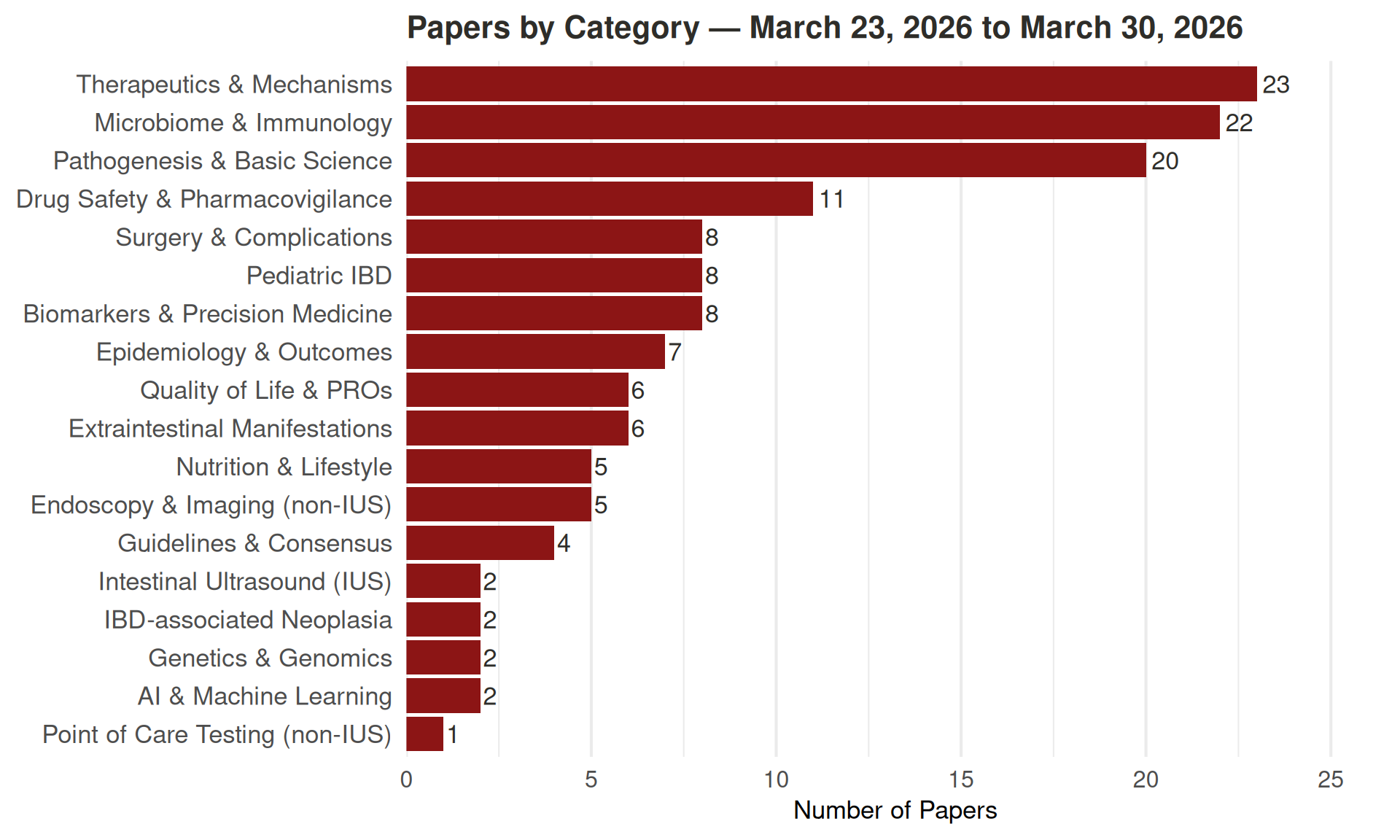
Papers by Category
Click a category to expand. Click a paper title to read its abstract.
Microbiome & Immunology (25 papers)
Integrating complementary datasets for constructing microbiome-metabolome-disease pathways. Bioinformatics (Oxford, England) | 2026-10-20
Microbiome-metabolome-disease pathways play a central role in host health, but studying them is limited by the data available. Large clinical microbiome cohorts often lack metabolomic measurements, while multi-omics studies with paired profiles are typically small or incompletely phenotyped. Combining such complementary datasets is challenging: the metabolite is not measured in the clinical cohort, microbiome data are high-dimensional and compositional, and log-ratio analyses depend on an arbitrarily chosen reference taxon. We propose a framework that integrates a large target cohort that has microbiome and outcome data with a smaller external study that has paired microbiome-metabolome profiles. A high-dimensional structural equation model jointly links the microbiome, the metabolome and the disease outcome. It allows for unmeasured confounding and groups microbes into functional categories. We address compositionality with the additive log-ratio (ALR) transformation, estimate parameters by penalized two-stage least squares, and test metabolite-disease associations with a regularized permutation test. A novel multiple-reference procedure treats each microbe in turn as the ALR reference. It combines the resulting p-values with the Cauchy combination test and classifies microbes by stability selection, which makes inference robust to the choice of reference. In simulations, the method controls the type I error rate, and its power increases with both target and external sample sizes. An application to inflammatory bowel disease, integrating the FRAN and iHMP cohorts, reveals biologically interpretable microbiome-metabolome-disease links. The method is implemented in the R package MMDP, freely available at https://github.com/lei-fang-stat/MMDP. Supplementary data are available at Bioinformatics online.
Fang L, Ye C, Wang Y
KCTD10 Modulates DSS-induced Ulcerative Colitis via Regulating Intestinal Stem Cell Function. The American journal of pathology | 2026-10-20
The incidence of inflammatory bowel disease (IBD) continues to rise annually, which severely threatens public health. While estimates indicate that current therapies cause a 30% IBD clinical treatment failure, the precise pathogenesis remains unclear. Here, we found that a key embryonic development regulator, KCTD10, is correlated with the severity of IBD. We observed enhanced KCTD10 expression during enterocolitis. Intestinal epithelial cell (IEC)-specific knockout of KCTD10 in mice impaired intestinal epithelial barrier function, activated intestinal adaptive immune response, and disrupted intestinal homeostasis. Furthermore, in a dextran sodium sulfate (DSS) -induced ulcerative colitis model, IEC deletion of KCTD10 exacerbated colonic inflammation and impaired post-injury repair. Mechanistically, KCTD10 deletion downregulated intestinal stem cell (ISC) marker genes and affected their function. Importantly, KCTD10 stabilizes the transcription factor ATOH1 by regulating its ubiquitination, thereby determining the fate of intestinal progenitor cells derived from Lgr5+ intestinal stem cells. Our data thus revealed a previously undescribed function of KCTD10 in modulating ulcerative colitis by regulating intestinal stem cell function.
Wang D, Xiao Y, Zhang J, Ding C, Li Z, Ren K
Crosstalk through cholinergic and aryl hydrocarbon receptor pathways in the anti-inflammatory actions of microbial metabolites. Naunyn-Schmiedeberg’s archives of pharmacology | 2026-10-20
The intestinal epithelium maintains immune and metabolic homeostasis at the host-microbiota interface, and its disruption contributes to inflammatory bowel disease (IBD). Microbial metabolites such as short-chain fatty acids (SCFAs) and indole derivatives are known to regulate epithelial and immune functions, but their roles in cholinergic signaling and aryl hydrocarbon receptor (AhR) pathways remain incompletely understood. Caco-2 intestinal epithelial cells were stimulated with lipopolysaccharide (LPS; 10 µg/mL) and co-treated with SCFAs (acetate, propionate, butyrate) or indole derivatives (IAA, IPA, IBA; 1000 µM). The AhR antagonist CH223191 was used to assess receptor involvement. Inflammatory markers (TNF-α, IL-6, COX-2), barrier integrity (FITC-dextran permeability, ZO-1 and occludin), cholinergic components (CHAT, ACHE, BCHE, α7nAChR, mAChR1, mAChR3), and AhR activation (nuclear localization, CYP1A1 expression) were analyzed using qPCR, ELISA, immunostaining, and enzymatic assays. Molecular docking was performed to predict metabolite-protein interactions. LPS induced inflammatory cytokine expression and barrier disruption, whereas SCFAs and indole derivatives significantly reduced inflammation, restored tight-junction organization, and decreased permeability. These metabolites enhanced CHAT and muscarinic receptor expression while suppressing ACHE upregulation, indicating restoration of cholinergic balance. Both groups reactivated AhR signaling, and AhR inhibition disrupted cholinergic regulation, supporting an AhR-dependent mechanism. Butyrate and indole-3-butyric acid exhibited the strongest protective effects. These findings identify a novel AhR-cholinergic axis in intestinal epithelial regulation and highlight microbial metabolites as promising therapeutic candidates for IBD.
Sonmez G, Sari S, Bodur E
Gastrodin alleviates acute colitis with comorbid anxiety- and depression-like behaviours rather than cognitive dysfunction by modulating gut microbiota and suppressing inflammation. Naunyn-Schmiedeberg’s archives of pharmacology | 2026-10-19
Inflammatory bowel disease (IBD) patients frequently suffer from emotional disturbances, predominantly anxiety- and depression-like symptoms, and may also have cognitive dysfunction, but the mechanisms remain unclear, and no therapies targeting the gut or nervous system exist. Gastrodin (GAS), the primary active component of Gastrodia elata, has anti-inflammatory and neuroprotective effects. Whether GAS can alleviate acute colitis with comorbid anxiety- and depression-like behaviours or cognitive dysfunction via the gut-brain axis is unknown. Using a 3% dextran sulfate sodium (DSS)-induced mouse model, we administered GAS (240 mg/kg) by gavage for 7 days. The open field, elevated plus maze, tail suspension, and forced swimming tests showed that GAS improved behavioural abnormalities (including anxiety- and depression-like behaviours); it also restored colon length and reduced colonic histopathological injury. Metagenomic sequencing revealed that GAS reshaped the gut microbiota, increasing Sporosarcina and Nitrospirae while decreasing Clostridiaceae and Lachnospiraceae. Untargeted metabolomics indicated that GAS shifted the metabolic profile away from DSS and normalized taurine levels, and KEGG pathway analysis suggested that GAS may partially ameliorate DSS-induced metabolic disturbances by downregulating virulence-related pathways and upregulating energy metabolic pathways such as the TCA cycle and oxidative phosphorylation relative to DSS. Western blot confirmed that GAS restored the tight junction protein Occludin and decreased TNF-α. Quantitative proteomics demonstrated that GAS reversed the aberrant expression of 191 colonic proteins. These results demonstrate correlative associations between GAS treatment and the alleviation of acute colitis and behavioural abnormalities, alongside concurrent changes in gut microbiota composition, metabolite profiles, and intestinal barrier proteins. Whether these associations reflect a causal gut-brain axis mechanism requires direct experimental validation. GAS modulates the microbiota, partially restores metabolism, repairs the gut barrier, and suppresses local inflammation, suggesting a potential gut-brain axis mechanism. These findings position GAS as a promising candidate for further mechanistic and translational investigation in IBD-associated behavioural comorbidities.
Song JL, Wu RC, Sun R, Gao YX, He BQ, Xie YJ, Xie JS, Li XR, Tong FX, Liu Y
Reviewing preclinical evidence for potent anti-colitogenic effects of the “bee glue” propolis.Review European journal of microbiology & immunology | 2026-10-19
The incidence and disease burden of inflammatory bowel diseases including ulcerative colitis have risen significantly in recent years, and current treatment remains limited by adverse effects and insufficient long-term efficacy, creating demand for alternative or adjunct treatment options. The “bee glue” propolis, a natural compound with a long history of medicinal use, has attracted growing attention for its anti-oxidant, anti-inflammatory, and immune-modulatory properties. This review summarizes and critically evaluates research into anti-colitogenic effects of propolis and its bioactive molecules in experimental colitis animal models. Our structured literature search revealed 21 preclinical studies showing that application of propolis and derivatives resulted in clinical and histopathological improvement of colitis. Treated animals presented with reduced colonic inflammation, restored intestinal barrier integrity, and a more diverse commensal gut microbiota. Notably, the composition of propolis varied considerably between studies depending on geographical and botanical origins and extraction method of the compound, for instance. In conclusion, propolis and derivatives exert potent anti-colitogenic effects in vivo, and might constitute promising disease-alleviating treatment options in human intestinal inflammation, including ulcerative colitis that should be further unravelled in future clinical trials.
Quincke SM, Bereswill S, Heimesaat MM
Monocyte surface Y RNAs potentiate innate immunity. Nature cell biology | 2026-10-19
RNAs can associate with the surface of diverse cell types, yet the functions of specific RNA species on primary immune cells remain unclear. Here, utilizing methods developed to profile, image and quantify surface RNAs in rare primary cell populations, we found that Y RNAs, a family of small noncoding RNAs, preferentially localize to human monocyte surface. In an exploratory pooled inflammatory bowel disease cohort, the proportion of cell-surface-Y-RNA-positive peripheral monocytes was markedly higher in patients with inflammatory bowel disease than in healthy donors or individuals with irritable bowel syndrome. In vivo depletion of cell-surface Y RNAs ameliorates disease activity in mice with colitis. Mechanistically, cell-surface Y RNAs co-cluster with Toll-like receptors TLR2 and TLR4, bind extracellular histones and promote receptor-mediated histone recognition, thereby activating NF-κB and AP-1 signalling and increasing IL6 expression and IL-6 secretion. These findings identify cell-surface Y RNAs as previously unrecognized amplifiers of inflammatory activation.
Jiang X, He W, Xu C, Zheng W, Li C, Xu D, Shao Q, Li Y, Liu Z, Li W
Myrica rubra juice attenuates DSS-induced colitis and is associated with changes in the gut microbiota-metabolite-host axis. Food & function | 2026-10-19
Ulcerative colitis (UC) is characterized by chronic intestinal inflammation and impaired mucosal barrier function. Myrica rubra contains polyphenols and flavonoids, but the mechanisms underlying its potential protective effects in colitis remain unclear. We evaluated Myrica rubra juice (MRJ) in a dextran sulfate sodium (DSS)-induced mouse model of colitis and a TNF-α-injured colonic organoid model. The study combined 16S rRNA gene sequencing, untargeted serum and fecal metabolomics, and molecular docking. MRJ treatment attenuated disease severity and was associated with increased expression of occludin and MUC2 in DSS-treated mice. MRJ also altered microbial diversity and taxonomic composition in a taxon-specific manner. Serum and fecal metabolomic profiles differed after MRJ treatment, including pathways related to amino acid and bile acid metabolism. Integrated analyses identified associations among microbial taxa, putatively annotated metabolites, and host inflammatory and barrier-related variables. Direct exposure to 20% (v/v) whole MRJ increased occludin immunofluorescence in TNF-α-injured colonic organoids cultured without a gut microbial community. This single-marker result is consistent with an epithelial response to whole MRJ under the applied in vitro conditions. Molecular docking generated predicted poses and docking scores for selected parent compound-protein pairs. These calculations did not demonstrate physical binding, functional inhibition, or target engagement in vivo. Together, the findings support a direct epithelial response and identify concurrent microbiota-associated changes. However, the present design could not determine whether these microbial changes contributed to protection. It also could not separate or quantify the host-directed and microbiota-mediated contributions or identify the active chemical species.
Chen L, Ye Y, Ma Y, Cheng D, Cheng Y, Guo Y, Liu C, Qian H
Primetime for the Gasdermins Seesaw in Intestinal Homeostasis and Digestive Disorders.Review Medicinal research reviews | 2026-10-18
The five pore-forming gasdermins (GSDMs, namely GSDMA-E) are best known for executing pyroptosis, a lytic and highly inflammatory form of programmed cell death. Accumulating evidence over the past decade has unveiled diverse nonlytic functions of GSDMs in digestive homeostasis and disease. GSDMs preserve intestinal barrier integrity and mucosal immunity under physiological conditions, whereas their dysregulated activation fuels tissue injury across a spectrum of digestive diseases, including inflammatory bowel disease, acute intestinal injury, radiation enteritis, acute pancreatitis, and liver disorders. Notably, the functional outcome of GSDM activation is highly context-dependent: the same protein can be either protective or injurious. This duality extends to digestive oncology, where GSDM-mediated pyroptosis can stimulate or suppress antitumor immunity. GSDM-targeted drugs, including GSDMD agonists, GSDMD inhibitors, and GSDME inhibitors, have shown encouraging efficacy in preclinical models, although none have yet reached the clinic. Here, we review the dual roles of GSDMs across the digestive system, outline the mechanistic basis of their form-, cell-, and tissue-specific functions, and discuss the progress and remaining challenges in GSDM-targeted therapy.
Liu Q, Liu H, Liu Y, Wang C
2’-Fucosyllactose enhances indole-3-lactic acid production by Bifidobacterium bifidum DNG-08 and alleviates colitis-associated bone loss: Associations with microbiota remodeling and intestinal AHR-related responses. Microbiological research | 2026-10-17
Inflammatory bowel disease is frequently associated with an imbalance in bone remodeling and a decline in bone mass, however, there is a lack of systematic research on microbiome-based intervention strategies targeting colitis-associated bone loss. In this study, Bifidobacterium bifidum DNG-08 (DNG-08) was selected from four candidate strains based on its favorable 2’-fucosyllactose (2’-FL) utilization and indole-3-lactic acid (ILA) production. Genomic annotation revealed that DNG-08 harbors functional genes related to fucosylated oligosaccharide utilization and the conversion of tryptophan to ILA. In a dextran sulfate sodium (DSS)-induced mouse model, combined intervention with DNG-08 and 2’-FL significantly alleviated colitis-associated phenotypes, and reduced pro-inflammatory cytokine levels by 13.33%-58.69%, while increasing IL-10-1.23 times that of the DSS group. Simultaneously, the combined intervention improved trabecular bone microstructure, increasing the bone formation marker procollagen type I N-terminal propeptide (PINP) by 14.61%-56.37%, decreasing the bone resorption marker C-terminal telopeptide of type I collagen (CTX-I) by 17.03%-21.77%, and upregulating the expression of Wnt3a, β-catenin, and Runx2. Gut microbiota analysis showed that combined intervention could partially reverse DSS-induced dysbiosis, enriching potentially beneficial bacterial taxa while reducing inflammation-associated genera. Notably, combined treatment group exhibited elevated serum ILA levels, increased colonic aryl hydrocarbon receptor (AHR) fluorescence, and upregulatied CYP1A1 expression. Correlation analysis identified significant associations among serum ILA, AHR-related indicators, selected bacterial genera, and bone remodeling parameters. This study highlights that strain-substrate matching may serve as a precise synbiotic strategy to improve inflammation-related gut-bone axis dysfunction.
Wang X, Zheng B, Sun Y, Liu L, Li C
Fecal Microbiota Transfer for Recurrent Clostridioides difficile Infection: A Retrospective Single-Center Analysis. Zeitschrift fur Gastroenterologie | 2026-10-16
Clostridioides difficile infection (CDI) is the leading cause of healthcare-associated infectious diarrhea. Despite high initial response rates to antibiotic therapy, recurrence occurs in approximately 20% of patients. Fecal microbiota transplantation (FMT) has emerged as an effective treatment option for multiple recurrences, demonstrating high efficacy and a favorable safety profile. This study aimed to evaluate the effectiveness and safety of FMT in patients with recurrent CDI (rCDI). In this single-center retrospective study, 75 patients who underwent FMT for rCDI between November 2016 and January 2026 after experiencing at least two recurrences despite standard antibiotic therapy were included. Donor screening was performed according to the requirements of the German Federal Institute for Drugs and Medical Devices (BfArM). Following CDI-directed antibiotic pretreatment, FMT was administered either by colonoscopy, oral capsules, or a combination of both. Patients were followed for three months. The primary endpoint was the absence of diarrhea as a surrogate marker for rCDI, including a predefined subgroup analysis of patients with inflammatory bowel disease (IBD). Follow-up data were available for 65 patients, of whom 56 (86.1%) achieved sustained clinical remission. Patients with concomitant IBD (n=15) showed a comparable response rate (86.7%). The route of FMT administration had no significant impact on treatment outcome. Overall, FMT was well tolerated, with only four patients (5.3%) reporting predominantly self-limiting adverse events. FMT is a highly effective and safe treatment for recurrent CDI, including in multimorbid patients and those with concomitant IBD. Die Clostridioides-difficile-Infektion (CDI) ist die häufigste Ursache einer nosokomial erworbenen infektiösen Diarrhoe. Trotz guter Ansprechraten unter antibiotischer Therapie treten Rezidive bei ca. 20% der Patienten auf. Der fäkale Mikrobiotatransfer (FMT) ist insbesondere bei multiplen Rezidiven eine effektive Therapieoption mit hoher Wirksamkeit und gutem Sicherheitsprofil. Ziel dieser Studie war die Untersuchung von Effektivität und Sicherheit des FMT bei rezidivierender CDI (rCDI).In einer monozentrischen retrospektiven Analyse wurden 75 Patienten untersucht, die zwischen November 2016 und Januar 2026 nach mindestens zwei Rezidiven einer CDI mittels FMT behandelt wurden. Das Spenderscreening erfolgte gemäß BfArM-Vorgaben. Nach vorbereitender antibiotischer Therapie wurde der FMT kolonoskopisch, oral mittels Kapseln oder kombiniert appliziert. Die Nachbeobachtung betrug drei Monate. Primärer Endpunkt war das Ausbleiben einer Diarrhoe als Surrogatmarker für eine rCDI, einschließlich einer Subgruppenanalyse bei chronisch entzündlichen Darmerkrankungen (CED).Von 65 Patienten mit vollständiger Nachbeobachtung erreichten 56 (86,1 %) eine anhaltende Symptomfreiheit. Auch Patienten mit CED (n=15) zeigten vergleichbare Ansprechraten (86,7 %). Die Applikationsform beeinflusste den Therapieerfolg nicht. Der FMT war insgesamt sehr gut verträglich; lediglich vier Patienten (5.3 %) berichteten über überwiegend selbstlimitierende Nebenwirkungen.Der FMT ist eine hochwirksame und sichere Therapie der rCDI, auch bei multimorbiden Patienten und Patienten mit CED.
Stallmach A, Guse J, Katzer K, Reuken PA, Knafla F, Schauer A, Thon S, Kiehntopf M, Haziri D, Steube A
Editorial: How Can We Best Detect Frailty in Older Patients With Inflammatory Bowel Disease? Authors’Reply.Editorial★ Alimentary pharmacology & therapeutics | 2026-10-16
Abstract not available.
Carballo-Folgoso L, Duque Alcorta JM, Varela P, Suárez A, Riestra S
Microbiome-Endocannabinoidome Crosstalk as an Immunometabolic Rheostat in Inflammatory Disease.Review FASEB bioAdvances | 2026-10-15
Chronic inflammatory diseases reflect disrupted coordination among microbial ecology, epithelial barriers, lipid signaling, and immunity. The microbiome-endocannabinoidome (eCBome) axis is already recognized as a regulator of metabolism, permeability, and inflammatory tone; the unresolved issue is how to distinguish direct crosstalk from parallel or associative changes. This review therefore operationalizes the axis as an immunometabolic rheostat defined by five measurable domains: microbial functions and metabolites, compartment-specific eCBome ligands and enzymes, barrier integrity and microbial translocation, immune-cell programming, and tissue or clinical outcomes. We distinguish classical endocannabinoids (anandamide and 2-arachidonoylglycerol) from the endocannabinoid-related N-acylethanolamines palmitoylethanolamide and oleoylethanolamide, which act prominently through PPARα, TRPV1, GPR119, and related pathways. Evidence is appraised as direct causal, mechanistically supportive, associative, or hypothesis-generating. The strongest causal foundation links microbiota manipulation to intestinal eCBome tone, permeability, and metabolic endotoxemia, while disease-specific evidence is most developed in obesity-associated inflammation and inflammatory bowel disease. Engineered Lactobacillus paracasei platforms that produce PEA or OEA in situ provide particularly informative proof-of-concept because they couple a defined microbial perturbation to lipid-mediator release, receptor-dependent barrier effects, and inflammatory or metabolic outcomes. By contrast, evidence in MASLD/MASH, neuroinflammation, and systemic autoimmunity remains more compartment-dependent and heterogeneous. Clinical translation must account for the psychiatric toxicity that ended centrally active CB1 antagonism with rimonabant, the target and off-target complexity of FAAH/MAGL inhibition, and limitations of surrogate barrier biomarkers. A causal roadmap should combine gnotobiotic and loss-of-function models, isotope tracing, organoids, and gut-on-chip systems with tissue-resolved lipidomics and longitudinal, biomarker-enriched human trials.
Maghembe RS, Damian D, Bahati S, Makaranga A
Aucubin Alleviates Ulcerative Colitis in Mice by Repairing the Intestinal Barrier and Modulating the Microbiota-Metabolism Axis. Food science & nutrition | 2026-10-15
Ulcerative colitis (UC) is a chronic inflammatory bowel disease with a complex pathogenesis, necessitating the development of safe and effective therapeutic interventions. This study aimed to investigate the protective effects and underlying mechanisms of Aucubin (Auc) against dextran sulfate sodium (DSS)-induced UC in mice. Using a DSS-induced colitis model, we systematically evaluated the multifaceted effects of Auc by assessing the Disease Activity Index (DAI), colon length, histopathological changes, immunohistochemical staining, ELISA results, proteomic profiles, 16S rRNA sequencing data, and untargeted metabolomic analyses. Compared with the DSS group, Aucubin high-dose (Auc-H, 100 mg/kg) treatment significantly attenuated DSS-induced body weight loss, DAI score elevation, and colon shortening (all p < 0.05). The therapeutic efficacy of Auc-H was comparable to that of the positive control drug 5-aminosalicylic acid (5-ASA). Mechanistically, Auc restored intestinal barrier integrity by stimulating mucin 2 (Muc2) secretion and upregulating the expression of zonula occludens-1 (ZO-1) and Occludin, which in turn significantly reduced serum lipopolysaccharide (LPS) concentrations (p < 0.001). Proteomic analysis identified 2180 DSS-induced differentially expressed proteins, of which 679 were significantly counter-regulated by Auc-H, mainly involving the complement and coagulation cascades and immune-inflammatory pathways. Furthermore, gut microbiota analysis showed that Auc promoted the growth of beneficial bacteria, improving microbial balance. Untargeted metabolomics further revealed that Auc-H significantly restored the levels of 120 DSS-induced differential metabolites, including 86 upregulated and 34 downregulated metabolites, among which were protective tryptophan-derived indole metabolites (p < 0.05). Consequently, Aucubin exhibits significant clinical potential in alleviating UC via a multifaceted mechanism. These effects include reduced inflammation, restored epithelial barrier integrity, and modulated microbial metabolism. These findings provide crucial experimental evidence supporting the potential application of Auc as a preventive therapy for UC.
Bi Y, Chen P, Jia S, Jia S, Lian Z, Zheng Y, Guo J, Xue J, Cheng S
Spontaneous hypopigmentation mutant in threespine stickleback fish exhibits changes in the gut microbiome consistent with inflammatory bowel diseases. G3 (Bethesda, Md.) | 2026-10-15
Albinism is a large group of disorders characterized by a loss of pigment in ectoderm-derived tissues - most noticeably impacting the skin, hair, and eyes. Albinism is categorized as either syndromic or non-syndromic. Syndromic albinisms include a wide range of disorders with mutations impacting not just pigmentation but other cellular functions. These include, non-exclusively, melanogenesis disorders, endosome trafficking disorders like lysosomal storage disorders, and cell migration disorders. Mutations leading to syndromic albinisms can cause multi-organ system symptoms due to broad disruption lysosome related organelles (LROs) function. Various genetic mutations impact biogenesis, cell maturation, or trafficking at different stages which can lead to a range of severity. Syndromic albinisms also present with different combinations of symptoms depending on the impacted organelles; including oculocutaneous albinism (OCA) (melanosomes), blood diathesis (platelet dense granules), pulmonary fibrosis (lamellar bodies), or chronic inflammation (multiple cellular sources). Animal models for these multisymptomatic complex disorders are needed to understand the effects on systemic health. One such area of interest is in gut health of those with syndromic albinism. Shared inflammatory patterns of syndromic albinisms like Hermansky-Pudlak Syndromes (HPS) and Inflammatory Bowel Disease (IBD) are well studied, with animal models of HPS jointly used to study patterns of inflammation in IBD. However, the impact of this shared gastrointestinal inflammation on the gut microbiome remains unexplored. Using a spontaneously identified mutant family of threespine stickleback fish, we characterize phenotypes consistent with oculocutaneous albinism and vision impairment and demonstrate shared features of gut health to IBD extend from inflammation to the gut microbiome. We argue syndromic albinism models should be explored as models to study the gut microbiome in addition to inflammatory phenotypes in IBD, and importantly, be used to test microbial/dietary interventions for both IBD and syndromic albinisms.
Beck EA, Smith CA, Currey MC, Small CM, Bohannan BJM, Cresko WA
Functionally declining microbiota in chronic disease: beyond taxonomic loss.Review★ Gut microbes | 2026-10-15
Microbiota deterioration in modern human populations has been linked to chronic disease, and taxonomic profiling is increasingly used to understand, diagnose, and guide treatment. Yet such profiles do not fully capture disease-relevant microbiota states. I propose functional decline within retained taxa as a distinct axis of microbiota deterioration, complementary to taxonomic loss. Modern environmental pressures can drive not only taxonomic loss but also directional selection toward variants or lineages with reduced host-beneficial function or increased harmful activity. Two mechanistically characterized systems from studies by my group illustrate this process: antibiotic-selected Akkermansia variants with diminished metabolic benefits, and Faecalibacterium pathobionts that promote disease when dominant over beneficial strains, with supporting evidence from atopic dermatitis and pediatric inflammatory bowel disease. Evidence from additional gut taxa suggests that this pattern may extend beyond these two examples. By integrating this hidden axis of functional decline with the well-established axis of taxonomic loss, the proposed two-axis framework could help clarify inconsistent microbiota-disease associations and guide strain-resolved, function-first approaches to microbiota analysis and intervention.
Kim HS
Hematopoietic cell transplantation using treosulfan-based conditioning for IL-10 receptor deficiency. Journal of human immunity | 2026-10-15
IL-10 receptor deficiency is a life-threatening inborn error of immunity associated with early-onset inflammatory bowel disease. Hematopoietic cell transplantation (HCT) using treosulfan-based conditioning resulted in excellent survival with full donor engraftment. Importantly, anakinra effectively served as a bridge to HCT.
Lakkaraja M, Schmitt EG, Sood AK, Chen K, Modi AJ, Verbsky JW, Torgerson T, Wahbeh G, Petrovic A, Baker KS
Gut Microbiota-Dependent Tryptophan Metabolism Drives the Therapeutic Effects of Baitouweng Tang in Colitis via the AhR Pathway. Food science & nutrition | 2026-10-14
With dysregulation of the gut microbiota and its metabolic byproducts playing a pivotal role in inflammatory bowel disease (IBD) pathogenesis. Baitouweng Tang (BTWT), a traditional herbal formulation, has long been employed to treat gastrointestinal disorders and shows promising potential in the management of IBD. However, its precise pharmacological mechanisms remain elusive. In this study, we employed targeted metabolomics, high-throughput sequencing, and molecular biology techniques to elucidate the therapeutic mechanisms of BTWT in the treatment of ulcerative colitis (UC). BTWT significantly enhanced the relative abundance of Bifidobacterium, improved the indole metabolic pathway of tryptophan, and restored the levels of indole metabolites, such as indole-3-lactic acid (ILA). These changes activated the aryl hydrocarbon receptor (AhR) and led to marked improvements in the clinical symptoms of UC in mice. Conversely, the therapeutic effects of BTWT were substantially diminished in an antibiotic-induced gut microbiota depletion model. Notably, fecal microbiota transplantation (FMT) partially restored BTWT efficacy, underscoring the critical role of the gut microbiota in mediating its therapeutic effects. Furthermore, in an in vitro lipoteichoic acid (LTA)-induced HT-29 inflammation model, ILA treatment attenuated inflammation and concurrently increased the expression of AhR, CYP1A1, and CYP1B1. These findings suggest a potential link between BTWT-induced changes in tryptophan metabolites, AhR pathway activation, and the amelioration of colitis, though the causal relationship remains to be established. Our study provides a basis for further mechanistic investigation into the AhR pathway as a possible therapeutic target in UC.
Niu C, Hua Y, Kang J, Li F, Chen B, Guo R, Wei Y
Enteric ChAT-Expressing Neurons Mediate the Protective Effect of Lactobacillus plantarum in Inflammatory Bowel Disease.★ Advanced science (Weinheim, Baden-Wurttemberg, Germany) | 2026-10-14
The gut microbiota plays a crucial role in inflammatory bowel diseases (IBD), yet how specific microbial components influence disease progression remains incompletely understood. Our study reveals that decreased abundance of Lactobacillus species correlates with ulcerative colitis severity in patients. Among tested strains, L. plantarum A736, isolated from traditional fermented foods, demonstrated protective effects in ameliorating dextran sulfate sodium (DSS)-induced colitis in a mouse model. Strikingly, multi-omics analysis revealed that L. plantarum A736 uniquely enhances choline acetyltransferase-expressing (ChAT+) neurons in the enteric nervous system and elevates acetylcholine (ACh) levels. Further analysis identified that L. plantarum A736 metabolizes tryptophan to produce indole-3-lactic acid (ILA), and supplementation with ILA significantly mimics this strain’s anti-inflammatory effects by restoring ChAT+ neurons and cholinergic signaling. Crucially, selective ablation of colonic ChAT+ neurons abolished the protective effect of both L. plantarum A736 and ILA, establishing their essential role in mediating these effects. These findings demonstrate that microbial metabolites can modulate enteric neuronal circuits to regulate gut immunity. The identified ILA-ChAT+ neuron axis represents a novel neuro-immune pathway that could be targeted for IBD treatment.
Xia B, Sun Y, Wang J, Liu Y, Wang L, Jiang S, Bai G, Zhang R, Zhang Y, Kou R
Bispecific antibodies targeting TL1A and IL-12/23p40 suppress pathogenic Th1/Th17 responses and ameliorate colitis in mice. iScience | 2026-10-09
Inflammatory bowel disease (IBD) remains a substantial therapeutic challenge, largely due to the limitations of single-target monotherapies. Here, we engineered two bispecific antibodies, KA-4316 and its half-life-extended derivative KA-5817, which co-target TL1A and IL-12/23p40 utilizing a common light chain design and knobs-into-holes Fc engineering. To improve clinical translatability, KA-5817 was modified with YTE Fc mutations to enhance FcRn binding. KA-4316 exhibited high binding affinity for both targets, high monomer purity, and favorable thermal stability. In vitro functional assays demonstrated that KA-4316 potently blocked TL1A-DR3 and IL-12/23p40-IL-12Rβ1 interactions, suppressing downstream signaling and pro-inflammatory cytokine release. In vivo, KA-5817 alleviated pathological severity in dextran sulfate sodium (DSS)-induced colitis in TL1A/IL23A/IL12B triple-humanized mice and showed a prolonged serum half-life in FcRn-humanized mice. KA-4316 and KA-5817 exhibit beneficial manufacturability and favorable biological activity. Our results support dual inhibition of TL1A and IL-12/23p40 as a potential therapeutic strategy for IBD.
Li X, Peng H, Hao F, Gu Y, Ning J, Yu C
TLR Signaling Beyond Immunity: Emerging Roles in Cell Migration, Metabolism, Development, and Host-Microbiome Crosstalk.Review Biology | 2026-10-07
Recent findings support a broader view of TLR signaling as an integrative signaling hub that links immunity with cell migration, metabolism, development, and host-microbiome crosstalk. In cell migration, TLRs exert context-dependent effects through chemokine receptor regulation, adhesion and cytoskeletal modulation, and indirect cytokine-mediated signaling. In metabolism, TLRs orchestrate insulin resistance, obesity, and glucose homeostasis in a receptor- and tissue-specific manner. In tissue injury and development, TLR signaling exerts dual roles; it is detrimental in ischemia-reperfusion injury, but beneficial in vascular remodeling and neurogenesis. We then examine the bidirectional interplay between TLRs and the gut microbiome, where TLRs shape microbial community structure and intestinal immune homeostasis. Finally, we survey the therapeutic landscape of TLR modulators, highlighting that while TLR agonists are predominantly explored in oncology, TLR antagonists show promise in autoimmune diseases such as inflammatory bowel disease. Special attention is given to insights from organoid, rodent and zebrafish models, which have provided powerful in vitro and in vivo evidence for multiple roles of TLR signaling under both physiological and pathological conditions. A deeper understanding of these non-canonical functions will be essential for developing next-generation therapeutic strategies that selectively modulate TLR signaling in infectious, inflammatory, metabolic, and microbiome-associated diseases.
Liu L, Spaink HP
Lactobacillus reuteri attenuates chronic diarrhea by modulating microbiota homeostasis and macrophage polarization through the cGAS/STING pathway dependent on D-lactate-mediated mitochondrial function. Microbiological research | 2026-10-04
Chronic diarrhea (CD) severely affects patients’ quality of life and is linked to ulcerative colitis, inflammatory bowel disease, and colorectal cancer. Gut microbiota dysbiosis plays a crucial role in intestinal health, with Lactobacillus reuteri emerging as a key regulator. However, its role in chronic diarrhea remains unclear. In this study, we observed macaques with spontaneous diarrhea and investigated microbial and metabolic changes. We also developed a chronic diarrhea mouse model using dextran sulfate sodium. CD group of both models revealed a significant reduction of L. reuteri. L. reuteri transplantation alleviates intestinal injury in CD by secreting D-lactate and modulates macrophage polarization. L. reuteri-derived D-lactate binds to IARS2 in intestinal epithelial macrophages, reducing mitochondrial IARS2 activation and suppressing cGAS-STING pathway activation. This preserves mitochondrial function while decreasing M1 macrophage polarization. Our research revealed the significance of microbiota dysbiosis in CD with both non-human primate and murine model, and highlighted the critical role of L. reuteri, which is conducted with D-lactate-mediated modulation of macrophage function and offered new insights into probiotic therapy for CD.
Cheng X, Zhang Y, Li C, Jiang M, Song J, Fang F, Chang K, Zhu X, Jian C, Chen J
Oudemansiella raphanipes polysaccharide alleviates DSS-induced colitis associated with gut microbiota and ZBP1-associated PANoptosis.★ Phytomedicine : international journal of phytotherapy and phytopharmacology | 2026-10-03
Ulcerative colitis (UC) is a chronic relapsing inflammatory bowel disease with limited preventive options. The edible mushroom Oudemansiella raphanipes produces polysaccharides with reported bioactivity, but the effects of its purified fraction Oudemansiella raphanipes polysaccharide (UAE-ORP) on colitis remain unknown. UAE-ORP was evaluated in mice with sodium dextran sulphate (DSS)-induced colitis using metagenomic and metabolomic analysis, as well as histological, ELISA and Western blot analysis of intestinal barrier function, ZBP1-associated PANoptosis-related proteins, and FFAR2/FFAR3 expression. UAE-ORP alleviated DSS-induced colonic injury, reducing the DAI scores to 1.7 ± 0.3-2.7 ± 0.5 across treatment groups and restoring colon length to 6.2 ± 0.9-8.2 ± 0.8 cm across doses. UAE-ORP was associated with attenuated ZBP1-associated PANoptosis-related protein expression, increased Lachnospiraceae abundance, and restored acetic acid and 3,4-dihydroxyphthalate levels. UAE-ORP also restored the protein expression levels of FFAR2 and FFAR3. Correlation analysis suggested a potential association between Lachnospiraceae-related metabolites and FFAR2/FFAR3 signaling. UAE-ORP alleviates DSS-induced colitis in mice. The protective effects coincide with altered gut microbiota composition, elevated microbial metabolites, restored FFAR2/FFAR3 expression, and concomitant changes in ZBP1-associated PANoptosis-related protein. These observations identify several candidate pathways warranting further investigation and provide preliminary mechanistic context for the anti-colitic activity of this mushroom polysaccharide.
Zhong C, Zhang J, Wang Y, Lu K, Sun Y, Li X, Ma H, Guan L
Targeting the Microbiota-Metabolism-Immunity Axis: Active Components of Traditional Chinese Medicine in Colitis-Associated Colorectal Cancer.Review International journal of molecular sciences | 2026-10-03
Colitis-associated colorectal cancer (CAC) develops in the setting of long-standing intestinal inflammation and remains a major complication of inflammatory bowel disease (IBD). Although effective control of inflammation may reduce cancer risk, approaches that specifically prevent the progression from chronic colitis to neoplasia remain limited. Disruption of the gut microbiota-metabolism-immunity axis is increasingly implicated in this process, as microbial dysbiosis and altered metabolite production can compromise epithelial barrier integrity, sustain inflammatory signaling, and disturb mucosal immune homeostasis. This review examines how active components derived from traditional Chinese medicine (TCM), particularly flavonoids, alkaloids, saponins, and polysaccharides, influence this interconnected network in CAC-related models. Rather than treating these constituents as a single group, we compare the mechanistic patterns and evidence base associated with each class. Flavonoids and alkaloids have been studied mainly in relation to inflammatory signaling and epithelial barrier protection, whereas saponins are more often linked to regulation of the immune microenvironment. Polysaccharides have been studied most frequently in relation to microbiota remodeling, short-chain fatty acid production, and mucosal immune balance. These distinctions are not absolute, and substantial overlap exists across component classes. Moreover, most evidence is derived from animal or cell-based studies, with marked variation in experimental models, compound characterizations, dosing, and outcome assessments. The microbiota-metabolism-immunity axis provides a coherent framework for interpreting the multi-level actions of TCM-derived components, but their causal mechanisms and clinical relevance to human CAC require further validation.
Chen Q, Zhang H, Fu L, Liu F, Yang Q, Zhang G, Huang Y, Yang Y, Yao C, Wang Y
Gegen Qinlian decoction alleviates ulcerative colitis by remodeling the gut microbiota-bile acid axis and inhibiting NLRP3-mediated pyroptosis. Frontiers in immunology | 2026-10-01
Gegen Qinlian Decoction (GQD) is used to treat intestinal disorders, but its mechanism in ulcerative colitis (UC) induced by combined high-fat diet (HFD) and dextran sulfate sodium (DSS) exposure remains unclear. A UC mouse model was induced by HFD plus DSS. GQD constituents were identified by UPLC-MS/MS. Colonic pathology and barrier integrity were assessed by H&E and immunofluorescence. Gut microbiota and bile acids were analyzed by 16S rRNA gene sequencing and targeted metabolomics. Transcriptomics, ELISA, Western blotting, fecal microbiota transplantation (FMT), and molecular docking were used to investigate mechanisms. LPS-stimulated Caco-2 cells were treated with 20 or 50 μM DCA; cell viability, NLRP3 inflammasome-related gene expression, and ZO-1/Occludin immunofluorescence were evaluated. GQD ameliorated gut dysbiosis, decreasing the Firmicutes/Bacteroidetes ratio, increasing Akkermansia muciniphila, and reducing Clostridium perfringens. It remodeled bile acid metabolism, decreasing primary bile acids (CA, TCA, and CDCA, etc.) and increasing secondary bile acids (DCA, 6,7-DKLCA and 3β-DCA, etc.). Transcriptomics indicated inhibition of NOD-like receptor signaling. GQD suppressed NLRP3 inflammasome activation and reduced ASC, pro-caspase-1, cleaved caspase-1, GSDMD-N, and IL-18. Docking prioritized DCA as a candidate NLRP3-interacting metabolite. In Caco-2 cells, DCA dose-dependently reduced LPS-induced NLRP3, ASC, GSDMD, IL1B, and IL18 mRNA expression and partially restored ZO-1 and Occludin signals without appreciable cytotoxicity. FMT supported the involvement of gut microbiota in GQD-mediated anti-inflammatory effects. GQD alleviates UC induced by combined HFD and DSS exposure by reshaping the gut microbiota and correcting bile acid dysregulation, thereby inhibiting NLRP3 inflammasome activation. This study highlights the gut microbiota-bile acid axis in GQD’s therapeutic effects.
Wang H, Ou G, Xu H, Liu T, Jiang Y, Wang S, Wu J, Wu S, Deng L, Xu L
Oral microbiome and inflammatory bowel disease: A scoping review. American journal of dentistry | 2026-10
To examine the association between the oral microbiome and IBD in terms of microbiota diversity, composition, function, and diagnostic potential through a scoping review of the existing literature. This scoping review was structured following the PRISMA-ScR guidelines. Literature searches were conducted in PubMed, Embase, and the Cochrane Library, with the time frame restricted from database inception to November 17, 2025. This review included 31 studies, among which seven topics for patients with periodontitis and IBD-related periodontitis, three studies assessed single bacterial species, and the remaining 21 articles explored the diversity and phylum-level taxonomic shifts of oral microbiota in IBD patients, functional and metabolic pathway alterations associated with oral dysbiosis, as well as the diagnostic potential and biomarkers derived from oral microbial profiles. The oral microbiota of IBD patients exhibits characteristic dysbiosis, manifested by the enrichment of pathogenic taxa, depletion of anti-inflammatory species, and metabolic dysfunction, which are closely associated with gut microbial alterations and systemic inflammatory status. The salivary microbiome demonstrates significant diagnostic potential for IBD.
Chen C, Zhang H, Cheng T, Zhou F, Chen X, Fang M, Qi P
Biomarkers & Precision Medicine (12 papers)
Epithelial NF-κB shapes protective Treg cell responses to restrain intestinal inflammation.★ Nature communications | 2026-10-20
Inflammation resolution depends on coordinated communication between tissue compartments, yet how the intestinal epithelium shapes its immune microenvironment remains poorly understood. Here, using colonic biopsies from patients with ulcerative colitis (UC) and mouse models enabling tissue-wide visualization of NF-κB activity, we combine single-cell RNA sequencing and secretome analysis to define epithelial communication during colitis. We show that, paradoxically, the NF-κB-driven pro-inflammatory secretome of intestinal epithelial cells (IECs) is essential for recovery and prevents unrestrained inflammation. Mechanistically, epithelial NF-κB promotes CCL22-dependent regulatory T cell (Treg cell) recruitment and promotes a tolerogenic, pro-repair cell state, accompanied by induction of the lipid-metabolism-associated GDPD3 and CCR4. In UC, epithelial NF-κB is not uniformly activated but instead induces a selective pro-inflammatory transcriptional program while repressing targets regulating T cell recruitment. Thus, we identify dynamic epithelial-immune communication and demonstrate a protective IEC NF-κB-Treg cell axis important for resolution of intestinal inflammation.
Barleben L, Schneegans AJ, Uyar B, Bruneau A, Vasileva G, Flohr F, Kabrani E, Vasilakis T, Hammann L, Gebert P
Methanogenic archaea Methanobrevibacter smithii and Methanosphaera stadtmanae promote mucosal homeostasis and protect from colitis. Proceedings of the National Academy of Sciences of the United States of America | 2026-10-20
The intestinal microbiota is a critical determinant of mucosal homeostasis, yet the functional contributions of Archaea-which constitute up to 10% of the anaerobic community-remain largely undefined. Here, we provide evidence that the human methanogens Methanobrevibacter smithii (MSm) and Methanosphaera stadtmanae (MSt) promote colonic health. Transcriptomic analysis of germ-free mice reveals that MSm and MSt induce distinct colonic programs important for epithelial integrity. Using gnotobiotic and antibiotic-treated specific-pathogen-free mouse models, we show that MSm and MSt reinforce the epithelial barrier, characterized by increased goblet cell expansion, mucus thickening, and enhanced epithelial regeneration. Furthermore, methanogens expand Foxp3+ regulatory T cell (Treg) populations without inducing pro-inflammatory TH17 responses. Notably, MSm and MSt protect against dextran sodium sulfate-induced colitis. While MSt-mediated protection requires adaptive immunity, MSm retains partial efficacy in lymphocyte-deficient mice, revealing nonredundant protective mechanisms. These findings indicate that methanogenic archaea promote mucosal integrity during host association and suggest that methanogens may hold therapeutic potential for inflammatory bowel disease, though translation to human disease remains to be established.
Byrd EE, Harris BW, Zhang H, Warren WE, Kolli SH, Putelo AM, McGinty MT, Solga MD, Rutkowski MR, Kendall MM
Lactobacillus brevis cell-free supernatant attenuates inflammation-associated gene expression and differentially modulates host defense-associated genes in DSS-stimulated HT-29 cells. Molecular biology reports | 2026-10-20
Dysregulated Toll-like receptor (TLR) signaling in intestinal epithelial cells contributes to persistent mucosal inflammation in inflammatory bowel disease (IBD). Although Lactobacillus brevis has demonstrated anti-inflammatory potential, the transcriptional effects of its secreted metabolites on inflammatory and host defense-associated components of epithelial innate immune signaling remain insufficiently characterized. This study investigated the effects of L. brevis cell-free supernatant (CFS) on TLR-associated gene expression in DSS-stimulated HT-29 cells. 1% DSS stimulated HT-29 human intestinal epithelial cells (inflammatory epithelial model) were treated with 50% L. brevis CFS (48 h) following viability assessment using MTT assay. Transcriptional profiling of 84 key genes involved in the TLR signaling pathway was performed using the RT² Profiler™ PCR Array. Differential gene expression was analyzed using the ΔΔCt method, followed by pathway-level mapping of the MyD88- and TRIF-dependent branches. Raw p-values were adjusted for multiple comparisons using the Benjamini-Hochberg FDR procedure. Treatment with L. brevis CFS was associated with significant downregulation of multiple inflammation-associated genes, including TLR2, TLR4, MYD88, TIRAP, IRAK1, IRAK4, MAP3K7, NFKB1, IL1A, IL1B, IL6, IL12A, CCL2, and PTGS2. Host defense-associated genes exhibited a non-uniform transcriptional response. Components of the TRIF-dependent antiviral axis, including TLR3, TICAM1, TBK1, IRF3, and CXCL10, were downregulated, whereas TLR1, TLR10, TICAM2, and BTK were upregulated, and several other immune-response genes showed no significant change. These findings indicate differential modulation of TLR-associated transcription rather than uniform suppression of all examined immune-related genes. L. brevis CFS attenuated the expression of multiple inflammation-associated genes and differentially modulated host defense-associated genes in DSS-stimulated HT-29 cells. This non-uniform transcriptional pattern indicates selective modulation of the TLR-associated gene network rather than indiscriminate suppression of all examined immune-related genes.
Moghanlou A, Rasouli S, Asadi Lanjavani S, Falsafi S, Behrouzi A
CXCL14+ fibroblasts promote development of IBD-associated fibrosis and cancer by interacting with SPP1+ macrophages via collagen IV secretion. British journal of cancer | 2026-10-17
The pathogenesis of inflammatory bowel disease (IBD) involves chronic inflammation of the gastrointestinal tract, which predisposes patients to an increased risk of fibrosis and cancer due to prolonged inflammatory stimulation. However, the specific mechanisms underlying secondary gastrointestinal carcinogenesis in individuals with IBD remain poorly elucidated, particularly due to a limited number of studies conducted at single-nuclei level. We investigated the dynamics and interactions of cell subtypes during the progression of IBD-associated cancers through comprehensive analysis including single-nuclei transcriptomics, spatial transcriptomics, ecological dynamic modelling, multiplex immunohistochemistry, in vitro co-culture and in vivo animal studies. The results revealed that CXCL14+ fibroblasts, the primary source of collagen in the microenvironment, play a pivotal role in the inflammation-cancer transition. These fibroblasts progressively increase in abundance during this transition and secreted elevated levels of collagen IV. The increased presence of collagen IV promotes the recruitment and differentiation of SPP1+ macrophages. This interaction ultimately contributes to the development and progression of IBD-associated fibrosis and cancer transformation. Collagen IV, secreted by CXCL14+ fibroblasts, plays a pivotal role in promoting the transition from IBD to cancer. Inhibition of collagen IV secretion not only prevents fibrosis but also hinders the development of inflammation-cancer transition. Our findings are crucial for understanding the mechanisms underlying IBD-associated cancer and developing innovative therapeutic strategies. During the inflammation-cancer transition, activation of the SOX4 leads to increased COL4A1/A2 secretion by CXCL14+ fibroblasts, resulting in enhanced collagen IV synthesis. Collagen IV binds to ITGB1/CD44 receptors on SPP1+ macrophages and activates EGR1/2 to promote SPP1+ macrophage differentiation, while upregulating S100A10 and ANXA2. Activation of S100A10 and ANXA2 promotes recruitment of SPP1+ macrophages, which contributes to immune escape and secretion of oncogenes, thus further promoting fibrosis and tumorigenesis. In addition, SPP1+ macrophages further stimulate CXCL14+ fibroblasts to secrete COL4A1/A2 via TGF-β1, forming a feedback loop that amplifies interactions in the tumour microenvironment.
Zhang H, Shi Y, Song Q, Li N, Lin Z, Chen Q, Yang Y, Chen Y, Liu Q, Tan Y
Putrescine alters the composition of interstitial dendritic cell subsets by suppressing Cybb-dependent oxidative phosphorylation. Immunobiology | 2026-10-15
Putrescine, a core polyamine, is closely linked to intestinal immune homeostasis and the pathogenesis of intestinal disease, yet its role in shaping dendritic cell (DC) subset differentiation in the intestinal lamina propria and the mechanism behind it remains undefined. Here, we first performed integrated analysis of seven public human single-cell RNA sequencing datasets to profile dendritic cell subsets across colorectal cancer tissues with varied MMR phenotypes. We fed mice a 1% (w/v) putrescine diet to raise intestinal putrescine levels and examined the effects on lamina propria DC subsets using flow cytometry, single-cell RNA sequencing, transcriptomics, and O2K-based metabolic assays. Elevated putrescine expanded the cDC1 subset (CD103+CD11b-CD172a-), contracted the cDC2 subsets (CD103-CD11b+CD172a+ and CD103+CD11b+CD172a+), and reduced surface expression of CD11b and CD172a on lamina propria DCs. Single-cell and transcriptomic profiling showed that putrescine reshaped the transcriptional landscape of DC subsets, with marked downregulation of reactive oxygen species (ROS) and oxidative phosphorylation (OXPHOS) pathways. O2K metabolic analysis confirmed that putrescine lowered ROS output and oxygen consumption rate across several mitochondrial respiratory states, including basal and ATP-coupled respiration, while western blotting showed reduced Cybb expression in lamina propria DCs. Together, these findings indicate that putrescine reshapes intestinal lamina propria DC subset composition by suppressing Cybb, thereby limiting ROS production and OXPHOS activity. This work offers new mechanistic insight into how polyamine metabolism governs intestinal immune homeostasis and points to potential therapeutic targets for intestinal disorders such as colorectal cancer and inflammatory bowel disease.
Zhang Y, Tan Z, Li D, Lian H
Real-World Effectiveness and Safety of Advanced Combination Treatment in Patients with Refractory Inflammatory Bowel Disease. Advances in therapy | 2026-10-15
Advanced combination treatment (ACT) pairs two advanced therapies with distinct mechanisms of action for inflammatory bowel disease (IBD) that has not responded to single agents. However, real-world evidence on individual regimens remains limited. We retrospectively identified all ACT courses at a tertiary centre in Abu Dhabi (June 2021 to May 2026). A course required the concurrent use of two advanced therapies with documented clinical intent, with no minimum duration. Disease activity, laboratory values, endoscopic findings and therapeutic drug monitoring were recorded prospectively in the centre’s IBD registry, and every rate is reported over the whole cohort. The primary outcome was composite remission (clinical and biochemical remission together); endoscopic outcomes were reported separately. A total of 16 patients (11 Crohn’s disease, 5 ulcerative colitis) received 21 courses across 12 regimens; 13 (81%) were Emirati. The commonest combinations paired a selective anti-interleukin-23 agent with a Janus kinase inhibitor (10 courses) or with an anti-tumour necrosis factor agent (5). Patients had failed a median of four prior advanced therapies, and the median course duration was 218 days. Composite remission was achieved in 11 of 21 courses (52%, 95% confidence interval [CI] 30-74%; 11 of 16 patients), clinical remission in 15 of 21 (71%) and biochemical remission in 11 of 21 (52%); 14 of 21 (67%) were corticosteroid-free. Clinically timed endoscopic reassessment in 14 courses showed endoscopic remission in five. Twelve courses (57%) were discontinued, seven for treatment failure. One serious adverse event, a urinary tract infection requiring admission, occurred during combination therapy. ACT achieved composite remission in just over half of courses in this multi-refractory cohort, with one serious adverse event. These findings support consideration of ACT in carefully selected multi-refractory patients under close monitoring; further real-world data on individual regimens are needed to guide the choice of combination.
Ahmed EF, Oribiana CC, Alahmad MA, Omar NM, Chitra Kumar KK, Quraishi MN
Breaking the Black Box: Revolutionizing Traditional Chinese Medicine with Formula-Derived Nanoparticles.Review International journal of nanomedicine | 2026-10-14
Traditional Chinese medicine (TCM) formulas produce distinctive multi‑target synergistic therapeutic effects governed by the monarch, minister, assistant, and guide compatibility principle for diverse chronic and refractory disorders. Nevertheless, a four‑layer “black‑box” barrier-encompassing poorly characterized bioactive constituents, ambiguous inter‑component synergistic mechanisms, untraceable in vivo transport profiles, and low oral bioavailability-substantially hinders TCM modernization and global adoption. Most existing reviews focus on single‑component nanocarriers or plant‑derived extracellular‑vesicle‑like particles; few comprehensively investigate nanoparticles generated from complete multi‑herb TCM decoctions while integrating material characterization, mechanistic dissection, and clinical‑regulatory translational bottlenecks. This review addresses this literature gap by focusing on formula‑derived nanoparticles (FDNs), fabricated from intact TCM‑decoction extracts via natural self‑assembly or degradable exogenous carrier‑assisted assembly. FDNs largely retain native component ratios and synergistic bioactivities while enabling precise targeted delivery of herbal constituents. We summarize three mainstream FDN fabrication workflows and establish a comprehensive multidimensional characterization toolkit for assessing physicochemical properties, intermolecular interactions, structural stability, and biocompatibility. Enabled by three quantifiable technical approaches, FDNs can partially mitigate the TCM black‑box dilemma and exert multitarget, precision‑guided intervention against tumors, inflammatory bowel disease, neurodegenerative conditions, and metabolic disorders. Major translational obstacles include non‑standardized industrial scale‑up, insufficient biological barrier penetration, poorly defined molecular interaction mechanisms, absence of unified multicomponent quality benchmarks, incomplete global regulatory frameworks, high manufacturing costs, and risks of poor batch‑to‑batch reproducibility. Priority future directions cover intelligent biomimetic carriers, multiomics‑supported molecular simulation, and end‑to‑end standardized clinical translation, advancing empirical TCM‑formula therapeutics toward standardized, quantifiable high‑precision modern medicine. This review outlines actionable research gaps and a phased translational roadmap to guide investigations.
Cheng M, Wen P, Jiang L, Shen H, Wang H
A review on MMP-2 modulating agents from natural and synthetic sources and their role in inflammatory bowel disease.Review Inflammopharmacology | 2026-10-14
Inflammatory bowel disease (IBD), encompassing Crohn’s disease and ulcerative colitis, is characterized by chronic intestinal inflammation, epithelial barrier dysfunction, immune dysregulation, and aberrant extracellular matrix (ECM) remodeling. Matrix metalloproteinase-2 (MMP-2), a zinc-dependent gelatinase, has emerged as a critical regulator of intestinal homeostasis owing to its dual role in tissue repair and inflammatory tissue destruction. Unlike several inducible matrix metalloproteinases, MMP-2 is constitutively expressed and tightly regulated through interactions with membrane-type MMPs, tissue inhibitors of metalloproteinases (TIMPs), cytokines, redox signalling, and microbial factors. Dysregulated MMP-2 activity contributes to epithelial barrier disruption, leukocyte infiltration, chronic inflammation, fibrosis, and disease progression in IBD. This review summarizes the current understanding of MMP-2 biology, activation mechanisms, and immunopharmacological functions in intestinal inflammation, while critically evaluating therapeutic strategies aimed at its modulation. Particular emphasis is placed on natural and synthetic MMP-2 modulators, including animal-derived peptides and endogenous inhibitors, plant-derived polyphenols, flavonoids, alkaloids, terpenoids, and rationally designed small-molecule and peptidomimetic inhibitors. Emerging nanocarrier-based and targeted delivery systems are also discussed as approaches to enhance selectivity and minimize systemic toxicity. Furthermore, the review highlights the limitations of broad-spectrum MMP inhibition and underscores the need for site-specific modulation that preserves physiological tissue remodeling while suppressing pathological activity. Advances in precision medicine, single-cell and spatial transcriptomics, organoid-based disease models, and microbiome-informed therapeutic strategies are expected to facilitate the development of next-generation MMP-2-targeted interventions. Collectively, MMP-2 represents a promising yet complex therapeutic target whose successful modulation may improve long-term outcomes in IBD.
Ragunath M, Ardra S, Balde A, Nazeer RA
Unlocking the therapeutic potential of traditional Chinese medicine in Crohn’s disease: from multi-target mechanisms to clinical promise.Review Frontiers in immunology | 2026-10-05
Crohn’s disease (CD) is a chronic, relapsing inflammatory disorder of the gastrointestinal tract with an unclear etiology. Current Western therapies, including 5-aminosalicylates, corticosteroids, biologics, and immunomodulators, often fail to maintain sustained remission and are associated with significant adverse effects and high recurrence rates following drug withdrawal. Traditional Chinese medicine (TCM) has shown potential in alleviating CD symptoms through multi-target and multi-pathway mechanisms. Thus, this review aims to systematically summarize recent advances in understanding the mechanisms by which TCM intervenes in CD, focusing mainly on: regulating immune balance (including modulation of Th1/Th2, Th17/Treg, and M1/M2 macrophage polarization), attenuating inflammatory cascades (via NF-κB, MAPK, PI3K/AKT, and JAK/STAT pathways), reducing oxidative stress, regulating programmed cell death in intestinal epithelial cells (including apoptosis, pyroptosis, ferroptosis, and autophagic cell death), enhancing intestinal mucosal barrier integrity, and promoting restoration of intestinal microbial homeostasis. Furthermore, TCM combined with Western therapies may exert synergistic effects to improve clinical efficacy and reduce relapse risk. Future research could further integrate network pharmacology and multi-omics technologies to elucidate the molecular mechanisms of TCM more deeply, advancing precision therapeutics for CD.
Zhou M, Chen Y, Hu J, Guo X, Jin W
GART expression is associated with a proliferative and purine-metabolic ISC-like epithelial state in ulcerative colitis. Frontiers in immunology | 2026-10-05
To characterize the epithelial state associated with GART expression in ulcerative colitis (UC) and determine whether this association reflects a GART-specific program or a broader proliferative and purine-metabolic phenotype. Four independent bulk transcriptomic cohorts were analyzed and synthesized by random-effects meta-analysis. Human colonic scRNA-seq datasets (GSE214695 and SCP259) were integrated, with principal comparisons repeated using donor-aware pseudobulk or mixed-effects approaches and adjustment for sequencing depth, gene detection, and cell-cycle covariates. GART detection was defined from raw counts and tested using alternative thresholds. Pseudotime, scTenifoldKnk, CellChat/LIANA, and transcriptional-network analyses were used as exploratory analyses. Spatial transcriptomics (GSE189184), human colonic multiplex immunofluorescence, and acute DSS-induced colitis tissues were used for tissue-level localization. Across the four bulk cohorts, GART expression showed an overall increase in UC (pooled Hedges’ g = 0.743, 95% CI 0.239-1.248; P = 0.0183). In the single-cell atlas, GART detection localized preferentially to an ISC-like epithelial compartment, although the magnitude of the UC-associated detection difference varied between cohorts. Within UC ISC-like cells, donor-paired pseudobulk analyses identified proliferative and nucleotide-metabolic transcriptional differences associated with GART detection. Across the broader ISC-like epithelial atlas, donor-aware module analyses showed positive associations of GART detection with purine-biosynthesis, DNA-replication, DNA-repair, and mitotic programs, and these associations remained positive within cell-cycle strata. Comparison with other de novo purine-synthesis enzymes did not support a uniquely GART-specific alteration. Exploratory network analyses linked the GART-associated state to proliferative and nucleotide-metabolic programs but did not establish functional dependence. In seven independent spatial donors, the single-cell-derived epithelial program was consistently higher in GART-detected than GART-undetected epithelial regions (mean within-donor difference = 0.0262, 95% CI 0.0140-0.0407; exact P = 0.0156). Human tissue immunofluorescence further showed co-enrichment of GART with OLFM4-positive ISC-like, MYBL2/Ki67-positive proliferative, and MIF/CD74-associated inflammatory regions across the corresponding panel-specific participant sets. GART identifies a proliferative and purine-metabolic ISC-like epithelial state in UC but is not established as a specific driver of epithelial regeneration. The findings support an association between GART detection, nucleotide-demand programs, proliferative epithelial activity, and the inflammatory tissue context, providing a framework for future direct functional studies.
Chong J, Ding H, Ma J, Li Y, Pan J, Li Y, Chen Y
Biopsy-Based Molecular Signatures Predicting Therapeutic Response in Ulcerative Colitis. International journal of molecular sciences | 2026-10-03
Ulcerative colitis (UC) is a chronic inflammatory bowel disease with marked molecular heterogeneity, resulting in highly variable responses to biologic therapies. Despite the efficacy of Infliximab (IFX), many patients fail to achieve sustained remission. Identifying biomarkers predictive of treatment response is essential for advancing precision medicine in UC. Gene expression profiling of colonic mucosal biopsies from IFX responders, IFX non-responders, and healthy controls was performed using a multiplex array, followed by technical confirmation by RT-qPCR and immunohistochemical assessment to further characterize tissue expression and biological relevance. IFX non-responders displayed a stromal-immune molecular signature marked by extracellular matrix remodeling, stromal remodeling, integrin-mediated signaling, and persistent inflammatory pathways. SPARC and SPP1 emerged as the most prominent biomarkers, with significantly increased gene and protein expression in non-responder patients, highlighting their association with chronic tissue remodeling and therapeutic resistance. Mucosal resistance to IFX is associated with a specific stromal-immune profile characterized by SPARC and SPP1 upregulation. These findings suggest that both molecules may serve as promising candidate markers for patient stratification, highlighting the need for future prospective studies to explore their role in personalized management strategies for ulcerative colitis.
Grassi I, Liso M, Mastronardi M, Valentini AM, Curlo M, Armentano R, Cavalcanti E
Building sustainable IBD clinical research units: a practical toolbox emerging from a Belgian multi-stakeholder initiative.★ Journal of Crohn’s & colitis | 2026-10
Clinical research is an essential pillar of modern inflammatory bowel disease (IBD) care, underpinning therapeutic innovation, biomarker discovery, precision medicine, and improvements in healthcare delivery. However, while international initiatives have successfully defined standards for clinical care, comparatively little attention has been devoted to the infrastructure required to conduct high-quality clinical research. Consequently, research capacity remains highly heterogeneous across centers, limiting patient access to clinical studies and reducing opportunities for collaborative research. To address this gap, a Belgian multi-stakeholder initiative involving patients, gastroenterologists, research nurses, study coordinators, and clinical researchers developed a practical toolbox for establishing and strengthening IBD clinical research units. Rather than defining rigid accreditation criteria, the toolbox distinguishes between essential components required for a functional research unit and important but non-essential elements that further improve quality, efficiency, and long-term sustainability. Structured across 3 complementary domains (administrative, operational, and collaborative) this framework provides a pragmatic roadmap that can support centers at different stages of research maturity. Beyond describing the toolbox, we discuss the concept of research readiness as a hallmark of excellence in modern IBD care and propose a roadmap for building sustainable research ecosystems. Although developed within the Belgian healthcare system, the principles presented are broadly applicable and may support the development of research capacity across healthcare systems and disease areas.
Arijs I, Govaerts L, Debrun L, Fierens L, Franc K, Kelchtermans H, Minsart C, Reenaers C, Vandenbroucke L, Vansteenkiste L
Therapeutics & Mechanisms (12 papers)
Large-scale proteomics identifies a pretreatment Crohn’s disease core proteome and a dynamic signature for anti-TNF response.★ Inflammatory bowel diseases | 2026-10-20
With modest rates of endoscopic remission to anti-TNF biologics in children with moderate-to-severe Crohn’s disease (CD), there is a critical need to develop noninvasive biomarkers associated with anti-TNF response. We performed a comprehensive proteomic evaluation to identify peripheral-blood candidate biomarkers for anti-TNF response. The ENvISION study enrolled patients (2-19 years old) with CD prior to starting infliximab or adalimumab with outcomes prospectively monitored at Month 3 (M3) and Month 12 (M12). The SomaScan® (Somalogic, Boulder, CO, 7322 analytes) was performed prior to anti-TNF treatment (baseline) at M3 and M12. Endoscopic remission was assessed at M12 (simple endoscopic score-CD < 3). Eighty patients with CD were enrolled with the CD Core Proteome developed from 61 prednisone-naive CD and 30 healthy controls. We identified 2999 differentially abundant proteins, 1403 with lower abundance and 1596 with higher abundance (FDR < 0.05). The CD Core Proteome was then compared across the three timepoints (baseline, M3 and M12) and we found that at both M3 and M12, the Core Proteome dysregulation retains strong identity with the baseline protein signal (β = .7, P < .001; β = .63, P < .001, respectively). Although the proteome exhibits change over time, it does not revert to a control-like state; rather, it transitions to a distinct “treated CD” proteome. In an exploratory investigation of the change in (delta) protein abundance from baseline to M3, we identified 132 proteins nominally associated with M12 endoscopic remission (P < .01). Using elastic net regression, we identified a three-protein panel (IRF1, NEUROG1, and APOA5) associated with M12 endoscopic remission (AUROC 0.94, 95% CI 0.88-1.0). In an exploratory investigation, we identified a CD Core Proteome and three-protein panel whose early changes were associated with M12 endoscopic remission, supporting their use as early pharmacodynamic response markers following external validation.
Karns R, Hyams JS, Boyle BM, Noe JD, Jackson K, Lynch K, Ewalt MK, Nasr A, Aviles T, Denson LA
Comparative risk of incident Clostridioides difficile infection with vedolizumab versus anti‑TNF in ulcerative colitis: A retrospective cohort study. Digestive and liver disease : official journal of the Italian Society of Gastroenterology and the Italian Association for the Study of the Liver | 2026-10-19
The comparative risk of Clostridioides difficile infection (CDI) between vedolizumab (VDZ) and anti-TNF in ulcerative colitis (UC) is unclear. To compare incidence densities (IDs) and risks of CDI and C. difficile nucleic acid positivity between UC receiving VDZ versus anti-TNF. We retrospectively enrolled patients receiving VDZ or anti-TNF (Nov 2020-Oct 2024) with negative baseline C. difficile tests. IDs and incidence density ratios (IDRs) were calculated. Hazard ratios (HRs) were estimated using marginal structural Cox models. Of 214 patients, 156 received VDZ (202 PY) and 58 anti-TNF (53 PY). CDI occurred in 22 on VDZ (10.89/100 PY) and 8 on anti-TNF (15.09/100 PY), IDR = 0.71 (p = 0.427). C. difficile positivity occurred in 33 on VDZ (16.34/100 PY) and 8 on anti-TNF (15.09/100 PY), IDR = 1.07 (p = 0.841). Adjusted HRs for CDI and positivity were 0.95 (95 % CI: 0.41-2.22, p = 0.907) and 1.40 (95 % CI: 0.62-3.19, p = 0.417), respectively. Sensitivity analysis in biologic-naïve patients gave consistent results. No statistically significant differences in CDI or C. difficile positivity risk were detected between VDZ and anti‑TNF in UC. Wide confidence intervals preclude definitive conclusions, and the observed signals require validation in larger prospective cohorts.
Huang J, Jiang Z, Deng J, Yao J, Peng X, Zhang Q, Zhi M, Zhang M, Liu T
Switching from Intravenous to Subcutaneous Infliximab in Children with Inflammatory Bowel Disease: A Systematic Review and Meta-Analysis.Meta-analysis Current gastroenterology reports | 2026-10-17
Subcutaneous infliximab (IFX-SC; CT-P13 SC/infliximab-dyyb/Remsima-SC/Zymfentra) is an approved maintenance option after intravenous (IV) induction in adults with inflammatory bowel disease (IBD), but it is not approved for patients < 18 years, and the pediatric evidence remains dispersed across small, largely observational cohorts. This review synthesizes the published pediatric experience of transitioning from IV to SC infliximab, examining maintenance of remission, drug concentrations, safety, and acceptability, and situates it within the adult evidence base and the distinctly pediatric concerns of access and dosing. A systematic search (PROSPERO: CRD420261465026) identified six independent, non-overlapping pediatric switch cohorts (n = 173). Random-effects proportional meta-analysis yielded pooled treatment persistence of 92% (95%CI 84-98), maintained clinical remission of 93% (95%CI 84-99), and any-cause discontinuation of 8% (95%CI 2-16), most often for injection-site intolerance, disease relapse, or paradoxical dermatitis. New anti-drug antibody formation was rare among the 129 children in cohorts measuring immunogenicity (four children, none sustained) while previously positive antibodies frequently resolved after switching. Steady-state SC concentrations ran roughly 2-fold above prior IV troughs, an expected step-up reflecting sustained subcutaneous exposure. Patient and caregiver satisfaction was high due to decreased school absence and travel, and cost analyses signaled net savings from avoided infusion-center use. The principal barrier was administrative: age-based denial. In appropriately selected children, transition to IFX-SC sustains remission with predictable pharmacokinetics, a reassuring immunogenicity profile, and excellent tolerability, mirroring the adult experience. These observations constitute a well-supported real-world signal and warrant prospective validation and pursuit of pediatric labeling.
Spencer EA
Filgotinib in Ulcerative Colitis: Long-term Outcomes and Treatment Positioning.Review Journal of visualized experiments : JoVE | 2026-10-16
The therapeutic landscape of ulcerative colitis (UC) has expanded substantially with biologics and small-molecule agents, yet durable disease control, safety, and treatment sequencing remain important challenges. Filgotinib is an oral inhibitor with preferential activity for Janus kinase 1 (JAK1) relative to JAK2, JAK3, and tyrosine kinase 2. The pivotal SELECTION trial established induction and maintenance efficacy, and long-term extension and real-world studies have reported sustained clinical and patient-reported benefits in selected populations. Direct head-to-head trials remain scarce; most comparative evidence derives from network meta-analyses and nonrandomized cohorts that are vulnerable to heterogeneity and channeling bias. Rare adverse outcomes also remain imprecisely estimated. This narrative review integrates pivotal trials, long-term extension data, full peer-reviewed real-world studies, comparative analyses, guidelines, and regulatory information. It emphasizes cautious interpretation of JAK1 preference, clinically relevant risk assessment and monitoring, reproductive considerations, and geographic variation in therapeutic positioning. Filgotinib should be considered one option within individualized treatment sequencing rather than a uniformly preferred therapy.
Zhong H, Ma X, Jiao Y
Multimodal prediction of infliximab initiation within 6 months after initiation of conventional therapy in pediatric Crohn’s disease: A multicenter algorithm development and validation study. Journal of pediatric gastroenterology and nutrition | 2026-10-15
Early prediction of treatment course in pediatric Crohn’s disease (CD) remains limited despite the importance of timely biologic therapy. We developed and externally validated a multimodal model integrating colonoscopy images and clinical data to predict infliximab initiation within 6 months after conventional therapy. We collected data from children newly diagnosed with CD at three hospitals: Seoul National University Bundang Hospital for internal validation, Kyung Hee University Medical Center, and Soonchunhyang University Bucheon Hospital for external validation. Each patient contributed 7 endoscopic images and 20 clinical variables. An attention-based multiple-instance learning framework aggregated endoscopic images into a patient-level representation and integrated them with clinical features. The imaging encoder used a ResNet-50 backbone pretrained with momentum contrastive learning on GastroNet-5M, and clinical features were encoded using a multilayer perceptron. Performance was assessed using the area under the receiver operating characteristic curve (AUROC), balanced accuracy, precision, recall, and F1 score. Explainable AI was evaluated using attention maps (image data) and SHAP values (tabular data). Seventy-seven children were included for model development and internal validation, with external validation performed in two independent cohorts (n = 10 and n = 20). The multimodal model achieved an AUROC of 0.839 and balanced accuracy of 0.732 in the discovery cohort. External-validation AUROCs were 0.857 and 0.688. SHapley Additive exPlanation analysis identified immunoglobulin G, body mass index, prealbumin, hematocrit, and age as key predictors. Attention maps highlighted inflamed mucosa and ulcerative lesions. A multimodal model integrating colonoscopy images with clinical data showed promising performance for predicting infliximab initiation within 6 months after conventional therapy in pediatric CD. Multimodal information may support early risk stratification and identify patients who could benefit from earlier biologic intervention.
Kim SY, Hwang SH, Yeo D, Kim J, Hwangbo G, Kim DH, Lee YM, Woo S, Hahn JW, Yon DK
Digital patient-reported outcomes to evaluate treatment response to filgotinib in patients with ulcerative colitis. Patient related outcome measures | 2026-10-12
Patient-reported outcomes (PROs) are valuable tools for improving long-term patient outcomes and providing patient-centered care. PROs can be used to investigate real-world treatment effectiveness in patients with a chronic inflammatory disease. This was a real-world cohort study with digital patient-reported data collection by patients with ulcerative colitis (UC) using TrueColours-IBD, a web-based platform for prospective monitoring of symptoms, quality of life, and outcomes in Oxford. Effectiveness of filgotinib was compared between advanced therapy-naïve (ATN, i.e. filgotinib 1st line, n = 44) and advanced therapy-experienced (ATE, i.e. prior biological/small-molecule therapy, n = 56) patients using the following outcomes, evaluated post-induction (8-12 weeks) and at 6 and 12 months: clinical remission (Simple Clinical Colitis Activity Index (SCCAI) ≤2), clinical response (≥2 point SCCAI reduction from baseline), corticosteroid-free remission (defined as clinical remission without any prednisolone or budesonide in the 12 weeks preceding that time point), and treatment discontinuation (defined as stopped prescription of the medication). There were no significant differences between the ATN and ATE groups regarding clinical remission, response, and corticosteroid-free remission at any time point, with P values > 0.1. More than half of the patients in each group achieved clinical remission and response at all time points. Filgotinib discontinuation rates within 12 months were comparable (P = 0.095). This study shows that PROs can serve as an important tool in evaluating real-world treatment outcomes in patients with UC using filgotinib. The results demonstrate good subjective clinical effectiveness, regardless of prior advanced therapy exposure. This study used a digital monitoring platform called TrueColours-IBD to collect data from patients with ulcerative colitis, a chronic inflammatory disease of the bowel, to show how patient-reported data can be used to measure real-world treatment success. The platform allows patients to track and report their symptoms and subjective quality of life. These data were used to evaluate a medication called filgotinib, comparing how well it worked for patients who were completely new to so-called advanced therapies versus those who had already tried other advanced therapies before. The results show that filgotinib was effective for both groups, with no differences in treatment success between the groups. This study shows that patient-reported data are a valuable tool to evaluate treatment outcomes in patients with chronic inflammatory disease, such as ulcerative colitis.
Mazza L, Matini L, Dunbar G, Punj Sharda A, White L, Kormilitzin A, Azzu H, Cripps S, Sanford J, Cheung V
Release and Targeting Mechanism of Nanomedicine Delivery System in Inflammatory Bowel Disease.Review International journal of nanomedicine | 2026-10-12
Inflammatory bowel disease (IBD), encompassing Crohn’s disease (CD) and ulcerative colitis (UC), arises from multifactorial pathogenesis involving colonic barrier dysfunction, gut microbiota dysbiosis, and aberrant immune regulation. The complexity of these mechanisms poses substantial challenges to achieving curative outcomes, necessitating long-term maintenance therapies. Conventional therapeutic agents (5-aminosalicylic acids, glucocorticoids, immunosuppressants, and biologics) are constrained by inherent limitations including poor solubility, chemical instability, non-specific biodistribution, and off-target toxicity, which collectively compromise therapeutic efficacy and safety. To address these challenges, nanomaterial drug delivery systems (NDDS) have emerged as a transformative strategy to enhance drug solubility, achieve spatiotemporal control, and improve intestinal targeting while reducing systemic exposure. Building upon our prior review that established a taxonomy of NDDS, this review outlines the in vivo delivery mechanisms of nanomedicine delivery systems for IBD, with the organic integration of drug-loading strategies, drug administration routes, stimulus-responsive release, and targeting mechanisms as the core framework. By systematically integrating these multidimensional mechanisms throughout the entire drug administration lifecycle, this review constructs a theoretical framework that combines macroscopic vision with mechanistic depth, laying the foundation for the rational design of next-generation intelligent NDDS and providing systematic theoretical support for improving the treatment efficacy of IBD, minimizing systemic toxicity, and promoting the clinical translation of NDDS.
Wang H, Zhou F, Shen M, Zhou S, Ma R, Yu Q
Vedolizumab treatment in adults with immunodeficiency-associated enteropathy: a case series.Case report Frontiers in immunology | 2026-10-05
Inflammatory gastrointestinal disease is a common manifestation of inborn errors of immunity (IEI) and may affect any segment of the gastrointestinal tract. Vedolizumab, a gut-selective anti-integrin approved for inflammatory bowel disease, has been scarcely studied in IEI. We describe our experience with vedolizumab in adults with immunodeficiency-associated enteropathy. We conducted a retrospective case series of adults with humoral or combined immunodeficiency and inflammatory gastrointestinal disease treated with vedolizumab at a single tertiary referral center. Clinical, endoscopic, laboratory and histopathological responses were assessed. Four adult patients with immunodeficiency-associated enteropathy received vedolizumab. Two patients achieved sustained clinical and endoscopic/histological remission, both of whom had predominant villous atrophy (one with TRAF3 haploinsufficiency, and the other had multiple autoimmune manifestations, refractory immune thrombocytopenia and agammaglobulinemia following rituximab). Another patient with combined immunodeficiency and protein-losing enteropathy had marked clinical improvement with mild histologic response, but relapsed at two years in the setting of norovirus and Clostridium difficile infection. In contrast, a woman with common variable immunodeficiency, autoimmune hepatitis, and severe refractory pancolitis failed to respond to vedolizumab and subsequently developed CMV superinfection, requiring treatment escalation. In this case series, vedolizumab was associated with clinical improvement predominantly in patients with villous atrophy rather than refractory colitis. These findings are hypothesis-generating and support further evaluation of vedolizumab as a therapeutic option for selected patients with immunodeficiency-associated enteropathy.
Angarola E, Etchevers MJ, De Paula JA, Sanchez MF, Santino JP, Liberatore D
[Association between vedolizumab levels and clinical outcomes in pouchitis]. Harefuah | 2026-10
Pouchitis is the most common complication in patients with ulcerative colitis (UC) following ileal pouch-anal anastomosis (IPAA). Vedolizumab (VDZ) is an effective therapy for chronic antibiotic-refractory pouchitis (CARP) and Crohn’s-like disease of the pouch (CLDP). We aimed to assess the association between serum VDZ levels and pouchitis outcomes. This single-center retrospective study was conducted at a tertiary hospital, evaluating patients who underwent IPAA and were treated with postoperative VDZ treatment for CARP or CLDP between October 2015 and January 2020. The primary outcomes were clinical remission rates at weeks 14 and 52 of VDZ therapy. Nineteen UC patients (13 males; mean age 53.8±4.7 years) who underwent total proctocolectomy with IPAA and were treated with VDZ for CARP or CLDP were included. At week 52, steroid-free clinical remission rates significantly increased to 52.6%, compared to 10.5% at baseline (p=0.01). Endoscopic remission rates during maintenance were 47%, compared to 21% at baseline (p=0.01). Higher mean serum VDZ trough levels at weeks 22 to 52 were significantly associated with clinical remission at week 52 (14.6±1.35 vs. 4.4±2 mcg/ml, p=0.015). VDZ is an effective therapy for CARP and CLDP, significantly improving clinical and endoscopic remission rates. Higher maintenance serum VDZ levels were associated with clinical remission, suggesting that therapeutic drug monitoring could optimize dosing, improve outcomes, and prevent unnecessary therapy. Future studies should identify the specific therapeutic window required to achieve remission.
Meir Y, Maharshak N, Tulchinsky H, Ben Yehoyada M, Hirsch A
Tofacitinib 20 vs 30 mg in acute severe ulcerative colitis: a double-blind randomized controlled trial.RCT★ Journal of Crohn’s & colitis | 2026-10
Tofacitinib has emerged as a promising therapy for acute severe ulcerative colitis (ASUC) due to its rapid onset of action. We compared the efficacy and safety of tofacitinib 20 mg/day vs 30 mg/day, both administered with intravenous corticosteroids (IVCS), in patients with ASUC. This was a double-blind, pilot, randomized controlled trial. Adult patients with ASUC were randomized to receive either tofacitinib 20 mg/day (Group 1) or 30 mg/day (Group 2) along with IVCS (hydrocortisone, 100 mg IV every 6 hours). The primary endpoint was clinical response by day 7. The secondary outcome was the cumulative probability of medical rescue therapy or post discharge escalation of therapy or colectomy within 90 days. Seventy-two patients were randomized, with 36 allocated to each treatment group. At day 7, clinical response was achieved in 33/36 (91.7%) patients in Group 1 and 31/36 (86.1%) in Group 2(RR 1.06, 95% CI 0.90-1.25; P = .46). The absolute difference in response rates was 5.6% (95% CI -9.98% to 21.34%). Rescue therapy was required in 3 patients in Group 1 (all received infliximab) and 5 patients in Group 2 (2 underwent colectomy and 3 received infliximab). Event-free survival at 90 days, defined as the absence of rescue therapy, treatment escalation, or colectomy, was similar between groups (83.3% vs 80.2%; log-rank P = .74). Adverse events were predominantly mild, with no reported venous thromboembolism or major adverse cardiovascular events. In this exploratory pilot trial, no statistically significant differences were observed with tofacitinib 30 mg/day compared with 20 mg/day when administered with IVCS. Clinical Trials Registry-India: CTRI/2024/10/075098.
Singh A, Garg A, Bhardwaj A, Singh D, Thakur A, Kaur L, Singla A, Kapoor L, Mahajan R, Mehta V
Loss of Acid Ceramidase in Myeloid Cells Protects From Chronic Colitis in IL10-Deficient Mice. FASEB journal : official publication of the Federation of American Societies for Experimental Biology | 2026-10
Patients with inflammatory bowel disease exhibit elevated expression of acid ceramidase (AC), an enzyme in sphingolipid metabolism. Recent studies have shown that myeloid cells contribute to the elevated expression of AC, such that the conditional loss in these cell types protects from acute colitis. We crossed conditional ASAH1 LyzMCRE knockout mice with IL10 knockout mice to determine the role of AC in a model of spontaneous, chronic colitis. Colon tissues were analyzed for lipids, mRNA, and protein. We performed flow cytometry to determine the role of myeloid AC in recruiting immune cells in disease. In this study, the conditional loss of AC in myeloid cells protected from chronic colitis, reduced markers of inflammation, increased ceramides in the colon, and reduced the inflammatory metabolite sphingosine-1-phosphate (S1P). Recruitment of immune cells into intestinal tissue was significantly impaired, specifically recruitment of neutrophils and effector Th1/Th17 T cells. The findings from this study indicate that AC may be a promising therapeutic target for patients with inflammatory bowel disease by modulating sphingolipid metabolism in immune cells.
Espinoza KS, Dahl BK, Ryan EM, Gordon MR, Doll CL, Marron MT, Beard CA, Dey PD, Besselsen DG, Simpson RJ
CD47 fuels intestinal fibrosis by inducing fibroblast phagocytic evasion and represents a therapeutic target.★ Cell reports. Medicine | 2026-10
Intestinal fibrosis is a major complication of Crohn’s disease, for which targeted therapies remain unavailable. Fibrosis is defined by excess matrix deposition, which may result from inadequate phagocytic clearance, yet how phagocytosis shifts here is unclear. Using single-cell and spatial transcriptomics, we identify fibrosis-associated CD47hi fibroblasts coupled to SIRPAhi macrophages in fibrotic regions. Cell-cell communication analyses and neutralizing-antibody experiments identify interleukin-1β as a mediator of their crosstalk, forming a profibrotic niche characterized by phagocytic evasion. Genetic disruption of fibroblast Cd47 or macrophage Sirpa enhances fibroblast clearance and attenuates fibrosis. Mechanistically, checkpoint disruption reprograms macrophages toward an NRF2-associated pro-phagocytic state, linking enhanced clearance to the antifibrotic response. Furthermore, therapeutic antibody blockade of this checkpoint attenuates intestinal fibrosis in mouse models with schedule-dependent efficacy. Collectively, these findings support CD47-mediated phagocytic evasion as a key pathogenic mechanism in intestinal fibrosis and identify CD47-SIRPα blockade as a promising therapeutic target.
Zhao X, Wang Y, Wang D, Wang X, Sun S, Li M, Song J, Zhuang H, Wang J, Yang Q
Pathogenesis & Basic Science (7 papers)
Targeting pyroptosis in intestinal and systemic inflammatory diseases: mechanisms and therapeutic opportunities.Review Molecular biology reports | 2026-10-20
Pyroptosis is a lytic form of programmed cell death driven by gasdermin cleavage and subsequent plasma membrane pore formation, which triggers cell swelling, lysis, and the release of inflammatory cytokines that amplify tissue injury. Once viewed as an innate antimicrobial defense mechanism, pyroptosis is now recognized as a central pathogenic pathway in both acute and chronic inflammatory diseases, including inflammatory bowel disease (IBD). Its execution proceeds through a cascade of druggable events-inflammasome assembly, caspase activation, and gasdermin pore formation-and it operates within an interconnected cell death network, engaging apoptosis, necroptosis, and ferroptosis under the emerging PANoptosis framework. In the intestine, this network displays striking cell type- and context-dependent duality: gasdermin-mediated death can disrupt the epithelial barrier and exacerbate mucosal inflammation, yet the same effectors support barrier integrity, epithelial repair, and controlled cytokine release. This duality may explain why pyroptosis inhibition, although robustly protective in preclinical colitis models, has so far shown limited clinical efficacy. In this review, we summarize the molecular mechanisms of pyroptotic signaling, its crosstalk with other death pathways, and its roles in intestinal and systemic inflammatory diseases. We then critically evaluate the therapeutic landscape, covering NLRP3 inflammasome inhibitors, regulators of gasdermin post-translational modifications, natural compounds, and nanotechnology-based delivery systems, with emphasis on multi-indication clinical progress and the lessons from recent trial failures. Finally, we highlight priorities for translation-human disease models, tissue-restricted delivery, and biomarker-guided patient stratification-that may convert mechanistic insight into clinical benefit for patients with IBD and related inflammatory disorders.
Li J, Chen Y, Yu Q, Fu X, Sun J, Zhu L
Retraction notice to “Diacetylrhein, an anthraquinone antiarthritic agent, suppresses dextran sodium sulfate-induced inflammation in rats: A possible mechanism for a protective effect against ulcerative colitis” [Biomedicine & Pharmacotherapy 154 (2022) 113651]. Biomedicine & pharmacotherapy = Biomedecine & pharmacotherapie | 2026-10-16
Abstract not available.
Zohny MH, Alrouji M, Alhajlah S, AlOmeir O, Ewees MGE, Abdel Ghaffar DM, El Adle Khalaf N, Mohammed OA, Abdeldaiem MSI, El-Bahouty WB
Fraxin alleviates intestinal epithelial cell necrosis in ulcerative colitis by inhibiting the P2Y₁₄R/cAMP/PKA/CREB signaling pathway. International immunopharmacology | 2026-10-16
Qinpi is a classic herb used in traditional Chinese medicine to treat diarrhea and dysentery caused by damp-heat. Modern research has confirmed that it can alleviate inflammation of the colonic mucosa in ulcerative colitis (UC). As its core active component, Fraxin exhibits potent anti-inflammatory and intestinal protective effects; however, the specific molecular mechanisms underlying its treatment of UC remain unclear. It is currently known that intestinal inflammation, epithelial necrosis, and disruption of the mucosal barrier are core pathological features of UC. Abnormal activation of the P2Y₁₄R receptor and the downstream cAMP/PKA/CREB signaling pathway is closely associated with the progression of UC; however, there is a lack of clear experimental evidence to confirm whether Fraxin intervenes in UC by regulating this target and pathway. Accordingly, this study took P2Y₁₄R as the core target and systematically investigated the therapeutic effects and molecular mechanisms of Fraxin on UC using in vivo and in vitro models. This study established an in vivo UC mouse model and an in vitro TSZ-induced HT-29 cell injury model. Using H&E staining, IHC, qPCR, ELISA, Western blot, and immunofluorescence techniques, we examined changes in histopathology, inflammatory factors, tight junction proteins, and signaling pathway protein expression. Molecular docking and CETSA experiments were used to validate the targeted binding relationship between Fraxin and P2Y₁₄R, and a P2Y₁₄R overexpression plasmid was employed to verify the functional specificity of the target. The results indicate that Fraxin significantly alleviates inflammatory damage in UC in both in vivo and in vitro models, suppresses abnormal P2Y₁₄R expression, and that P2Y₁₄R overexpression reverses its therapeutic effects. Concurrently, Fraxin downregulates pro-inflammatory factors such as TNF-α, repairs intestinal tight junctions, and improves mucosal permeability. By enhancing CREB-RIPK1 binding to inhibit RIPK1/MLKL pathway activation, it reduces intestinal epithelial necrosis and effectively improves pathological symptoms and disease indices in UC-affected mice. In summary, Fraxin UC damage by antagonizing P2Y₁₄R, regulating the cAMP/PKA/CREB signaling axis, inhibiting intestinal epithelial necrosis and inflammatory cascades, and repairing the intestinal mucosal barrier. This study elucidated the core mechanism of Fraxin in treating UC, confirmed that the P2Y₁₄R-cAMP/PKA/CREB axis is a key pathway regulating epithelial damage and inflammatory progression in UC, and provided a novel target and experimental basis for targeted natural medicine therapy for UC.
Miao Z, Chen B, Bu S, Yan J, Song Y, Zhao M, Xu Y
Thymoquinone alleviates DSS-induced colitis in mice by protecting the intestinal mucosal barrier through inhibition of the Notch signalling pathway. European journal of pharmacology | 2026-10-15
To investigate the therapeutic effects and potential molecular mechanisms of the natural plant monomer thymoquinone (TQ) on colitis in mice. Particular attention was paid to protecting intestinal barrier integrity, apoptosis, and inflammatory responses. Colitis was induced in mice using 3% Dextran Sulfate Sodium (DSS). Concurrently, TQ (20 and 80 mg/kg) was administered intragastrically from days 1 to 7. The development of colitis and intestinal barrier integrity were assessed by monitoring body weight, Disease Activity Index (DAI) score, colonic length changes, pathological alterations, inflammatory cytokines, and the expression of relevant proteins. Caco-2 cells were stimulated in vitro with 100 ng/ml TNF-α to validate the regulatory effects of TQ on the Notch signaling pathway and tight junction proteins. TQ significantly alleviates DSS-induced histopathological damage in mouse colon tissue, lowering the DAI. It reduces levels of pro-inflammatory cytokines (TNF-α, IL-1β) in peripheral serum, increases levels of the anti-inflammatory factor IL-10, and upregulates expression of intestinal barrier proteins (ZO-1, Occludin, MUC2). Furthermore, TQ upregulated Bcl-2, downregulated Bax, inhibited the activation of Cleaved Caspase-3, and reduced the apoptosis of mouse colonic epithelial cells. Mechanistically, TQ suppressed the excessive activation of the Notch signaling pathway, which is consistent with the results of the in vitro experiments. TQ significantly alleviated the clinical manifestations and pathological damage in DSS-induced colitis in mice, protected the integrity of intestinal epithelial cells, and reduced apoptosis, demonstrating its potential as a novel therapeutic agent for inflammatory bowel disease (IBD).
Sun T, Tang Q, Xu L, Liu W, Chen F, Zhang X, Ren Z, Ma Z, Zheng H, Li D
PLA2G2A inhibition by Aristolochic acid IVa suppresses colonic inflammation in experimental colitis. International immunopharmacology | 2026-10-15
Aristolochic acid IVa (AAIVa), a bioactive analogue derived from Aristolochiaceae herbs traditionally used in Chinese medicine, exhibits potent anti-inflammatory properties without the known toxicities associated with other aristolochic acids. This study aimed to elucidate AAIVa’s specific interaction with phospholipase A2 (PLA2) isoforms and evaluate its immunopharmacological potential in dextran sulfate sodium (DSS)-induced colitis, a model of inflammatory bowel disease (IBD). Computational docking and experimental validations, including Drug Affinity Responsive Target Stability and Cellular Thermal Shift Assay, demonstrated selective binding of AAIVa to PLA2G2A, a secreted PLA2 isoform upregulated in IBD and implicated in arachidonic acid-mediated inflammation, with dose-dependent enzymatic inhibition (IC50 = 58 μM). In BALB/c mice subjected to 4.25% DSS for 10 days, oral administration of AAIVa (30 mg/kg/day) significantly ameliorated disease severity, as evidenced by improved Disease Activity Index scores (p < 0.05 on days 9-10), restored colon length (10.54 ± 0.12 cm vs. 8.99 ± 0.15 cm in DSS group, p < 0.05), reduced histopathological damage, and decreased myeloperoxidase expression. Mechanistically, AAIVa suppressed colonic PLA2 activity by 43%, lowered arachidonic acid levels, and inhibited pro-inflammatory responses in LPS-stimulated RAW264.7. The anti-inflammatory effects of AAIVa were attenuated by recombinant PLA2G2A or genetic overexpression of Pla2g2a, whereas exogenous arachidonic acid supplementation reversed both its anti-inflammatory activity and its modulation of M2 macrophage polarization. These findings suggest that AAIVa targets PLA2G2A and its downstream lipid pathway to attenuate inflammation and shape macrophage phenotypes in experimental colitis, highlighting its therapeutic potential in IBD.
Liu WY, Gao QW, Bai FJ, Yan XY, Cao YY, Xi J, You XY, Wu JY, Hu YS, Yang YT
Chronopharmacological effects of 5-aminosalicylic acid in the treatment of experimental colitis in mice. Frontiers in immunology | 2026-10-02
5-Aminosalicylic acid (5-ASA) is a first-line therapy for ulcerative colitis, but whether dosing timing influences its therapeutic efficacy remains unclear. This study aims to investigate the chronopharmacological effects of 5-ASA in experimental colitis. A dextran sulfate sodium (DSS)-induced colitis model was used to compare the therapeutic effects of 5-ASA administered at different Zeitgeber times. Colonic proteomic profiling was performed to identify circadian-responsive proteins associated with differential drug efficacy. Intestinal epithelial-specific Bmal1 knockout mice were used to determine whether the circadian clock regulates the chronopharmacological response to 5-ASA. 5-ASA showed marked time-dependent efficacy in DSS-induced colitis, with greater protection at ZT14 than at ZT2. Proteomic analysis identified ferritin heavy chain 1 (FTH1) as a circadian-responsive protein associated with differential treatment outcomes. 5-ASA suppressed FTH1 expression, whereas FTH1 overexpression attenuated anti-inflammatory effects of 5-ASA. Moreover, intestinal epithelial-specific deletion of Bmal1 largely abolished diurnal variation in both FTH1 expression and 5-ASA efficacy, indicating that the intestinal clock coordinates the time-dependent response to 5-ASA. These findings identify FTH1 as a circadian-responsive factor linked to the time-dependent efficacy of 5-ASA and support circadian-guided optimization of 5-ASA administration as a potential strategy for improving UC treatment.
Wen Y, Li S, Jian J, Liu J, Wang S, Wu H
Pharmacological mechanisms of quercetin in liver and intestinal diseases: a gut-liver axis perspective.Review Frontiers in pharmacology | 2026-10-01
Hepatic and gastrointestinal disorders share interconnected pathogenic mechanisms, yet their clinical management remains challenging. This has prompted interest in therapeutic approaches targeting the gut-liver axis. Quercetin, a natural flavonoid, has been studied in this context. To assess its pharmacological effects, we searched PubMed, Web of Science, EMBASE, and the Cochrane Library for literature published since 2000 on quercetin in hepatic and intestinal diseases. This review focuses on the gut-liver axis as a framework for understanding the pharmacological effects of quercetin. Mechanistically, quercetin modulates gut-liver communication by reshaping the gut microbiota, promoting short-chain fatty acid production, and modulating bile acid metabolism. In preclinical models, it has been reported to modulate FXR/TGR5 signaling and preserve intestinal barrier integrity, thereby reducing endotoxin translocation and systemic inflammation. These effects are associated with downstream modulation of oxidative, inflammatory, and apoptotic pathways, including NF-κB, PI3K/Akt, and Nrf2. Furthermore, preclinical evidence indicates that quercetin attenuates liver injury, MASLD/MASH, fibrosis, and hepatocellular carcinoma, and exerts protective effects in models of ulcerative colitis and colorectal cancer. However, most of this evidence comes from in vitro and animal studies, and clinical evidence remains limited. By focusing on gut-liver crosstalk, this review provides a framework for understanding the pharmacological effects of quercetin and identifies key gaps that need to be addressed before clinical translation can be considered.
He X, Zhang T, Li Y, Qiu Y, Wang C, Wang H, Liu L, Wang Y, Zhang G, Feng Z
Quality of Life & PROs (6 papers)
Defining and measuring disease burden in Crohn’s disease: a systematic literature review.Review Scandinavian journal of gastroenterology | 2026-10-16
Crohn’s disease (CD) is a chronic, progressive inflammatory bowel disease with evolving disease behaviour, cumulative bowel damage, and long-term impact on patients and health systems. While treat-to-target strategies focus on inflammatory control, disease burden extends beyond active inflammation to include functional, psychosocial, and economic effects. This review aimed to synthesise how disease burden in CD is defined and measured across the literature. A systematic literature review and narrative synthesis were conducted (PROSPERO protocol CRD420251182987). MEDLINE, EMBASE, CINAHL, and PsycINFO were searched on 3 November 2025 for primary studies involving adults with CD that referenced disease burden. Screening and data extraction were performed in duplicate. Study quality was appraised using Joanna Briggs Institute (JBI) tools and considered during narrative synthesis. Twenty-eight studies from diverse regions and study designs were included. Disease burden was variably defined, encompassing clinical activity, cumulative complications, patient-reported symptoms, functional and societal impact, healthcare utilisation, and population-level epidemiology. Measures clustered into five domains: disease activity and inflammation, patient-reported burden, functional and societal impact, healthcare utilisation and treatment burden, and population-level burden. These domains were typically assessed in isolation, and no study integrated objective clinical measures with patient-reported or quality-of-life outcomes. Disease burden in Crohn’s disease is inconsistently defined and measured, reflecting its multidimensional nature but highlighting the absence of an integrated framework. Development of longitudinal, multidimensional tools combining biological, patient-reported, functional, and economic measures is needed to better capture disease burden and support holistic clinical care. This review demonstrates that disease burden in CD is variably defined and measured across the literature, with no unified framework currently in place. Existing approaches are fragmented, typically assessing clinical, patient-reported, or healthcare-related outcomes in isolation. There is a clear need for an integrated, multidimensional model that captures the full spectrum of disease burden to better inform research, clinical decision-making, and patient-centred care.
Radford SJ, Olsen BJ, Noor NM, Crooks CJ, Segal J, Lindsay JO, Panaccione R, Moran G
ABCA1 deficiency-induced cholesterol accumulation aggravates colonic epithelial injury in knockout hamsters. Animal models and experimental medicine | 2026-10-16
ATP-binding cassette transporter A1 (ABCA1) mediates cellular cholesterol efflux, yet its role in inflammatory bowel disease (IBD) remains incompletely understood. This study investigated the consequences of intestinal epithelial cholesterol accumulation-primarily driven by ABCA1 deficiency-on colonic inflammation and the underlying molecular mechanisms. ABCA1 knockout (KO) and wild-type (WT) Syrian golden hamsters were fed a high-cholesterol high-fat diet for 12 weeks. Colon specimens were analyzed for pathological changes, inflammatory markers, cholesterol accumulation, and gene expression profiles. Furthermore, in vitro experiments were performed using the human colon epithelial cell line Caco-2. ABCA1 deficiency, in the context of a high-cholesterol high-fat diet, triggered significant colonic inflammation in KO hamsters, characterized by epithelial damage, inflammatory cell infiltration, and elevated pro-inflammatory cytokine levels. These pathological changes were associated with impaired mucosal barrier integrity, a four-fold increase in epithelial cholesterol accumulation, and reduced E-cadherin, ZO-1 and occludin expression. Furthermore, ABCA1 deficiency promoted oxidative stress and induced marked remodeling of the gut microbiota. Our findings establish a pathogenic role for ABCA1 deficiency in driving colonic epithelial injury and inflammation, suggesting that ABCA1 may play an important role in the pathogenesis of IBD.
Liu C, Zheng J, Shi S, Chen J, Liu G, Huang W, Xian X, Wang Y, Fan J, Zhu P
Fatigue in Inflammatory Bowel Disease: The Role of Drug Therapy Within a Holistic Management Framework.Review★ Drugs | 2026-10-15
Fatigue is one of the most common and disabling symptoms experienced by individuals with inflammatory bowel disease (IBD). Significant fatigue is experienced by approximately 40-80% of adults with IBD, with higher prevalence during active disease states but persisting in up to one-third of individuals who are in clinical remission. Fatigue is not solely a consequence of disease activity, but rather a unique and multifactorial manifestation of IBD. In this narrative review we synthesize evidence on the various mechanisms of fatigue in IBD, as well as pharmacological agents to address fatigue both directly or through secondary contributors including anaemia, psychiatric comorbidities, sleep disturbance, and pain. The review further situates pharmacological therapy within a holistic framework that integrates non-pharmacological approaches as part of a multidisciplinary approach to fatigue in IBD. Drug therapy has a meaningful role in this context, both when targeting disease-related inflammation and secondary contributors to fatigue. However, the evidence base for most of these approaches remains weak. It is clear that no single pharmacological agent will resolve IBD-related fatigue in isolation, but effective management should identify a patient’s dominant contributors and address them systematically with both drug and nondrug intervention strategies. This framework should be delivered by a multidisciplinary team through an integrated care approach and optimally be guided by the patient’s priorities and goals.
Sareen J, Prichodko M, Graff LA, Keshavarzian A, Voigt RM, Bernstein CN
The aryl hydrocarbon receptor and kynurenine pathway: connecting inflammatory bowel disease and depression via the microbiota gut brain axis.Review Frontiers in neuroscience | 2026-10-05
Inflammatory bowel disease (IBD) is a disorder characterized by chronic inflammation in the gastrointestinal (GI) tract. This disease has a complex etiology with major contributing factors including genetics, host-microbiome interactions, dysregulation of the immune response, and various environmental triggers. The negative impacts of IBD are not limited to the GI tract however, as IBD patients also develop extraintestinal manifestations involving multiple organs and organ systems. In support of this, IBD patients have increased incidence of mood and behavioral disorders, such as depression, which are often attributed to the concept known as the microbiota gut brain axis (MGBA). This concept refers to the bidirectional communication between the GI tract and central nervous system (CNS) via key components. While it is clear IBD and depression often manifest together, it remains unclear what major mechanisms drive this relationship. Growing evidence suggests that the aryl hydrocarbon receptor (AhR) impacts disease severity in both IBD and behavioral disorders. The purpose of this review is to summarize IBD and depression with emphasis on the potential role AhR plays in both disorders. In addition, evidence of the kynurenine pathway (KP) in IBD and depression will be discussed with particular focus on how this biochemical pathway is linked to both the activation of AhR and its regulation, thus making it an interesting connection requiring further investigation. This review will also summarize key mechanisms of the MGBA implicated in the comorbidity of IBD and depression highlighting the impact, if any, AhR and KP play in these factors. Lastly, the review will discuss limitations of this current topic and any potential future directions to better understand the roles of AhR and KP in comorbid IBD and depression.
Bogdon R, Roark K, Busbee PB
Polysaccharides from Radix Hedysari exhibited preventive effects against DSS-induced ulcerative colitis in C57BL/6 mice. Frontiers in immunology | 2026-10-02
Hedysarum polysaccharide (HPS), the major bioactive constituent of Radix Hedysari, possesses anti-inflammatory activity; however, few studies have explored its application for ulcerative colitis (UC). In this study, HPS-80 was extracted using combined complex-enzyme hydrolysis and ultrasonication. We further evaluated its preventive effects and underlying mechanisms in a dextran sulfate sodium (DSS)-induced UC model in C57BL/6 mice. Results showed HPS-80 significantly improved DSS-induced UC symptoms (weight loss, hematochezia, colon shortening) and reduced Disease Activity Index (DAI). Mechanistically, it inhibited pro-inflammatory factors Tumor Necrosis Factor-alpha(TNF-α),Interleukin-6, (IL-6), alleviated oxidative stress, upregulated tight junction proteins occludin, claudin-1(ZO-1), and modulated intestinal microbiota (suppressed harmful bacteria like Bacteroidota, enriched beneficial ones like Firmicutes and Akkermansia). Conclusion: HPS-80 exerts protective effects against UC via anti-inflammatory, antioxidant and gut-microbiota-regulating capacities. It is a promising candidate agent for UC prevention.
Ma L, Han Y, Zhao X, Niu Y, Xie Y, Pan Y, Zheng Y, Xue Z
Objective validation of the Crohn’s Anal Fistula Quality of Life questionnaire using quantitative MRI fistula volume in perianal fistulising Crohn’s disease. Colorectal disease : the official journal of the Association of Coloproctology of Great Britain and Ireland | 2026-10
The Crohn’s Anal Fistula Quality of Life (CAF-QoL) questionnaire is the first disease-specific patient-reported outcome measure (PROM) for perianal fistulising Crohn’s disease (pfCD). However, validation against objective measures of disease burden is limited. We evaluated the relationship between CAF-QoL and quantitative MRI fistula volume to determine whether MRI-derived disease burden supports the construct validity of this PROM. Adults with pfCD were prospectively recruited from a tertiary referral centre. Patients underwent pelvic MRI and completed CAF-QoL within 3 months of imaging. MRI fistula volume was independently quantified by two radiologists using ITK-SNAP, with concurrent scoring of the Van Assche Index (VAI). Clinical disease activity was assessed using the Perianal Disease Activity Index (PDAI). Associations between MRI measures, CAF-QoL and PDAI were evaluated cross-sectionally and longitudinally. Thirty-eight patients were included. MRI fistula volume correlated with both CAF-QoL (ρ = 0.40, p = 0.03) and PDAI (ρ = 0.59, p < 0.001). Patients achieving CAF-QoL remission had significantly smaller fistula volumes than those with active disease (279 vs. 965 mm3, p = 0.04). Longitudinal changes in fistula volume correlated with changes in CAF-QoL (ρ = 0.61, p = 0.02) and PDAI (ρ = 0.74, p ≤ 0.01). There was no significant association between the VAI and either CAF-QoL or PDAI. Inter-observer agreement for MRI volume measurement was excellent (ICC = 0.995). Quantitative MRI fistula volume provides objective construct validation of the CAF-QoL questionnaire and captures clinically meaningful disease burden in pfCD. Combined assessment of MRI fistula volume and CAF-QoL may provide complementary imaging and patient-reported endpoints for clinical practice and future therapeutic trials. Larger prospective multicentre studies are warranted.
Anand E, Pelly T, Patel U, Callan R, Kanani R, Hart A, Tozer P, Lung P
Epidemiology & Outcomes (5 papers)
Nanomaterial Design for Macrophage Reprogramming: Emerging Strategies and Mechanistic Insights for Inflammation and Tumor Therapy. ACS applied bio materials | 2026-10-20
Macrophages play a paradoxical role in inflammation and tumor. They can protect the host during acute inflammation but act as the main driver for the chronic inflammation which is a common characteristic of several diseases including rheumatoid arthritis, atherosclerosis, type 2 diabetes, inflammatory bowel disease, and neurodegenerative diseases such as Alzheimer’s disease and Parkinson’s disease. In the tumor microenvironment, macrophages switch their phenotype to the immunosuppressive M2 state that promotes tumor growth, angiogenesis, and metastasis. Emerging nanomaterial platforms are trying to offer transformative solutions by enabling the precise delivery of immunomodulatory drugs directly to disease-site macrophages. This review will provide comprehensive comparative analysis of these emerging nanomaterial designs strategies across two disease paradigms: inflammatory diseases and tumor. The discussion will focus on various strategies which include inhibiting chemokine axis (CCL2-CCR2 axis), selective elimination of macrophages through apoptosis, metabolic reprogramming, biomimetic and apoptotic cell-inspired nanoparticles leveraging natural macrophage clearance pathways to promote M2 polarization in inflammation, and the activation of tumor-associated macrophages via TLR and STING agonist. We highlight the role of nanoparticle surface chemistry, composition, and targeting ligands in achieving the two opposite therapeutic outcomes of these two diseases while maintaining some common design principles including EPR-mediated accumulation at the disease sites and biomimetic modifications. We also mentioned novel next-generation nanoparticle-based platforms that are currently in clinical trials for the treatment of tumor and inflammatory diseases. Finally, we discuss the barriers that limit the clinical translational potential of broad nanoparticles, with particular emphasis on nanoparticle-related immunotoxicity, macrophage heterogeneity, and manufacturing reproducibility of the nanoparticles.
Giri N, Chakraborty A
Emulsifier Intake in Healthy Controls and Patients with Inflammatory Bowel Disease: A Cross-Sectional Comparative Study with Longitudinal Follow-Up of Long-Term Outcomes. Journal of the Academy of Nutrition and Dietetics | 2026-10-17
Ultra-processed foods (UPFs) and dietary emulsifiers have been linked to inflammatory bowel disease (IBD) pathophysiology, but intake in IBD patients compared to healthy controls (HCs) and their association with clinical outcomes remains incompletely understood. We hypothesized that IBD patients consume higher amounts of UPFs and emulsifiers than HCs and this associates with long-term IBD-relevant outcomes including hospitalization, surgery and emergency department (ED) visits in patients. The study has a cross-sectional design comparing dietary intakes between HCs and IBD patients with a longitudinal extension for the IBD cohort only. 186 subjects (65 HC, 59 Crohn’s disease (CD) and 62 ulcerative colitis (UC) patients) were recruited and analyzed. For the cross-sectional study, dietary intake was calculated from Food Frequency Questionnaires in all subjects, complemented by two 24-hour dietary recalls in IBD patients and two prospective food records in HC recruited for an interventional study in Leuven, Belgium (November 2022-April 2023). Patients were recruited at the infusion unit of Leuven University Hospital (September 2023-April 2024) and followed up for one year for the longitudinal assessment. Eligible patients were aged 18-65 years, excluding those who had undergone terminal ileostomy or ileo-anal pouch anastomosis, as well as pregnant or breastfeeding women. We cross-sectionally compared the intake of emulsifiers and UPFs between HCs and IBD patients and longitudinally assessed associations of intake of emulsifiers and UPFs with IBD-related outcomes for IBD patients only. Kruskal Wallis with post-hoc Dunn test and Fisher exact test were used to compare UPF and emulsifier intake. Kaplan-Meier survival analysis and log-rank tests were used to assess the association between nutritional intake and IBD-related outcomes. Adjusted analyses for confounding variables including age, sex, disease activity, energy and fiber intake were performed. While UPF intake (mean ± SD servings) was not different among groups, significantly higher total emulsifier intake was observed in IBD patients, with the lowest consumption in HC (5.64±4.94) followed by UC (8.50±6.13, p=0.003) and highest in CD (9.02±5.28, p=0.0004). After adjustment for confounding emulsifier intake in UC patients (adjusted p=0.002) and CD patients (adjusted p=0.00009) remained higher compared to controls. When stratified by exposure level, Kaplan-Meier estimator curves demonstrated a separation between high- and low-tier consumers, for combined IBD-related adverse related events (p=0.02, HR 2.93 CI 95% 2.34-24.26 for UPFs, and p=0.04, HR 4.85, 95% CI 1.05-22.47 for emulsifiers). In univariate continuous Cox proportional hazards model analysis, number of UPF (p=0.02), but not emulsifier (p=0.08) servings were associated with increased risk of adverse IBD outcomes. However, when modeled in multivariable Cox regression, neither UPF nor emulsifier intake remained a significant independent predictor. Intake of emulsifiers, but not UPFs, was higher in IBD patients compared to controls. Although unadjusted analyses suggested an association between higher UPF and emulsifier intake and adverse IBD-related outcomes, neither remained an independent predictor after adjustment for potential confounders, yet larger studies are warranted.
Wellens J, Debrauwere M, Hoekx S, Lenfant M, Vanderstappen J, De Maegd E, Luppens M, Vissers E, Verstockt B, Ferrante M
The prevalence of nutritional disorders in inflammatory bowel disease: A systematic review and meta-analysis.Review★ Advances in nutrition (Bethesda, Md.) | 2026-10-17
The epidemiology of nutritional disorders in inflammatory bowel disease (IBD) remains poorly characterized. Existing evidence is fragmented across specific conditions or confined to single regions, and no study has simultaneously assessed the principal nutritional disorders-malnutrition, overweight or obesity, and sarcopenia-in a unified framework. To address this gap, we systematically searched PubMed, Embase, Cochrane Library, and China Biology Medicine from inception to July 31, 2024 and updated on July 30, 2026. Observational studies reporting prevalence based on standard diagnostic criteria were included. Pooled estimates with 95% confidence interval (CI) and prediction interval (PI) were derived using a random-effects model. Pre-specified subgroup analyses were conducted by sex, age, disease subtype and activity, diagnostic criteria, study setting and gepgraphic variation. Study quality and publication bias were also assessed. After literature screening, 201 studies across 32 countries were included. Underweight affected 11.5% (95% CI: 9.0-14.6%, 95% PI : 1.0-61.7), whereas consensus-based malnutrition [GLIM (Global Leadership Initiative on Malnutrition), ESPEN (European Society for Clinical Nutrition and Metabolism), MNA (Mini Nutritional Assessment), SGA/PG-SGA (Subjective Global Assessment or its variant Patient-Generated SGA) affected 27.6% (95% CI: 20.5-36.1%, 95% PI : 3.6-79.7). Notably, this malnutrition estimate was derived almost exclusively from hospital-based settings (over 80%) and predominantly from a single region. Overweight and obesity affected 23.1% (95% CI : 20.6-25.9, 95%PI : 8.1-50.8) and 13.5% (95%CI : 11.7-15.6, 95%PI : 2.9-44.6), respectively. For muscle depletion, low muscle mass defined by skeletal muscle index was identified in 48.3% (95% CI: 41.8-55.0%, 95% PI : 19.7-78.1), whereas consensus-based sarcopenia [EWGSOP (European Working Group on Sarcopenia in Older People) or AWGS (Asian Working Group on Sarcopenia)] affected 12.6% (95% CI: 6.1-24.2%, 95% PI : 0.9-70.6). Of note, the majority of included studies for malnutrition and sarcopenia were hospital-based. Active disease was associated with significantly higher prevalence of malnutrition. No significant differences were observed between disease subtypes. In conclusion, our findings provide a broad overview of the prevalence of major nutritional disorders in patients with IBD, highlighting that nutritional care in IBD should extend beyond simple weight monitoring. However, given the wide prediction intervals, these pooled estimates should be viewed as averages across highly heterogeneous settings rather than a precise global figure. Future research, particularly population-based studies with standardized diagnostic criteria across diverse regions, is needed to validate our observation.
Chen T, Zhou Z, Guo M, Pan Y, Guo Z, Xie W, Xiao S
Non-Invasive and Cost-Effective Fecal Occult Blood Detection for Colon Cancer Prognosis in Murine Models. Journal of visualized experiments : JoVE | 2026-10-16
Fecal occult blood testing is a widely used diagnostic method for the early detection of colorectal cancer and the assessment of gastrointestinal pathologies in humans. For preclinical research purposes, we developed a cost-effective, non-invasive luminol-based chemiluminescent assay to detect fecal occult blood in murine feces that can function as a predictive tool, with sufficient sensitivity to correlate with disease severity. Fecal samples were collected and weighed, solubilized in a sodium hydroxide solution, then combined with luminol and hydrogen peroxide and immediately analyzed using a luminometer. Luminol reacts with the iron in hemoglobin to produce a measurable chemiluminescent signal; therefore, known hemoglobin concentrations from mouse blood, quantified using a hemoglobinometer, were used to generate a standard curve along with feces from naïve mice. The method was validated against standard Guaiac paper slide tests for accuracy. We demonstrated a strong correlation with disease severity metrics, including colonoscopy findings and tumor burden in multiple models of colon cancer, offering an accessible, non-invasive, and inexpensive alternative for routine monitoring of disease progression. The application of this technique can be broadened to other murine models of gastrointestinal pathologies, such as peptic ulcers, inflammatory bowel disease, Crohn’s disease, and gastritis.
Iden JA, Liron T, Gabet Y
Relationship between vitamin D serum concentration and inflammatory bowel disease demographics: A cross-sectional study. Medicine | 2026-10
Vitamin D deficiency is increasingly recognized as a common comorbidity in patients with inflammatory bowel disease (IBD), potentially influencing immune regulation and disease outcomes. Despite high rates of vitamin D deficiency reported globally, data from the Middle East remain scarce. This study aimed to evaluate the relationship between vitamin D concentration and the demographics of patients with IBD. We conducted a cross-sectional comparative study utilizing an IBD clinical cohort from a tertiary care center and a separate, previously published population-based control cohort. Serum 25-hydroxyvitamin D [25(OH)D] concentrations were measured in 184 patients with IBD (122 Crohn disease, 62 ulcerative colitis) and 410 controls without IBD. Associations between vitamin D concentrations, demographics, and disease subtype were assessed using chi-squared tests, Wilcoxon rank-sum tests, and logistic regression to calculate adjusted odds ratios (aOR). IBD patients had significantly lower median vitamin D concentrations than controls (18.0 vs 31.0 nmol/L, P < .001), with 78.8% exhibiting severe deficiency (<25 nmol/L). Severe vitamin D deficiency was associated with higher odds of IBD in both sexes, with a stronger association among females (aOR 10.57, 95% CI: 5.33-20.96) than males (aOR 4.64, 95% CI: 2.57-8.37; P-interaction = .021). Vitamin D concentrations were significantly lower in Crohn disease compared to ulcerative colitis (16.5 vs 22.0 nmol/L, P = .003), though no associations were found with CD phenotype, and UC extent showed no association overall. Vitamin D deficiency is highly prevalent among patients with inflammatory bowel disease, particularly in those with Crohn disease and in females, underscoring both systemic disease-related associations and sex-specific vulnerability. Larger, prospective, multicenter studies are warranted to further elucidate the associated factors and clinical implications of vitamin D deficiency in this population.
Shehab M, AlSayegh A, Ziyab AH
Pediatric IBD (5 papers)
Paediatric Helicobacter pylori infection and allergic and inflammatory diseases: a contemporary systematic review with meta-analysis.Meta-analysis European journal of pediatrics | 2026-10-19
Helicobacter pylori (H. pylori) infection is prevalent worldwide, and its potential protective role in allergic and immune diseases has been a topic of speculation. This systematic review aims to analyse recent literature to establish a consensus on this relationship. Articles published in the past 12 years regarding association of H. pylori and various allergic diseases were screened. Thirty-five articles from three databases were assessed for bias using the ROBINS-E tool. Objective data from each article were collected for this review. Among the reviewed articles, 14 focused on asthma, 10 on eliac disease(CeD), 5 on eosinophilic esophagitis (EoE), 7 on inflammatory bowel disease (IBD), and 8 on mixed conditions. In the asthma meta-analysis, H. pylori infection was not significantly associated with asthma overall (OR 0.75, 95% CI 0.54-1.05; I2 = 67.3%). Subgroup analyses showed an inverse association in studies using UBT/SAT, whereas histology-based studies showed no association. Low-risk-of-bias studies likewise showed no significant association. Results for celiac and IBD were mixed. No clear trends were observed for the other conditions analysed. Current paediatric evidence does not demonstrate a significant overall association between H. pylori infection and asthma. Apparent inverse associations were confined to specific diagnostic and risk-of-bias subgroups. Evidence for celiac disease, IBD, EoE, and other immune-mediated disorders remains inconsistent. More prospective paediatric studies are needed to understand the immune modulation of H. pylori infection. • The relationship between Helicobacter pylori infection and allergic or immune-mediated diseases remains complex and incompletely understood. • Previous studies, including mixed studies with adult and paediatric populations, have reported inconsistent and sometimes conflicting associations. • This is the first comprehensive paediatric review covering multiple conditions simultaneously, synthesising evidence on the association between Helicobacter pylori infection and allergic and immune-mediated diseases. • Analysis of paediatric data found no overall association between H. pylori infection and asthma risk. Histology-based studies confirmed this finding, whereas a slight inverse association was observed only in studies using non-invasive diagnostic methods (UBT or SAT) and in those with a higher risk of bias.
Tavares M, Ferreira A, Campo E, Santos Silva E, Lima R, Lopes AI
Human immunodeficiency virus infection mimicking very early onset inflammatory bowel disease. JPGN reports | 2026-10-16
Very early onset inflammatory bowel disease (VEO-IBD), defined as diagnosis before 6 years of age, is often associated with immune dysregulation and monogenic etiologies; however, infectious mimics may be overlooked in low-prevalence regions. We report a 4-year-old male with poor weight gain, intermittent diarrhea, elevated fecal calprotectin, and persistently elevated erythrocyte sedimentation rate. Endoscopy showed diffuse friable colonic mucosa, and biopsies demonstrated focal active colitis with mild crypt distortion. He was diagnosed with VEO-IBD and treated with mesalamine, infliximab, adalimumab, and upadacitinib, with incomplete response. At age 7, he was hospitalized with fever, cytopenias, and pulmonary infiltrates; human immunodeficiency virus (HIV) testing was positive, with Pneumocystis jirovecii pneumonia and cytomegalovirus viremia. After discontinuing immunosuppression and initiating antiretroviral therapy, gastrointestinal symptoms and inflammatory markers improved. HIV-associated colitis can closely mimic VEO-IBD, and progressive lymphopenia should prompt evaluation for secondary immunodeficiency.
Abi Radi Abou Jaoudeh R, Sauer C, Oh T
Association of Nutritional Status at Diagnosis with Disease Course in Pediatric Inflammatory Bowel Disease. Nutrients | 2026-10-03
Growth impairment is a major component of pediatric inflammatory bowel disease (IBD), yet the prognostic role of baseline nutritional status remains debated. We assessed the impact of nutritional status at diagnosis on subsequent medical and surgical disease course. We retrospectively studied 183 children with IBD (84 Crohn’s disease, 99 ulcerative colitis) followed for at least 18 months. Patients were classified at diagnosis using BMI Z-scores as underweight (n = 35), normal weight (n = 123), or overweight/obese (n = 25). Multivariable regression models-adjusted for diagnosis, biological sex, age at diagnosis, and extraintestinal manifestations/comorbidities-evaluated relapse burden, surgical resection, and longitudinal anthropometric recovery at last follow-up. Baseline underweight status was not independently associated with a higher relapse burden or time to first relapse. A sensitivity analysis excluding surgically resected patients showed higher estimated relapse rates for underweight patients, though these did not reach statistical significance. In exploratory analyses, baseline underweight showed a borderline, non-significant association with subsequent surgical resection (adjusted OR 2.68, 95% CI 0.97-7.27; p = 0.056), warranting validation in larger prospective cohorts. Exploratory VEO-IBD analyses were limited by small subgroup size; within UC, a higher crude resection frequency was observed in VEO-UC than in older-onset UC (15.0% vs. 1.3%), but this finding should be interpreted cautiously. At follow-up, 85.7% of initially underweight patients reached normal weight. Higher baseline BMI Z-score was independently associated with higher follow-up BMI Z-score, whereas therapeutic escalation and total relapse burden were not independently associated with follow-up BMI Z-score. Persistent stunting was very rare (1.9%), precluding multivariable analysis. Baseline underweight showed a suggestive but non-significant association with subsequent surgical resection, warranting confirmation in larger prospective cohorts, while it was not independently associated with medical disease instability. Substantial weight recovery occurred during pediatric IBD follow-up. Baseline BMI Z-score was associated with BMI Z-score at follow-up, although substantial between-patient variability remained unexplained.
Morelli A, Caprarelli M, Ruiz RG, Mazzoli B, Salatto A, Knafelz D, Bracci F, Cardile S, Bolasco G, Trovato CM
Evidence of autoimmune etiology in children with small fiber neuropathy. Frontiers in neurology | 2026-10-01
Small fiber neuropathy (SFN) is becoming increasingly recognized as a cause of autonomic dysfunction, sensory disturbances, and neuropathic pain. While SFN was previously considered predominantly idiopathic, cases of autoimmune SFN are now well described in adults but remain underexplored in children. In this retrospective chart review, we identified pediatric patients diagnosed with SFN of suspected autoimmune etiology. SFN was diagnosed based on epidermal nerve fiber density (ENFD) and/or sweat gland nerve fiber density (SGNFD) values from skin biopsy and/or quantitative sudomotor axon reflex testing (QSART). Autoantibodies were assessed using the Mayo Clinic Dysautonomia Panel and the Washington University in St. Louis (WUSTL) Sensory Neuropathy Panel. Twenty patients with SFN of suspected autoimmune etiology were identified. Seventy-five percent were females, with mean ages at symptom onset and diagnosis of 11.158 and 14.038 years, respectively. Presenting symptoms included gastrointestinal (GI) symptoms (60%, n = 12), neurological/sensory (40%, n = 8), and postural orthostatic tachycardic syndrome (POTS) (40%, n = 8); 35% (n = 7) presented with a combination of symptoms. IgM TS-HDS antibodies were identified in 45% (n = 9), IgG FGFR3 antibodies in 25% (n = 5), both antibodies in 5% (n = 1), and ganglionic acetylcholine receptor antibodies in 5% (n = 1). Comorbid autoimmune conditions included Crohn’s disease (n = 1), and Sjögren’s syndrome (n = 3). Abnormal findings were recorded on QSART in 5 of 6 patients and GI motility studies in 10 of 11 patients. Twelve patients received IVIG therapy for more than 3 months, of whom 10 (83%) reported improvement in symptom burden or complete resolution of symptoms. Pediatric SFN typically presents with a combination of POTS, neurologic, and GI symptoms. Our study demonstrates a potential autoimmune etiology, supported by the presence of identifiable autoantibodies and observed clinical improvement after a minimum of 3 months of IVIG therapy.
Rook M, Perry F, Zaheer A, Safder S, Prakash V
Assessment of serum levels of vitamin D and tumor necrosis factor alpha in ulcerative colitis patients at Egyptian Military Hospitals: Cross-sectional observational study.Multicenter study The Egyptian journal of immunology | 2026-10
Ulcerative colitis (UC) is a chronic inflammatory disorder confined to the colonic and rectal mucosa. The disease is marked by infiltration of immune cells, leading to excessive production of inflammatory mediators. A key pro-inflammatory cytokine that plays a vital role in the pathophysiology of ulcerative colitis is tumor necrosis factor alpha (TNF-alpha). Low levels of vitamin D have been associated with several autoimmune disorders. This study aimed to assess vitamin D serum levels in UC patients as regard TNF-alpha serum levels and the Severity of UC (UCDAI). This cross-sectional observational research was carried out at Military healthcare facilities in Cairo, Egypt, over six months, from 1 July 2025 to 31 December 2025. Utilizing a convenience sample of 50 adults aged 15 to 70 years with a confirmed diagnosis of ulcerative colitis, newly diagnosed. They were divided into two groups according to disease severity (UCDAI or Mayo score): 26 patients in the mild group & 24 patients in the moderate/severe group. Demographic data were collected from patients’ interviews. Colonoscopy for ulcerative colitis disease activity index (UCDAI) score, CBC, ESR, CRP, and Fecal calprotectin (FC) were investigated at Egyptian Military hospitals. Serum levels of 25-hydroxyvitamin D (using CLIA) and TNF-alpha (using ELISA) were measured at central laboratories of the armed forces and blood bank. Correlation analysis showed Serum Vitamin D had a moderate negative correlation with UCDAI (r = -0.466, p-value= 0.001), and a strong negative correlation with serum TNF-alpha (r = -0.669, p-value <0.001). Serum TNF-alpha showed a moderate positive correlation with UCDAI (r = 0.472, p-value= 0.001). Fecal calprotectin had a strong positive correlation with UCDAI (r = 0.704, p-value <0.001) and a weak positive correlation with serum TNF-alpha (r = 0.388, p-value= 0.005). In conclusion, this study demonstrates that patients with moderate to severe ulcerative colitis had pronounced mucosal and systemic inflammation, reflected by markedly elevated fecal calprotectin and TNF-alpha levels, concomitant with significantly lower vitamin D concentrations compared with those in mild disease.
Eldahan W, Hassan MZH, Asaad AM, Salaheldin M, Elnakib M
Surgery & Complications (5 papers)
Perianal fistulizing Crohn’s disease: emerging biology, therapeutics, and roadmap for precision treatment.Review Trends in pharmacological sciences | 2026-10-20
Perianal fistulizing Crohn’s disease (PFCD) remains difficult to treat despite integrated medical and surgical management, and no validated biomarkers are currently available to guide pharmacological treatment selection. Recent single-cell, spatial, and multiomic studies have identified immune, stromal, epithelial, and microbial features across fistula tissue and rectal mucosa, expanding the biological characterization of PFCD. In this review, we examine how these molecular advances refine the biological understanding of PFCD and inform the evaluation of current and emerging pharmacological strategies. We critically assess the efficacy, safety, and strength of clinical evidence across distinct therapeutic approaches. We also discuss how molecular insights could support biomarker development for patient stratification and treatment selection, alongside anatomical phenotype, surgical context, and standardized multidimensional assessment of fistula healing.
Solitano V, Bertani L, Di Salvo C, Ribaldone DG, Antonioli L
Pharmacological TRPM8 blockade reprograms patient-derived intestinal fibroblasts and mitigates experimental fibrosis through modulation of myofibroblast activation. Pharmacological research | 2026-10-20
Intestinal fibrosis is a major long-term complication mostly prevalent in Crohn’s disease (CD) and remains without approved antifibrotic therapies. Transient receptor potential melastatin 8 (TRPM8) is a pharmacologically targetable ion channel involved in inflammatory regulation, but its contribution to intestinal fibrotic remodeling is unknown. This study investigated TRPM8 association with human stenotic CD and whether pharmacological TRPM8 modulation limits fibroblast activation and experimental intestinal fibrosis. TRPM8 expression was increased in stenotic ileocolonic tissues from CD patients and in primary patient-derived intestinal fibroblasts. In these cells, the TRPM8 antagonist AMTB reduced proliferation and migration at non-cytotoxic concentration and attenuated the expression of fibroblast activation, matrix and myofibroblast-associated markers. In mice with chronic 2,4,6-trinitrobenzenesulfonic acid (TNBS)-induced intestinal fibrosis, AMTB reduced disease activity and endoscopic severity and attenuated stromal remodeling-associated gene expression. Histological analyses further showed reduced tissue injury and collagen remodeling, supported by Masson’s Trichrome staining and quantitative analysis of Picrosirius Red. In contrast, pharmacological TRPM8 activation with WS12 did not significantly modify fibroblast proliferation in vitro or the evaluated clinical, endoscopic and molecular readouts in vivo. AMTB also reduced the TNBS-induced T helper 17 response without reducing interleukin-23 production by colonic mononuclear phagocytes. Finally, fibroblasts isolated from AMTB-treated fibrotic mice displayed reduced expansion, lower collagenogenic gene expression, reduced contractile/activated fibroblast markers and decreased actin cytoskeletal remodeling ex vivo. Overall, these findings identify TRPM8 as a druggable regulator of fibroblast-driven intestinal remodeling and support TRPM8 antagonism as a candidate antifibrotic strategy for stricturing CD.
Nanì MF, Rinaldi MM, Cerqua I, De Cicco P, Miraglia M, Pagano E, Roviezzo F, Piazza S, Martinelli G, Tropeano FP
Comment on “predictors of time to surgical recurrence after ileal or ileocolonic resection in Crohn’s disease: role of integrin αvβ6 and development of a predictive nomogram”.Letter Updates in surgery | 2026-10-14
Abstract not available.
Omrani S, Hadrich Z, Gharbi G
The Therapeutic Potential of Berry-Derived and Berry-Based Interventions in Inflammatory Bowel Disease: A Comprehensive Systematic Review of Preclinical and Clinical Evidence.Systematic review Nutrients | 2026-10-06
Berry-derived and berry-based interventions have gained increasing attention for their potential health benefits. Berries are rich in diverse bioactive compounds, including polyphenols and anthocyanins, which are associated with a broad range of biological activities, particularly antioxidant and anti-inflammatory effects. Over the last decade, numerous studies have focused on berries, particularly those from the Ericaceae family (blueberry, cranberry and bilberry), the Solanaceae family (goji berry, Solanum nigrum berries) and the Elaeocarpaceae family (maqui berry). Berries are considered among the best dietary sources of bioactive compounds (BACs). Among chronic gastrointestinal disorders, inflammatory bowel disease (IBD) mainly includes Crohn’s disease (CD) and ulcerative colitis (UC), both chronic inflammatory conditions of the gastrointestinal tract. The multifactorial nature of IBD significantly impairs quality of life and makes disease management particularly challenging, increasing interest in complementary approaches, in addition to pharmacological treatments, such as phytotherapeutic strategies based on plant-derived bioactive compounds and, in particular, berry-derived and berry-based interventions. A systematic literature search was conducted using PubMed, Web of Science, and Scopus databases. Specific inclusion and exclusion criteria were applied to identify relevant articles published up to July 2026. After the removal of duplicates and a thorough screening of titles, abstracts, and full texts, a total of 19 studies were included, comprising 16 studies conducted on animal models and 3 clinical studies involving patients. The 3 clinical studies corresponded to 5 publications and involved a total of 68 unique participants, as two publications were secondary analyses of the same patient cohorts. These investigations evaluated the possible effects of berry-derived and berry-based interventions in both experimental models and clinical settings. Preclinical studies suggested potential protective effects against intestinal inflammation by reducing pro-inflammatory cytokines, improving epithelial barrier integrity, and restoring gut microbiota composition. The included clinical studies reported improvements in disease activity, fecal calprotectin levels, quality of life, and remission rates in patients with ulcerative colitis. Nevertheless, the available clinical evidence remains limited and heterogeneous, preventing definitive conclusions regarding clinical efficacy. The current clinical data should therefore be considered preliminary. Larger and more rigorous randomized controlled trials are needed to determine whether the biological effects observed in preclinical models translate into clinically relevant benefits in patients with IBD. Overall, preclinical evidence complements clinical findings by providing mechanistic insights that help contextualize and interpret outcomes observed in human studies.
Passacatini LC, Caminiti R, Mazza V, Nucera S, Proietti S, Oppedisano F, Maiuolo J, Macrì R, Serra M, Malafoglia V
Beyond ‘early surgery’: Reframing Ileocaecal resection as strategic care in Crohn’s disease.Editorial Colorectal disease : the official journal of the Association of Coloproctology of Great Britain and Ireland | 2026-10
The concept of ‘early surgery’ for ileocaecal Crohn’s disease (CD) has gained traction since the LIR!C trial demonstrated that laparoscopic ileocaecal resection is a cost-effective alternative to infliximab for uncomplicated terminal ileitis. However, the term ‘early’ is imprecisely defined, temporally misleading and difficult to operationalise in clinical practice. This article aims to propose a more useful clinical framework for the timing of ileocaecal resection in CD. We critically appraised the 10-year follow-up of the LIR!C trial, together with population-based and pooled observational data comparing ileocaecal resection with continued medical therapy. Current evidence suggests that resection may be superior to continued medical therapy in selected patients. It is associated with higher rates of therapy-free remission and less need for subsequent surgery. Operating before complications develop is also associated with better perioperative outcomes. We propose distinguishing between reactive surgery, meaning operating in response to complications that have already developed, and strategic surgery. Strategic surgery is a proactive, multidisciplinary decision to offer ileocaecal resection at the optimal point in the disease course. It is based on phenotype, patient condition and shared decision-making, rather than on elapsed time or biological exposure alone. The evidence underpinning this position is largely retrospective and subject to selection bias. Substantial clinician, patient and health-system barriers stand in the way of implementation. Prospective data are needed before guideline revision is warranted.
Spinelli A, Avellaneda N, Armuzzi A
Drug Safety & Pharmacovigilance (3 papers)
Safety profile of IL-23 inhibitors from the perspective of physicians and pharmacists: A retrospective real-world pharmacovigilance observational study based on the FAERS database.Observational study Science progress | 2026-10-19
ObjectiveInterleukin-23 (IL-23) inhibitors are widely used for psoriasis and inflammatory bowel disease, yet their long-term safety profiles require continual monitoring. This retrospective observational real-world study aimed to detect potential disproportionate reporting signals associated with tildrakizumab, risankizumab, and guselkumab using the FDA Adverse Event Reporting System (FAERS).MethodsAE reports for tildrakizumab, risankizumab, and guselkumab from Q3 2017 to Q3 2025 were retrieved from FAERS. Disproportionality analysis using reporting odds ratios (RORs) was performed, and reported adverse events were classified by system organ classes (SOCs).ResultsA total of 1124, 8574, and 14597 AEs were retrieved for the three IL-23 inhibitors, generating 42, 286, and 348 disproportionate reporting signals, and accumulating 23, 24, and 24 SOCs. Frequently reported AEs included drug ineffectiveness, psoriasis, injection-site reactions, and infections. Disproportionate reporting signals not listed in the current FDA-approved product label comprised cardiovascular events (e.g., myocardial infarction; tildrakizumab ROR = 6.45), malignancies (e.g., malignant melanoma; risankizumab ROR = 8.57), hepatobiliary disorders, and renal complications.ConclusionThese exploratory, hypothesis-generating disproportionate reporting signals may inform routine pharmacovigilance practice for IL-23 inhibitors, alongside well-established common reported events such as infections and systemic reactions. Further pharmacoepidemiologic studies are needed to validate these observations.
Guo C, Geng T, Ye L, Sun Z, Zhao S
Engineered TYK2 dependence enables myeloid-selective IL-10 receptor agonism. Nature | 2026-10-14
Interleukin-10 (IL-10) is a central anti-inflammatory cytokine that suppresses immune responses in myeloid cells but can also activate T cells, limiting its therapeutic use in chronic inflammatory diseases owing to narrow efficacy windows and dose-limiting toxicities1-5. Here we show that myeloid and T cells differ in their dependence on JAK-family kinase pairing for IL-10 signalling and function. We took advantage of this differential kinase dependence to engineer a tetravalent nanobody-based myeloid-selective IL-10 receptor agonist (msIL-10R agonist) that fully recapitulates IL-10’s potent suppression of monocytes, macrophages and dendritic cells while avoiding stimulation of T cells. Cryo-electron microscopy structural analysis reveals a distinct receptor cross-linking geometry of the msIL-10R agonist compared with native IL-10 family cytokines. This tetravalent architecture renders signalling strictly TYK2-dependent and highly sensitive to IL-10Rα and IL-10Rβ receptor abundance, thereby conferring selective activity in myeloid cells. This msIL-10R agonist reduces inflammation in humanized mouse models of lipopolysaccharide challenge, delayed-type hypersensitivity and colitis. A humanized version exhibits IgG-like pharmacokinetics, sustained receptor occupancy and durable myeloid suppression up to 30 days without T cell activation or haematological toxicities in non-human primates. These findings establish a geometry-based strategy for achieving cell-type-selective cytokine signalling and identify the msIL-10R agonist as a therapeutic candidate for myeloid-driven inflammatory diseases, including inflammatory bowel diseases.
Canaria DA, Nguyen TTT, Huang H, Xu H, Yue L, Fu Y, Truong H, Patel K, Xing W, Ravichandar JD
Safety and tolerability of anti-toll-like receptor 3, monoclonal antibody PRV-300 in patients with moderate-to-severe ulcerative colitis: a randomized phase 1B clinical trial (PULSE).RCT★ Journal of Crohn’s & colitis | 2026-10
PRV-300 is a fully human IgG4κ monoclonal antibody that binds the extracellular domain of human toll-like receptor 3, which is overexpressed in the inflamed colonic epithelium in patients with inflammatory bowel disease. This study aimed at proving its safety and efficacy in patients with ulcerative colitis (UC). Patients with moderate-to-severe UC (Mayo Clinical Score [MCS] 6-12) were randomized to receive 7 doses of PRV-300 intravenously or matched placebo (PBO). After a 12-week treatment period, participants underwent an 8-week follow-up. The primary endpoint was to assess the safety and tolerability of PRV-300. Secondary endpoints included assessment of pharmacodynamics, pharmacokinetics, immunogenicity, and endoscopic disease activity. In total, 38 patients were randomized (28 in PRV-300 arm, 9 in placebo arm), of whom 32 completed the trial (24 and 8, respectively). Although TEAEs and TE-SAEs were numerically higher with PRV-300 than placebo (50.0% vs 11.1% and 39.3% vs 0.0%, respectively), the drug was well-tolerated, with only 7.1% (2/28) discontinuing therapy due to AEs and most events being mild, non-specific, or related to underlying disease. In colonic biopsies, PRV-300 had a greater, albeit not statistically significant, effect on the downregulation of TLR3 expression, but not on a UC gene expression signature. No differences in MCS and endoscopic severity were observed. While PRV-300 demonstrated an acceptable safety profile, TLR3 blockade did not translate into clinical benefit despite exploratory evidence of target engagement. Our results are challenging a pivotal role of the mode-of-action for the pathogenesis of UC (funded by Provention Bio). ClinicalTrials.gov (NCT03849599).
Pokryszka J, Comer GM, Richmond CA, Leon F, Reinisch W
Genetics & Genomics (3 papers)
A genetically regulated SKAP2 switch modulates human T lymphocyte adhesion and migration. The Journal of experimental medicine | 2026-10-20
Genome-wide association studies investigating autoimmune disorders may reveal previously unrecognized regulators of immune cell functions. A Crohn’s disease risk allele was associated with increased expression in T lymphocytes of the adapter protein Src kinase-associated phosphoprotein 2 (SKAP2), whose functional role in these cells is unknown. By analyzing T cells from individuals homozygous for either allelic variant or engineered to modulate SKAP2 endogenous levels, we found that SKAP2 promotes T cell adhesion while restraining migration, acting nonredundantly with its homologue SKAP1. Consistent with such functional differences, SKAP1 and SKAP2 displayed distinct activation-induced regulation as well as unique protein interactomes. Prolonged TCR activation triggered caspase-mediated SKAP2 cleavage, leading to the disassembly of its interactome and enabling a migratory program. Together, these findings identify SKAP2 as a genetically regulated modulator of T cell function whose expression and activity control the balance between adhesion and migration.
Spinella MC, Gualdrini F, Leoni C, Low JS, Polletti S, Kenyon A, Mauri S, Vallelonga V, Mostanfar M, Pecoraro M
USP25 augments XIAP-mediated signaling to safeguard intestinal homeostasis. Cell death and differentiation | 2026-10-14
Nucleotide-binding oligomerization domain containing 2 (NOD2) recognizes conserved bacterial components in the cytoplasm to initiate innate immune responses, and its mutations are closely associated with Crohn’s disease (CD). Here, we discover that the NOD2 signaling is regulated by the deubiquitinase USP25. Macrophages lacking USP25 exhibit impaired NOD2 signaling and are defective in cytokine production upon stimulation with muramyl dipeptide (MDP). USP25 enhances NOD2-initiated signal transduction by increasing the expression and recruitment of X-linked inhibitor of apoptosis protein (XIAP). In mice, USP25 deficiency exacerbates intestinal inflammation induced by 2,4,6-trinitrobenzenesulfonic acid (TNBS), whereas USP25 overexpression alleviates TNBS-induced colitis. Moreover, USP25 deficiency leads to spontaneous intestinal inflammation in aged mice. Importantly, a known single nucleotide polymorphism associated with human inflammatory bowel disease compromises USP25 expression, and lower USP25 expression is detected in patients with CD. Thus, USP25 plays a critical role in NOD2 signaling and may represent a potential therapeutic target for CD.
Shen J, Deng D, Wang D, Zhang J, Lin Y, Lou L, Xu Y, Ma L, Cao Z, Jin K
Integrated genetic and functional analyses reveal the pathogenic effects of a novel STXBP3 variant in very-early-onset inflammatory bowel disease with immunodeficiency.Case report Frontiers in immunology | 2026-10-05
Very early onset inflammatory bowel disease (VEOIBD) is frequently driven by monogenic defects. Pathogenic variants in the syntaxin-binding protein 3 (STXBP3) gene have been implicated in VEOIBD; however, the relationship between specific variant types and clinical manifestations remains incompletely understood. This study aimed to identify the genetic cause in a patient with VEOIBD and explore the possible genotype-phenotype correlations of STXBP3-related disorders. We performed trio-whole-exome sequencing (trio-WES) on a male infant presenting with VEOIBD, sensorineural hearing loss, and immunodeficiency. Functional consequences of the identified variant were investigated using RNA sequencing (RNA-seq), reverse transcription-polymerase chain reaction (RT-PCR), western blotting and co-immunoprecipitation (co-IP) assay. A systematic literature review was conducted to analyze clinical features and inheritance patterns across all reported STXBP3 cases. A novel heterozygous splice-site variant in STXBP3 (c.1022_1029 + 3del) was identified. RNA-seq and RT-PCR confirmed that this variant causes aberrant splicing, leading to the skipping of exon 12 and the production of a truncated protein. Co-IP showed that the aberrant protein reduced the ability to bind STX4. The comprehensive analysis of 13 patients revealed possible genotype-phenotype correlations: splice-site and frameshift variants were observed predominantly follow an autosomal dominant (AD) pattern associated with VEOIBD, sensorineural hearing loss, and immunodeficiency; conversely, missense variants generally follow an autosomal recessive (AR) pattern linked to VEOIBD, and congenital malformations. Given the small cohort, these comparisons were descriptive and were not intended to establish definitive genotype-phenotype associations. We identified a novel pathogenic STXBP3 variant and validated its impact on its function. The observed differences between AD and AR cases provided a preliminary, hypothesis-generating framework for understanding STXBP3-related disease, which require validation in larger cohorts.
Pan C, Zhang P, Tang W, Wang S, Huang Z, Lu X, Meng Y, Xia H, Wang L, Huang Y
Extraintestinal Manifestations (2 papers)
Recurrent primary sclerosing cholangitis after liver transplantation: Impact of inflammatory bowel disease on graft outcomes in a Southern European multicenter cohort. Liver transplantation : official publication of the American Association for the Study of Liver Diseases and the International Liver Transplantation Society | 2026-10-14
Primary sclerosing cholangitis (PSC) is an established indication for liver transplantation (LT), but disease recurrence (rPSC) and the course of associated inflammatory bowel disease (IBD) may influence post-transplant outcomes. This study aimed to determine the prevalence of rPSC and evaluate associated risk factors in a Mediterranean population. We conducted a multicenter retrospective study including PSC patients who underwent LT across 14 transplant centers in Southern Europe. Clinical characteristics, IBD phenotype and activity, immunosuppressive therapy, colectomy status, and post-LT outcomes were analyzed. rPSC was defined according to established diagnostic criteria based on imaging and/or histology after exclusion of secondary causes of biliary injury. A total of 143 patients were included. rPSC occurred in 19.6% of recipients, a prevalence comparable to Northern European cohorts. The presence of IBD was independently associated with increased risk of rPSC in multivariable analysis (HR 4.26; 95% CI: 1.27-14.23; p=0.02), whereas recurrence was more frequently observed among patients with ulcerative colitis. De novo IBD developed in 6.9% of patients and was more frequent among those with rPSC. Post-LT IBD activity worsened in 25% of cases, requiring therapeutic escalation, although it was not significantly associated with recurrence. Neither pre- nor post-transplant colectomy significantly influenced recurrence risk. rPSC was not associated with overall patient survival but was linked to impaired graft survival and a higher need for retransplantation. In this large Mediterranean cohort, IBD was independently associated with increased recurrence risk, whereas ulcerative colitis and de novo IBD were more frequently observed among patients with rPSC. Recurrent PSC was associated with impaired graft outcomes, including reduced graft survival and increased retransplantation. These findings highlight the importance of careful IBD monitoring after LT and support structured long-term surveillance strategies.
Yunquera AF, Caballero-Marcos A, Ródriguez-Tajes S, Senosiain M, Cova M, Bustamante J, Conde I, Martín-Mateos R, Glez-Diéguez ML, Pascual S
Disease- and Region-Specific Molecular Patterns Involving miRNAs and Associated Signalling Pathways and Epithelial Cell-Fate Responses in PSC-Associated Ulcerative Colitis. Cells | 2026-10-07
Patients with primary sclerosing cholangitis-associated ulcerative colitis (PSC-UC) have an elevated risk of colorectal cancer compared with ulcerative colitis (UC), but the molecular mechanisms linking chronic inflammation to epithelial cell fate remain unclear. The present study investigated disease- and region-specific molecular patterns involving miRNAs and associated PI3K/AKT, STAT3, and NF-κB signalling pathways. miR-21, miR-181a, miR-181b, and key pathway components were analysed in paired ascending and sigmoid colon biopsies from patients with PSC, PSC-UC, UC, and controls. Functional effects were examined in HT-29 and NCM460D cells, and circulating miRNAs, including miR-155, were assessed. UC was characterised by marked miR-181a upregulation and PI3K/AKT activation, whereas PSC-UC showed reduced PDCD4, divergent p65 regulation, and altered miR-181a/miR-181b coordination. In NCM460D cells, miR-181a and miR-181b reduced viability, promoted apoptosis, impaired cell-cycle progression, and decreased PDCD4, p-AKT, and p-STAT3; miR-181b additionally reduced CYLD. Serum miR-155 was elevated in PSC-UC compared with UC and showed the strongest individual discriminatory capacity. Random forest analysis and an exploratory multivariable serum miRNA profile showed discriminatory potential. These findings support disease- and region-specific molecular patterns involving miRNAs and associated signalling pathways linked to epithelial cell-fate responses in PSC-UC and highlight molecular differences between PSC-UC and conventional UC.
Łaba A, Abramczyk J, Lubkowski M, Rogoza-Mateja W, Milkiewicz M, Knap O, Milkiewicz P, Kempinska-Podhorodecka A
Guidelines & Consensus (2 papers)
Correction to: Third N-ECCO Consensus Statements on the Nursing Roles in Caring for Patients with Inflammatory Bowel Disease.★ Journal of Crohn’s & colitis | 2026-10
Preclinical Evaluation of Bacterial Lysates in Murine Disease Models: A Systematic Review.Systematic review Immunity, inflammation and disease | 2026-10
Bacterial lysates are biologically active preparations obtained by thermal, mechanical, or chemical inactivation of whole bacterial cells, preserving their immunomodulatory properties. This systematic review evaluates preclinical studies published between 2010 and 2025 that investigated bacterial lysates in murine disease models, according to the PRISMA 2020 guideline. A total of 34 original studies met the inclusion criteria. The included studies cover a wide spectrum of pathologies, with respiratory infections and allergic/asthmatic diseases representing the most extensively investigated areas, followed by recurrent urinary tract infections, inflammatory bowel disease, acute lung injury/fibrosis, neuroinflammation, and cancer. Lysates ranged from monobacterial preparations to complex polybacterial formulations (particularly OM-85), administered orally, intranasally, or systematically. Key mechanisms include activation of TLRs and NOD receptors, modulation of the NLRP3 inflammasome, T-cell polarization, macrophage remodeling, and induction of trained immunity. Beneficial effects were consistently reported, including reduced allergic inflammation, protection against recurrent infections, barrier restoration, and potentiation of anticancer immunotherapy. The most robust and translationally advanced evidence remains that obtained in respiratory infection models, the original clinical indication of bacterial lysates. Clinical translation is still limited by preparation heterogeneity, lack of standardization, differences between murine and human immunity, and predominance of preventive study designs. Methodological standardization and rigurous bridging studies are needed to realize the therapeutic potential of bacterial lysates. PROSPERO (ID: CRD420261282071).
Ancuța DL, Coman C
IBD-associated Neoplasia (2 papers)
Clinical characteristics of secondary myeloid neoplasms in patients with inflammatory bowel disease. British journal of haematology | 2026-10-18
Abstract not available.
Abuasab T, Mohamed SF, Hwang H, Wang X, Sasaki K, Yilmaz M, Kadia T, DiNardo C, Daver N, Pemmaraju N
HECTD1 Directs HIF-1α to Facilitate Intestinal Inflammation and Carcinogenesis via Promoting Th17 Differentiation and Glycolysis.★ Advanced science (Weinheim, Baden-Wurttemberg, Germany) | 2026-10-18
Targeting glucose metabolism in Th17 cells may be beneficial for treating inflammatory bowel disease (IBD) and colitis-associated cancer (CAC), however, the molecular mechanisms orchestrating Th17 cell metabolism remain unclear. Here, we revealed that HECTD1 regulates IGF2BP3-dependent HIF-1α translation to promote Th17 cell glycolysis and differentiation and that HECTD1 expression correlates with IBD and CAC pathogenesis. T-cell-specific deletion of HECTD1 mitigated the severity of colitis and CAC in murine models. RNA-seq revealed enrichment of Th17 differentiation, glycolysis/gluconeogenesis, and HIF-1 signaling pathways among differentially expressed genes between HECTD1-sufficient and HECTD1-deficient CD4+ T cells. Consistently, loss of HECTD1 suppressed Th17 cell differentiation both in vitro and in vivo, and suppressed glycolytic metabolism and HIF-1α activity, revealing the mechanism underlying its protective effects against IBD and CAC. Mechanistically, HECTD1 potentiates m6A-based HIF-1α translation by mediating IGF2BP3 K63-linked ubiquitination to promote the binding of IGF2BP3 with the translation initiation machinery of Hif1a mRNA. Reciprocally, HIF-1α acts as a key transcription factor that promotes Hectd1 gene expression, establishing a distinct positive feedback loop. Our findings highlight a self-reinforcing feedback mechanism in which HECTD1 and HIF-1α engage in mutual regulation to dictate Th17 cell fate and metabolic reprogramming, providing novel potential IBD and CAC treatments targeting HECTD1.
Xu S, Han Q, Wang F, Zhang Y, Feng H, Liu K, Luo FX, Yuan F, Zhao X, Yu X
Intestinal Ultrasound (IUS) (2 papers)
Nanoencapsulation of phycocyanin peptides enhances anti-inflammatory activity and alleviates ulcerative colitis. Journal of the science of food and agriculture | 2026-10-19
Ulcerative colitis (UC) is a prevalent inflammatory bowel disease, and current medications have considerable side effects. Phycocyanin peptides (PCPs) have demonstrated anti-inflammatory potential; however, their clinical application is limited by poor stability and low bioavailability. This study prepared highly active PCPs via ultrasound-assisted enzymatic hydrolysis and used chitosan-sodium tripolyphosphate nanoencapsulation to improve their application performance. PCPs significantly inhibited nitric oxide release in lipopolysaccharide-induced RAW264.7 cells. The encapsulation efficiency of phycocyanin peptide nanoparticles (PCP-NPs) reached 91.33%, with markedly enhanced gastrointestinal stability and bioavailability. In mouse experiments, PCP-NPs reduced the disease activity index of ulcerative colitis mice, repaired colonic injury, down-regulated pro-inflammatory cytokines, and up-regulated anti-inflammatory cytokines and intestinal tight junction proteins. Three core anti-inflammatory peptides, YAINA, FPYTT, and YVTYA, were isolated and identified. Nanoencapsulation strengthens the anti-inflammatory activity and intestinal barrier repair capacity of PCPs, which hold promising application potential as functional food ingredients for ulcerative colitis prevention. © 2026 Society of Chemical Industry.
Zhang Z, Du S, Chen Y, Dai J, Xu G, Yin H, Lv L
Acne therapy with isotretinoin is well tolerated in patients with established inflammatory bowel disease: a retrospective, single center study. Crohn’s & colitis 360 | 2026-10-05
Early case reports and observational studies have suggested an association between isotretinoin and inflammatory bowel disease (IBD). However, large cohort studies and meta-analyses have not demonstrated a meaningful association between isotretinoin use and IBD development. Most prior research has focused on incident IBD risk, with limited attention to disease activity among patients with established IBD. We conducted a single-center retrospective cohort study of patients with Crohn’s disease (CD) or ulcerative colitis (UC) treated with isotretinoin between 2015 and 2025. Inclusion required at least 1 IBD assessment within the 4 months before and 12 months after isotretinoin initiation. Disease activity was assessed using Harvey-Bradshaw Index (HBI), partial Mayo score (pMS), inflammatory biomarkers, and in some patients, intestinal ultrasound and fecal calprotectin. The primary outcome was composite IBD status change, defined as new clinical activity (Δ ≥ 1 in HBI/pMS), or isotretinoin discontinuation attributed to IBD activity. Thirty-seven patients met inclusion criteria (57% CD, 43% UC). Most patients were in clinical remission at baseline (86%). Following isotretinoin exposure, 92% remained in remission, with no significant changes in HBI, pMS, erythrocyte sedimentation rate, C-reactive protein, or fecal calprotectin. IBD status change occurred in 4 patients (11%), with events largely attributable to underlying IBD-related factors, including biologic transitions, anti-drug antibody development, or medication dose adjustments. Among patients with established, well-controlled IBD, isotretinoin was not associated with clinically meaningful worsening of disease activity, supporting its use in carefully selected patients with stable disease.
Cutrona M, Cices A, Dubinsky MC, Spencer EA
Point of Care Testing (non-IUS) (2 papers)
Updated treatment targets in inflammatory bowel disease (STRIDE-III): an initiative of the International Organization for the Study of IBD.Review★ The lancet. Gastroenterology & hepatology | 2026-10-19
Since Selecting Therapeutic Targets in Inflammatory Bowel Disease-II (STRIDE-II), new evidence has become available across inflammatory and patient-centred outcomes. We aimed to update the STRIDE recommendations for Crohn’s disease and ulcerative colitis. We searched MEDLINE, Embase, and Cochrane CENTRAL for studies published after the STRIDE-II search period. Findings were integrated with surveys of International Organization for the Study of IBD (IOIBD) members and paediatric gastroenterologists from the Porto group of the European Society for Paediatric Gastroenterology, Hepatology and Nutrition. Statements were subsequently voted on using a modified Delphi approach; consensus was defined as ≥75% of participants rating a statement 7-10 on a 10-point scale. Of 13 071 records identified in the systematic review, 1018 were included. Surveys were completed by 60 of 79 IOIBD gastroenterologists and 23 of 30 paediatric gastroenterologists in the Porto group. STRIDE-III defines three conceptually distinct categories of treatment targets. Actionable targets include clinical response and remission, which reflect patient priorities, and objective inflammatory targets (C-reactive protein normalisation, faecal calprotectin within target range, and endoscopic remission), supported by interventional evidence demonstrating benefits of target-guided treatment modification. Adjunctive targets (ie, urgency, histological remission in ulcerative colitis, transmural remission in Crohn’s disease, and growth) are supported by studies showing association with favourable outcomes and guide treatment optimisation and tighter monitoring but do not necessarily require a change in therapeutic class. Patient-centred targets (ie, disability, fatigue, and quality of life) directly reflect patients’ well-being and are impaired in a substantial proportion of patients with inflammatory bowel disease; impairment should prompt assessment of inflammation and alternative causes and management through shared decision-making. Targets are further classified as immediate, short-term, intermediate, and long-term. STRIDE-III also defines treatment-specific times to target achievement, new faecal calprotectin thresholds, and adaptations for resource-limited settings. STRIDE-III distinguishes targets that should prompt treatment change from those that primarily guide optimisation and monitoring, while establishing a separate patient-centred pathway based on shared decision-making. This framework supports consistent, evidence-based treat-to-target care.
Turner D, Ricciuto A, Yuval Bar-Asher S, Vuyyuru SK, Solitano V, Bock N, Estevinho MM, Yuan Y, Iacucci M, Rieder F
A Review of Detection Probes for Vanin-1: Development and Biological Applications in Various Inflammatory Diseases.Systematic review Chemistry & biodiversity | 2026-10
Vascular non-inflammatory molecule-1 (Vanin-1), also known as pantetheinase, is a key enzyme that regulates oxidative stress, inflammatory responses, and metabolic processes by catalyzing the hydrolysis of pantetheine into cysteamine and pantothenic acid. Recent studies have progressively elucidated its pivotal role in various pathological processes, including acute kidney injury (AKI), inflammatory bowel disease (IBD), liver injury, and rheumatoid arthritis (RA). As an important biomarker for early diagnosis and assessment of treatment efficacy, it has attracted widespread attention and driven the rapid development of highly sensitive and specific detection tools. This article provides a systematic review of Vanin-1 probes developed in recent years, covering fluorescent, chemiluminescent, bioluminescent, and electrochemical sensors, with a focus on their molecular design principles, detection mechanisms, performance characteristics, and biological applications. In addition, this article outlines future trends in Vanin-1 probe technologies, providing a comprehensive theoretical and methodological reference to support further basic research and clinical translation applications related to Vanin-1.
Wang S, Li X
Pregnancy & Reproductive Health (2 papers)
Beyond the pelvis: redefining endometriosis as a systemic inflammatory disorder. A systematic review and meta-analysis.Review Autoimmunity reviews | 2026-10-20
Endometriosis has traditionally been defined as a disease localized to the pelvis. However, its clinical presentation is often accompanied by systemic comorbidities that extend far beyond the pelvic cavity, a phenomenon that challenges the traditional disease paradigm. This study aimed to comprehensively assess the associations between endometriosis and autoimmune diseases, allergic conditions, chronic pain syndromes, and endocrine disorders through a systematic review and meta-analysis, thereby providing evidence for redefining endometriosis as a systemic immuno-inflammatory disorder. To conduct this study, a comprehensive search strategy was employed to identify relevant published studies. Electronic databases, including Web of Science and Medline, were searched from their inception up to December 31, 2025. We additionally examined the reference lists of all identified papers to capture any additional articles that were not identified through the electronic database searches. Eligible studies were observational in design (cohort, case-control, and cross-sectional) and reported quantitative data on the association between endometriosis and predefined comorbidities in women. Exclusion criteria included non-human studies, non-English publications, secondary literature types (e.g., reviews, case reports), and studies lacking sufficient data for effect size calculation. Quality assessment was conducted based on the GRADE criteria. The final analysis included 55 studies that met the predefined inclusion criteria and were incorporated into the comprehensive analysis. Of these, 48 studies provided sufficient data for quantitative synthesis (meta-analysis). Specifically, 32 studies investigated the association between endometriosis and autoimmune diseases: 14 on systemic lupus erythematosus (SLE), 8 on Sjögren’s syndrome (SS), 10 on rheumatoid arthritis (RA), 5 on multiple sclerosis (MS), 5 on celiac disease (CLD), and 4 on inflammatory bowel disease (IBD). Additionally, 17 studies examined associations with allergic diseases, 13 focused on pain syndromes, and 6 explored associations with endocrine disorders. Meta-analysis showed that women with endometriosis had a significantly higher risk of certain autoimmune diseases in cohort studies, including SLE (RR: 1.81, 95% CI: 1.50-2.18), SS (RR: 1.54, 95% CI: 1.40-1.71), and RA (RR: 1.71, 95% CI: 1.40-2.09), as well as significantly higher odds in case-control and cross-sectional studies for SLE (OR: 3.93, 95% CI: 2.59-5.98), SS (OR: 3.13, 95% CI: 1.10-8.90), RA (OR: 2.27, 95% CI: 1.75-2.95), MS (OR: 2.30, 95% CI: 1.57-3.37), CLD (OR: 4.50, 95% CI: 1.94-10.42), and IBD (OR: 2.82, 95% CI: 0.58-13.61). Significant associations were also observed for allergic conditions-such as asthma (RR: 1.27, 95% CI: 1.14-1.40) and eczema (OR: 1.58, 95% CI: 1.34-1.87)-and for pain syndromes including fibromyalgia (RR: 1.65, 95% CI: 1.42-1.92), chronic fatigue syndrome (RR: 1.41, 95% CI: 1.31-1.51), and irritable bowel syndrome (RR: 2.51, 95% CI: 1.55-4.07; OR: 3.49, 95% CI: 3.21-3.80). In contrast, no statistically significant increase was observed in the odds of endocrine disorders such as hypothyroidism (OR: 1.89, 95% CI: 0.61-5.90) and hyperthyroidism (OR: 0.95, 95% CI: 0.60-1.52) among women with endometriosis compared with women without endometriosis. However, the overall quality of evidence was generally low or very low according to the GRADE approach, largely due to a high risk of bias in most of the included study designs and statistical analyses. The body of evidence provided by this study supports the reconceptualization of endometriosis as a systemic immuno-inflammatory disease. The associations with various comorbidities are underpinned by shared mechanisms of immune dysregulation and central sensitization. This paradigm shift necessitates a move in clinical practice from a purely gynecological intervention model toward a patient-centered, comprehensive multidisciplinary management approach. It also provides a theoretical foundation for developing novel treatment strategies targeting shared pathological pathways. CRD420251258716.
Zheng SH, Gao SJ, Cai JJ, Shen ZX, Wang ZH, Wang ZJ, Xu SQ, Chen Y, Dong B, Chen XQ
IgG N-glycosylation in autoimmune diseases.Review Frontiers in immunology | 2026-10-05
IgG is the most abundant antibody in the human circulation. It carries a single conserved glycosylation site, Asparagine 297, in its Fc domain. This N-glycan is critical for the ability of the antibody to activate immune cells via binding to, and cross-linking Fc receptors in order to elicit functional responses. First documented in the context of rheumatoid arthritis (RA), the IgG N-glycan may undergo changes that are correlated to host health. We present a narrative in-depth comparison of changes incurred by IgG N-glycans in autoimmune diseases; RA, systemic lupus erythematosus, multiple sclerosis, type I diabetes, primary biliary cholangitis and inflammatory bowel disease (Crohn’s disease and ulcerative colitis). Based on a systematic literature search, we identify common traits and features that are specific for any one autoimmune disease. Our analysis shows that the single most common trend in most of the conditions analyzed here is increased IgG agalactosylation. Changes to the IgG N-glycan typically accompany and often precede disease onset and flare-ups, while they decrease in remission and pregnancy. The correlation of agalactosylated IgG with inflammatory disease is so striking that the agalactosylated IgG N-glycan has long been viewed as inflammatory and even pathogenic. Yet, despite the association with inflammation, any mechanism by which disease-associated IgG N-glycans may mediate their pro-inflammatory nature remains enigmatic.
Pumpe C, Vermeren S
Nutrition & Lifestyle (1 papers)
The dual role of capsaicin in inflammatory bowel disease: from TRPV1-mediated protection to neurogenic inflammation.Review Inflammopharmacology | 2026-10-14
Capsaicin, the pungent vanilloid of chili pepper, is a widely consumed dietary constituent that exerts pleiotropic actions on physiological and pathophysiological processes, including anti-inflammatory, antioxidant, antiproliferative, metabolic and cardioprotective effects. Capsaicin is a small, highly lipophilic molecule that is not appreciably hydrolyzed by digestive enzymes in the gut lumen; it is absorbed across the gastrointestinal epithelium largely in its intact form, mainly by passive diffusion, and enters the portal circulation, where it undergoes extensive first-pass metabolism in the intestinal epithelium and liver before reaching the systemic circulation. Its principal molecular target, transient receptor potential vanilloid 1 (TRPV1), is upregulated in the inflamed colonic mucosa of patients with inflammatory bowel disease (IBD), a chronic relapsing disorder in which current therapies remain limited by incomplete efficacy, loss of response and cumulative toxicity. Because capsaicin activates TRPV1 on capsaicin-sensitive sensory neurons and can thereby evoke burning pain and neurogenic inflammation, its potential relevance to IBD was long overlooked. In recent years, however, a growing body of preclinical evidence has shown that capsaicin can attenuate experimental colitis through multiple pathways, including anti-inflammatory action, mucosal protection, microbiota regulation and microcirculation regulation, whereas higher doses, certain routes of administration and an already-inflamed mucosa favour adverse effects-consistent with the bell-shaped dose-response relationship reported for capsaicin. This review summarizes the evidence for the protective effects of capsaicin in IBD, outlines its gastrointestinal adverse effects and the TRPV1-dependent mechanisms that underlie them, and discusses how dose, route, duration of exposure and disease stage determine whether capsaicin acts as friend or foe.
Zhang L
Category Distribution
TipWant More Control?
The Interactive Dashboard lets you filter and search across all categories, download results as CSV or Excel, and explore the full 30-day backlog - useful if you missed a week or want to search by keyword across a wider date range.
Subscribe via RSS to get daily updates automatically, or use the per-category feeds to follow just one subfield.